
"The true value of a developmental catalyst lies not in its physical preservation, but in its ability to foster a child’s uninhibited discovery of identity through tactile engagement and autonomy."
In the study of early childhood development, the tension between parental expectation and a child’s innate inclinations often dictates the trajectory of a minor’s interests. While many parents attempt to curate their children’s environments—introducing specific sports, arts, or academic disciplines—the emergence of a child’s "first passion" frequently occurs through spontaneous, self-directed interaction with their surroundings. By prioritizing a child’s tactile exploration over the material value of objects, parents can facilitate a deeper cognitive and emotional connection to the world, allowing for the formation of an identity that is authentically their own rather than a reflection of parental projection.
The history of music education in the United States has long been characterized by a structured, often mandatory introduction to performance. For decades, the plastic recorder has served as the ubiquitous entry point for kindergarten students. While intended to teach the basics of breath control and finger placement, the low-stakes nature of the instrument often results in it being viewed by children as a mere novelty—an activity on par with playground games like four-square. However, the transition from these introductory toys to "real" instrumentation often represents a significant hurdle in child development. At Increase Miller Elementary School, the curriculum’s progression to the violin serves as a case study for how forced discipline can occasionally lead to total alienation. When the pressure to perform exceeds a child’s intrinsic interest, the result is often a rejection of the medium entirely, sometimes manifesting in the physical destruction of the instrument itself as a form of protest against enforced identity.
Despite a personal rejection of musical performance, the consumption of music remains a cornerstone of identity for many during their formative years. The evolution of audio technology—from the portable CD player to the digital revolution of the iPod and the ethically gray era of file-sharing platforms like Limewire—shifted the focus of music from a communal or performative act to a private, curated experience. For many in the late 20th and early 21st centuries, music was something to be "owned" digitally, a collection of data points that signaled taste but required little physical interaction. This digital insulation often results in a secondary form of musical apathy, where the sounds are present but the medium is invisible. This creates a vacuum in which a parent may feel their lack of musical identity will naturally be passed down to the next generation.
However, the "nature versus nurture" debate is frequently upended by the arrival of a new generation. Developmental psychology notes that a child’s first words are significant indicators of their primary interests and environmental fixations. While "Mama" and "Dada" remain the standard linguistic milestones, the emergence of a specific noun like "record" as a first word indicates a profound cognitive alignment with a particular object. This phenomenon often occurs in spite of a parent’s efforts to steer the child toward other disciplines. A child may be surrounded by the iconography of athletics—baseballs in the bassinet, trips to world-class museums, exposure to diverse art forms—yet remain singularly drawn to a medium the parent had long relegated to the background.
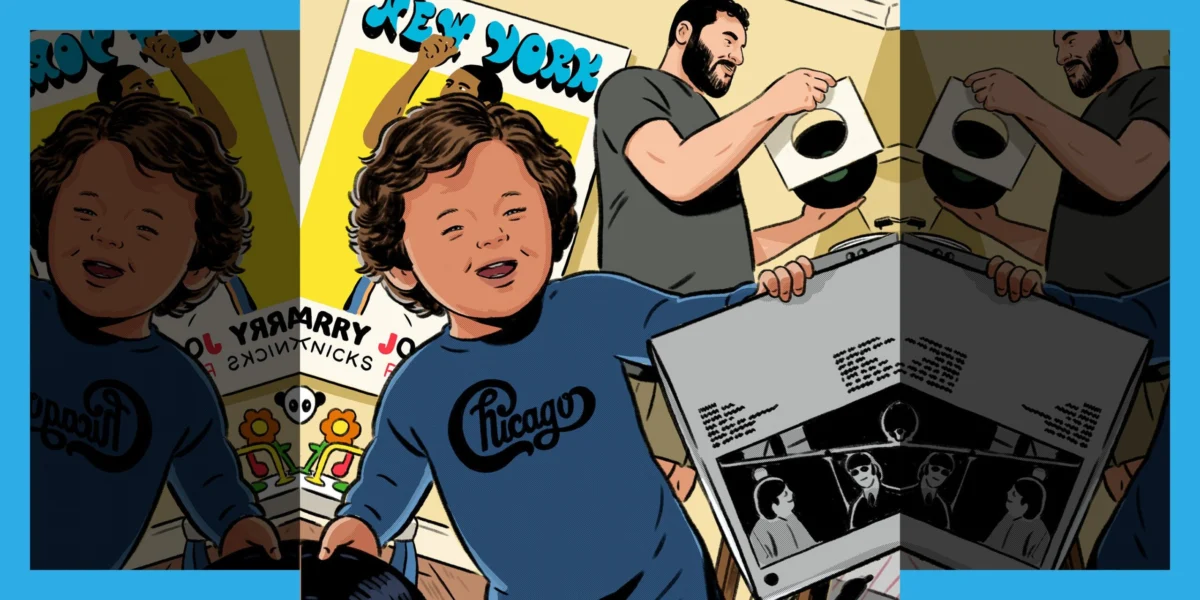
The catalyst for this specific developmental pivot is often the presence of physical media. In many modern households, the vinyl record collection exists as a relic of a previous generation, often inherited during a parental "downsizing." For an adult, a collection of 300-some LPs may be a dormant piece of furniture, a console that occupies space but serves little functional purpose in a world of streaming services. For a toddler, however, these collections are situated at a perfect eye-level, presenting a library of tactile possibilities. The shift from crawling to walking coincides with an increased desire for sensory input, and the ritual of the vinyl record—the removal from the sleeve, the placement on the platter, and the mechanical movement of the tonearm—provides a complex series of "cause and effect" lessons that digital media cannot replicate.
The 14-month-old child’s interaction with vinyl is a masterclass in fine motor skill development and sensory processing. To an adult collector, a record is a fragile object to be protected from dust, oils, and scratches. To a developing child, it is a robust tool for exploration. The "scuffed, dog-hair covered, booger-encrusted" state of a frequently handled record is not a sign of neglect, but a testament to its utility as a developmental bridge. When a child learns to move the arm of a record player and pull the lever to drop the needle, they are engaging in a sophisticated sequence of movements that require patience and precision. The resulting explosion of sound provides immediate neurological feedback, reinforcing the behavior and fostering a deep, emotional bond with the medium.
Interestingly, the musical preferences of a toddler often lean toward the "maximalist." While an adult might appreciate the subtlety of a folk singer or the complexity of modern jazz, a child’s ear is often drawn to "big, full, loud music" characterized by epic swings in sound and a high density of instrumentation. The works of The Beatles, Billy Joel, Bruce Springsteen, and the disco-era anthems of the Saturday Night Fever soundtrack provide the rhythmic and melodic consistency that appeals to early auditory processing. Perhaps most surprising to the modern parent is a child’s affinity for the brass-heavy, complex arrangements of bands like Chicago. This unexpected preference highlights a core truth of parenting: the child’s identity is a distinct entity, capable of gravitating toward aesthetics that the parent may have never personally embraced.
This divergence in taste forces a reevaluation of the concept of "value." In the context of a record collection, value is typically measured by the rarity of the pressing, the condition of the sleeve, or the sentimental attachment to the artist. However, from the perspective of a parent observing a child’s burgeoning passion, the value of the object shifts entirely. The records become "mental sinew"—the building blocks of a lifelong interest. The physical degradation of the media (the "yogurt on Elton John" or the "scuffs on Passion Pit") is a small price to pay for the cultivation of a child’s autonomy. By refusing to intervene with warnings to "be gentle," the parent allows the child to claim the music as their own, rather than treating it as a borrowed or forbidden artifact.
The psychological implications of this "hands-off" approach are significant. When a parent allows a child to interact freely with their environment, they are supporting the development of self-efficacy—the belief in one’s ability to succeed in specific situations or accomplish a task. For a 14-month-old, successfully "playing a record" is a major achievement that builds confidence. Furthermore, by stepping back, the parent acknowledges the limits of their own control. One can provide the tools (the baseball, the museum pass, the record player), but the child ultimately chooses which tool to pick up.
As this child approaches the age where mandatory music education begins, the contrast between their self-taught passion for vinyl and the structured requirements of the classroom will become apparent. The child who has spent years as their own DJ, curating a selection of classic rock and disco, may view the kindergarten recorder not as a chore, but as another facet of a world they have already begun to master. Alternatively, they may find the structure of the classroom stifling compared to the freedom of the living room console.
In conclusion, the journey of LJ Rader and his son illustrates a vital lesson in the modern parenting landscape. The transition from a parent who once broke their violin in a fit of musical apathy to a father who serves as a "personal DJ assistant" to a toddler reflects a profound shift in the understanding of how passions are formed. It is a reminder that the most impactful educational tools are often the ones we stop trying to protect and start allowing our children to use. Whether the records survive the toddler years is irrelevant; what matters is the "unquantifiable value" of a child finding their voice through the scratches and skips of a well-loved collection. In the end, the goal of parenting is not to produce a replica of oneself, but to provide the stage—and perhaps the record player—for a new individual to perform their own soundtrack.
