
"Basketball has been the glue connecting me to every defining experience; it is a lifelong lesson in patience, the power of human connection, and the strength found in vulnerability."
This narrative explores the multifaceted career of Jayson Tatum, detailing his evolution from a standout freshman at Duke University to a cornerstone of the Boston Celtics. By examining his recent recovery from a devastating Achilles injury and his enduring ties to the college game, the article highlights how elite athletes navigate the intersection of professional ambition, physical rehabilitation, and personal legacy.
The visibility of an NBA superstar often fluctuates between the high-octane environment of the hardwood and the curated world of national media. For Jayson Tatum, a six-time NBA All-Star and champion, these worlds recently converged in an AT&T commercial titled "Baby’s First Dunk." The campaign, which features a cameo from his mother, Brandy Cole-Barnes, and his 21-month-old son, Dylan, serves as more than just a marketing vehicle; it is a reflection of the "connection" that Tatum views as the through-line of his life. For a player who grew up "glued to the TV" during March Madness, the commercial signifies a full-circle moment where he is no longer just a spectator or a participant, but a symbol of the tournament’s enduring cultural reach.
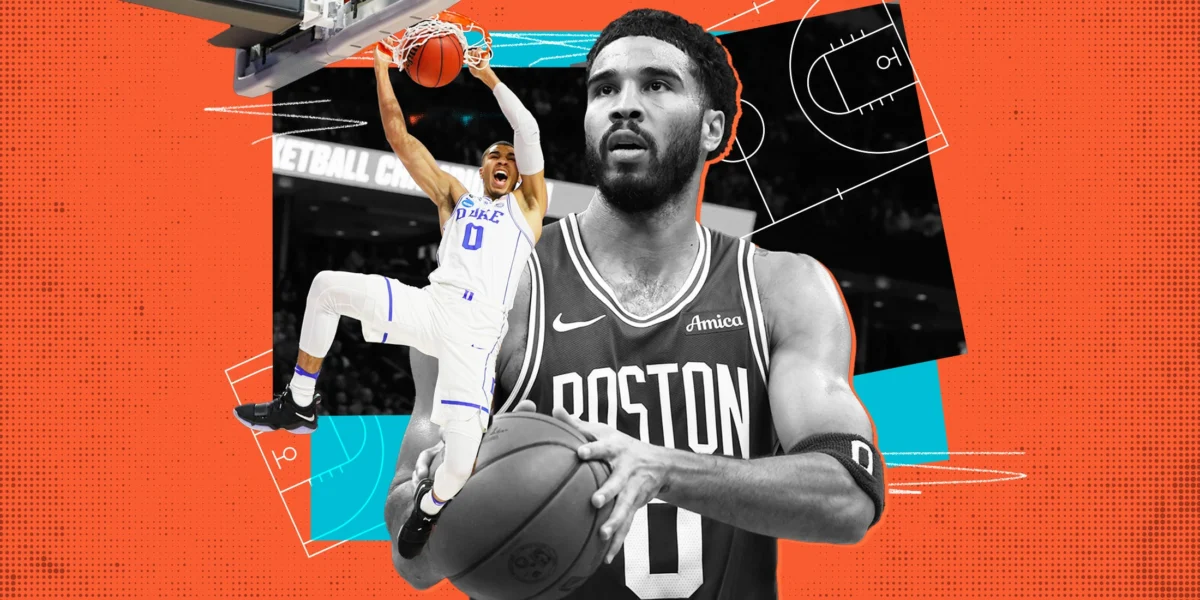
Tatum’s connection to the collegiate game is rooted in the hallowed halls of Duke University. While Duke is a perennial powerhouse, Tatum admits that the program was not always his primary destination. It was only as his high school talent reached elite levels that the Blue Devils became a tangible goal. The appeal was rooted in the program’s historic track record and its presence on the sport’s grandest stages. Tatum’s brief but impactful tenure in Durham was defined by high-stakes competition, most notably the storied rivalry with the University of North Carolina. He recalls the atmosphere of Cameron Indoor Stadium during his first matchup against the Tar Heels as a "core memory," a game that ended in a Duke victory.

The pinnacle of his collegiate career, however, occurred during the 2017 ACC Tournament. Entering as a five-seed, the Blue Devils faced an uphill battle that required winning four games in four consecutive days. They achieved this historic feat, culminating in a victory over UNC to claim the title—the first time a five-seed had ever accomplished such a run. While the team’s subsequent NCAA Tournament exit in the second round was a disappointment, the momentum of that season propelled Tatum to the NBA, where he was selected third overall by the Boston Celtics in 2017. Despite the professional lure, Tatum describes the decision to leave Duke after one year as difficult, noting he "wasn’t ready to leave" the community he had found in Durham.
Tatum’s transition to the NBA was seamless, yet he never truly severed ties with his alma mater. Today, he serves as the Chief Basketball Officer (CBO) for the Duke program, a role that allows him to consult with coaches and players on program improvements. His commitment to the program remains visible as he watches as many games as his schedule allows, particularly during the 2026 tournament cycle. As a 1-seed in 2026, Duke’s path through the tournament—surviving a scare against 16-seed Siena before a dominant win over TCU—mirrors the "win or go home" intensity that Tatum identifies as the essence of March Madness. He notes that the unique locations, unfamiliar matchups, and heightened stakes bring out a level of performance that is rare in the regular season.
However, the trajectory of Tatum’s professional career faced its greatest challenge in May 2025. Following a championship season where the Celtics were favored to repeat, disaster struck during Game 4 of the Eastern Conference Finals against the New York Knicks. On May 12, 2025, Tatum suffered a ruptured Achilles tendon. The injury did more than just end his season; it effectively ended the Celtics’ hopes for a consecutive title, as they eventually fell to the Knicks in six games. For an athlete whose game is built on explosive movement and precision, an Achilles rupture represents one of the most daunting physical and psychological hurdles in professional sports.
The ensuing recovery period was a humbling departure from the life of an elite athlete. Because he was unable to navigate stairs or perform basic daily tasks, Tatum moved back in with his mother for the first ten weeks of his rehabilitation. He described the experience as "being in high school again," a period of forced stillness that contrasted sharply with the frenetic pace of the NBA. This phase of recovery was marked by profound doubt. Tatum candidly admitted that he was unsure if he possessed the mental fortitude to endure the grueling nature of modern sports rehabilitation.
The breakthrough came through a shift in perspective. Tatum realized that his body was capable of responding to stressors in ways he hadn’t previously imagined. By embracing evolving recovery modalities and surrounding himself with a support system of family and friends, he began to view the injury not just as a setback, but as a test of character. He leaned heavily on the lessons he had learned from league veterans during his early years in the NBA—the philosophy that "your body is your temple." This holistic approach to health, encompassing nutrition, intentional recovery, and mental distraction, became the foundation of his return.

Ten months after the injury, on March 6, 2026, Jayson Tatum returned to the NBA hardwood. While the physical healing was complete, the psychological adjustment remains an ongoing process. Tatum speaks openly about the difficulty of finding "grace" for himself as he regains his rhythm. For an athlete at the peak of his powers, the frustration of not immediately returning to 100% capacity can be overwhelming. He attributes his ability to navigate this frustration to the patience he learned through fatherhood. Having become a father at age 20, Tatum credits his sons with teaching him to value the present moment rather than rushing toward a distant goal.
Tatum’s journey highlights the often-overlooked human element of professional sports. Behind the statistical dominance and the multi-million-dollar endorsements is an individual who must grapple with physical frailty and the weight of expectation. His story is one of "connection"—to his family, to his collegiate roots at Duke, and to the game of basketball itself. As he continues his 2026 season, Tatum remains a student of the game, actively figuring out how to balance the intense drive for success with the patience required for long-term longevity.
Ultimately, Tatum views basketball as the catalyst for every significant opportunity in his life. It has provided a global platform, a means to support his family, and a network of relationships that transcend the court. His role in the AT&T "Baby’s First Dunk" commercial is a symbolic representation of this reality: a blend of high-level athletic achievement and the intimate, grounded reality of family life. Whether he is advising the next generation of Blue Devils as CBO or leading the Celtics back toward championship contention, Tatum’s career serves as a testament to the idea that the strength of an athlete is measured as much by their ability to recover and reconnect as it is by their performance in the spotlight. In the volatile world of professional sports, where "anybody can win on any given day," Jayson Tatum has found that the most enduring victories are those won through persistence and the support of the people who knew him before the fame.
