
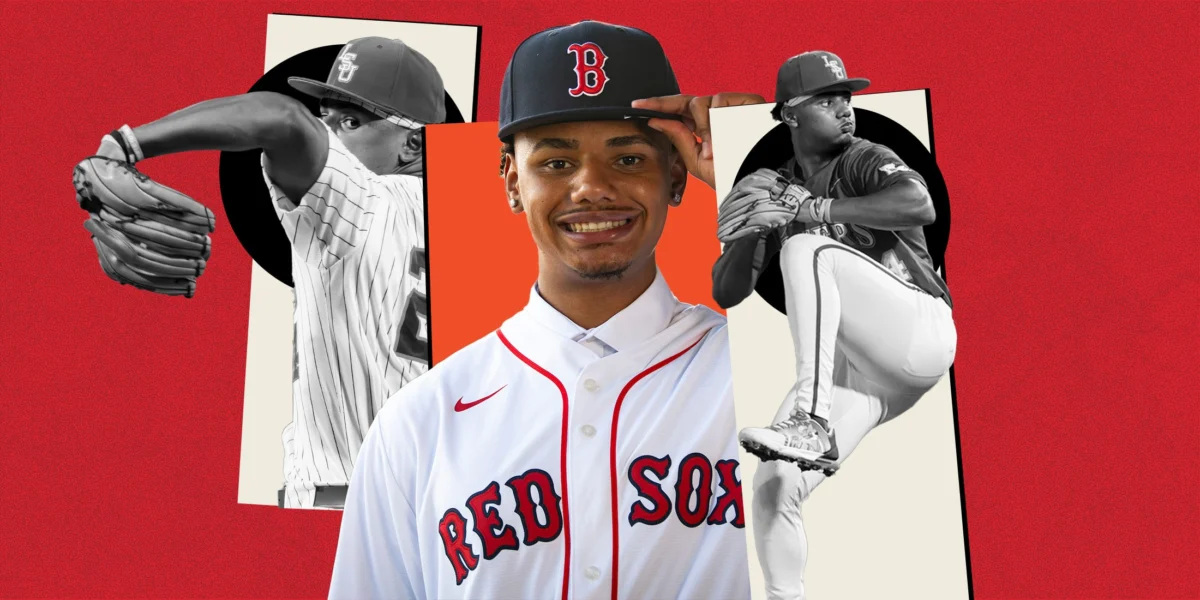
"Recovery has made me who I am today; by speaking out, I hope to show other athletes that seeking help isn’t a sign of weakness, but the first step toward reclaiming your strength."
As Anthony Eyanson prepares for his professional debut with the Boston Red Sox, his story serves as a powerful reminder that the most daunting challenges an athlete faces often occur far from the bright lights of the stadium. Diagnosed at age ten with achalasia—a rare neuromuscular disorder that severely impairs the ability to swallow—Eyanson endured years of physical depletion and disordered eating that nearly derailed his promising career. Now a First Team All-American and a national champion, Eyanson is leveraging his platform to partner with the National Eating Disorders Association (NEDA), pledging donations for every strikeout to fund awareness and support for others facing similar struggles.
The Rise of a Red Sox Prospect
The arrival of the baseball season marks a significant milestone for Anthony Eyanson. At 21 years old, the right-handed pitcher carries a reputation that precedes his first professional pitch. After a stellar collegiate career at Louisiana State University (LSU), where he finished third in Division I for strikeouts and played a pivotal role in securing a national championship, Eyanson was named a 2025 First Team All-American. His transition to the Red Sox organization is the fulfillment of a childhood dream, yet the path to the mound was paved with a medical and psychological struggle that remained hidden from the public eye for over a decade.
For Eyanson, the excitement of joining one of Major League Baseball’s most storied franchises is tempered by a profound sense of responsibility. He is no longer just playing for wins; he is playing for a cause. Through his partnership with NEDA, Eyanson has committed to a "K’s for a Cause" initiative, where each strikeout he records translates into a financial contribution toward eating disorder awareness. This mission is deeply personal, rooted in a childhood defined by a terrifying disconnection between his body’s needs and its physical capabilities.
Understanding Achalasia: A Physical Barrier to Nutrition
To understand Eyanson’s journey, one must understand the rare condition that shaped his youth. Achalasia is a neuromuscular disorder of the esophagus, affecting approximately 1 in 100,000 people. In a healthy body, the esophagus uses rhythmic muscular contractions (peristalsis) to move food toward the stomach, where the lower esophageal sphincter (LES) relaxes to allow entry. In patients with achalasia, these contractions fail, and the LES remains tightly closed.
For a ten-year-old Eyanson, this manifested as a "nervous lump" in the throat that never went away. Every meal became a tactical battle. He described the sensation of food sitting in his chest, refusing to move, often resulting in the involuntary regurgitation of undigested food. The physical symptoms were accompanied by an agonizing buildup of saliva, forcing him to spit constantly because he simply could not swallow.
The medical community often notes that achalasia can be difficult to diagnose in children, as the symptoms may be mistaken for severe acid reflux or even behavioral issues. For Eyanson, the result was a deteriorating relationship with food. He was trapped in a cycle of intense hunger and the paralyzing fear of the pain and embarrassment that came with attempting to eat.
The Psychological Toll on a Young Athlete
The impact of achalasia extended far beyond the dining table. As Eyanson trained to become an elite athlete, he was doing so on a caloric deficit that would break most adults. He recalls skipping meals before doubleheaders, knowing that the physical exertion would only be met with more exhaustion because he couldn’t keep liquids or solids down.
"Mentally, I was stressing myself out because I had no idea what was wrong," Eyanson reflected. The psychological burden of disordered eating is often compounded by the "masking" that many athletes feel forced to perform. While his on-field performance remained remarkably consistent—a testament to his raw talent and grit—his internal world was collapsing. He described feeling "empty and exhausted," often returning home from games to cry in private, wondering if he would ever be "normal" again.

The severity of his condition reached a breaking point in the summer of 2015. Between May and July, Eyanson’s weight plummeted from 107 pounds to a skeletal 75 pounds. The turning point came during a moment of viral levity—the Ice Bucket Challenge. When his mother saw his emaciated frame in the backyard, she realized his struggles were not a "normal sickness" but a life-threatening crisis.
The Path to Recovery: Surgery and Relearning
On July 20, 2015, Eyanson was admitted to the hospital, where he remained for twelve days. He underwent four procedures, culminating in a Heller myotomy. This surgical intervention involves cutting the muscles of the lower esophageal sphincter to allow food and liquids to pass more easily into the stomach.
The recovery was grueling. For the first week post-surgery, Eyanson was restricted from all food. When he was finally allowed to attempt soft foods like mashed potatoes and strained broths, the trauma of his condition remained. He sat with tears in his eyes, waiting for the familiar, painful blockage in his throat. When the food finally passed through to his stomach, it wasn’t just a physiological success; it was an emotional breakthrough.
Rebuilding his body required a slow, disciplined approach. Today, while he still eats more slowly than his peers and takes smaller bites of "difficult" foods like rice, he is able to maintain a rigorous nutritional schedule of four full meals a day plus snacks—a necessity for a professional pitcher whose body is his livelihood.
Breaking the Stigma for Male Athletes
Eyanson’s decision to speak publicly about his eating disorder is a landmark moment for men’s health in professional sports. According to Jessica Scheer of NEDA, there is a persistent and damaging stigma that eating disorders primarily affect a specific demographic—typically young, white, affluent women. In reality, eating disorders do not discriminate, and athletes are among the highest-risk populations.
Research indicates that males are approximately 19 percent more likely to develop disordered eating patterns when under the pressure of athletic performance. For male athletes, the drive for a specific body composition, the "lean" look of a runner, or the "mass" of a pitcher can lead to dangerous restrictions or compensatory behaviors. Furthermore, the "tough it out" culture of sports often prevents men from seeking help, fearing they will be seen as "different" or "weak."
Eyanson admits he was embarrassed to ask for help as a child. By coming forward now, he is challenging the narrative that physical vulnerability is a liability. "I’m very proud to have recovered from this," he says. "I feel like it’s made me who I am."
A Mission Beyond the Box Score
As Eyanson embarks on his first season with the Red Sox, he views his success through a different lens. While his stats on the mound will be closely watched by scouts and fans, his personal metric for success is his ability to inspire others. He credits his support system—his faith, his family, and his teammates at LSU—for giving him the courage to turn his private struggle into public advocacy.
His partnership with NEDA is designed to provide a lifeline to those who feel trapped in the same dilemma he faced: being hungry but scared to eat. His advice to young men struggling with food or body image is simple yet profound: "Don’t be nervous to speak up. You’re one question away from finding the answer that you need."
For Anthony Eyanson, the 2025 season is about more than just a professional debut. It is a celebration of a body that was once failing him but is now capable of elite performance. Every strikeout he records this year will serve as a dual victory—one for the Boston Red Sox, and another for the millions of people fighting the silent battle of disordered eating. In his own mind, he feels "like a superhero," not because of his 95-mph fastball, but because he survived the fight of his life before he even reached high school.
