
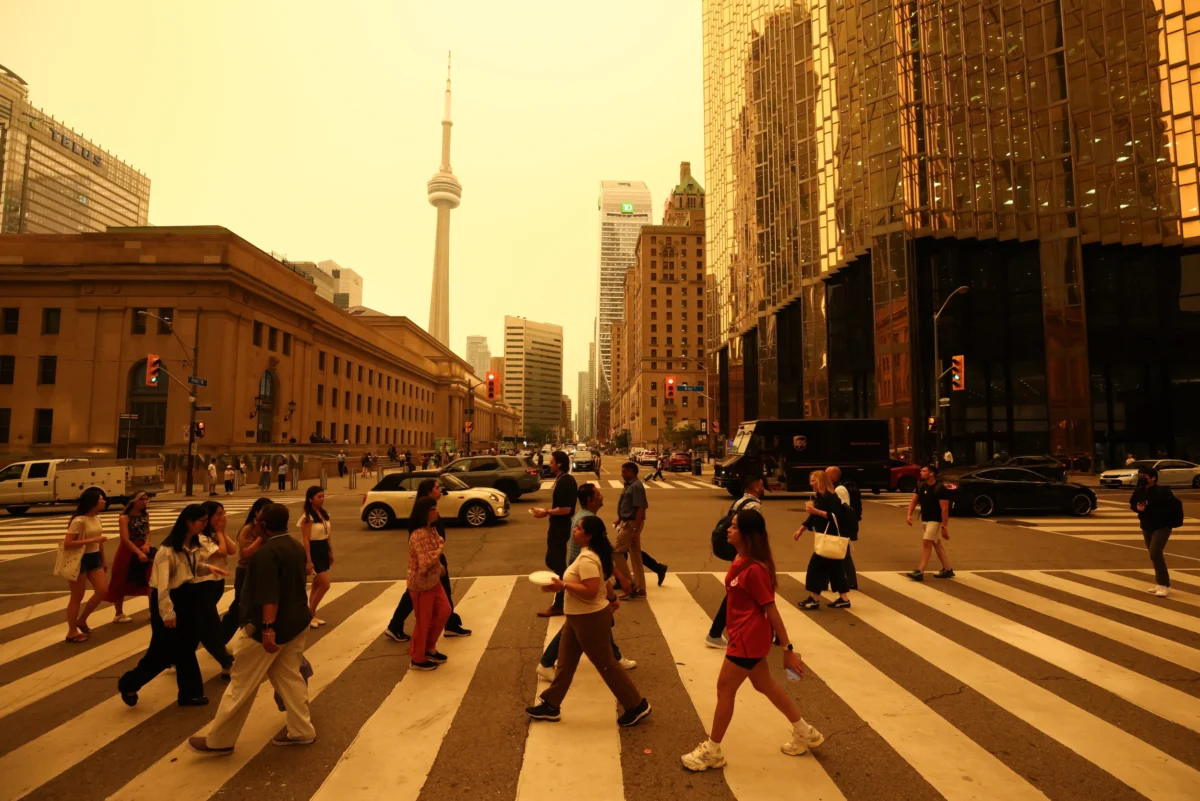
"The U.S. EPA’s air quality scale became inadequate on July 16, 2026, as Milwaukee recorded an AQI of 644, more than double its previous record and far exceeding the ‘Hazardous’ threshold. This event highlights the critical need for updated environmental monitoring and robust public health strategies to address increasingly severe wildfire smoke impacts."
The summer of 2026 has been marked by an environmental crisis of alarming proportions, as unprecedented wildfire smoke plumes originating from Canada have blanketed vast swathes of North America, pushing air quality monitoring systems to their limits. On July 16, 2026, cities like Milwaukee, Wisconsin, and Detroit, Michigan, registered Air Quality Index (AQI) readings that soared beyond the highest category of "Hazardous" on the U.S. Environmental Protection Agency’s (EPA) scale. This extreme air pollution, driven by a confluence of factors including an intense wildfire season in Canada and prevailing wind patterns, has raised significant public health concerns and exposed the limitations of current environmental assessment frameworks.
The EPA’s AQI system, designed to inform the public about air pollution levels, categorizes air quality into five tiers: Good, Moderate, Unhealthy for Sensitive Groups, Very Unhealthy, and Hazardous. The "Hazardous" category, beginning at an AQI of 301, signifies that "everyone is likely to be affected." However, on July 16, Milwaukee recorded an astonishing AQI of 644 at approximately 12:30 p.m., more than doubling the city’s previous all-time record of 300 set in 1987. Detroit, Michigan, experienced readings approaching 600. These levels far surpassed the EPA’s standard scale, indicating an air quality crisis of a magnitude not previously encountered in the modern era of environmental monitoring. Chicago, a major urban center, ranked third globally on IQAir’s tracker for the worst air quality, while Toronto, situated over 1,100 miles from the source of the Ontario fires, ranked sixth. This 2026 Canadian wildfire smoke event is shaping up to be one of the most severe air quality crises North America has faced due to wildfire smoke.
The sheer scale of the Canadian wildfire season is the primary driver of this widespread air pollution. As of July 17, 2026, Canadian authorities reported over 850 wildfires actively burning across the country, with 859 confirmed by the Canadian Wildland Fire Information System. Of these, a staggering 109 remained completely out of control. The most significant contributor to the smoke affecting the U.S. Midwest and Northeast is northwestern Ontario. This region, a vast, sparsely populated boreal forest corridor stretching between Thunder Bay and the Ontario-Minnesota border, was home to approximately 180 fires, with 134 concentrated in its northwestern reaches.
The intensification of these fires was exacerbated by a perfect storm of environmental conditions on July 13. Multiple fires, which had previously been contained, experienced explosive growth due to extreme heat, critically low humidity levels, and powerful northwest winds. These conditions fueled the formation of pyrocumulonimbus columns, also known as fire-induced thunderstorms, which propelled massive quantities of fine particulate matter high into the stratosphere. Once in the upper atmosphere, prevailing winds acted as a vast conveyor belt, transporting these smoke plumes southeastward across the Great Lakes region and into the United States. Since the beginning of 2026, Canada has grappled with 3,549 wildfires that have consumed a total of 2.3 million hectares, an area roughly equivalent to the size of the United Kingdom. While this total is still below the catastrophic figures of the 2023 season, the rate of acceleration in fire activity over the preceding two weeks has been exceptionally stark.
The primary health threat from wildfire smoke is fine particulate matter, scientifically known as PM2.5. These particles, less than 2.5 micrometers in diameter, are infinitesimally small, allowing them to bypass the body’s natural defenses in the nose and throat. They penetrate deep into the lungs and, in sufficient concentrations, can enter the bloodstream, posing systemic health risks. At AQI levels between 301 and 500, the EPA recommends that everyone, not just sensitive groups, avoid all outdoor activity. However, at the unprecedented AQI levels recorded in Milwaukee and Detroit on July 16, there was no formal federal guidance available, as the established scale was simply not designed to accommodate such extreme readings.
Research published in the Journal of the American Heart Association has extensively documented the increased risk of cardiac events, respiratory failure, and strokes associated with exposure to PM2.5. These effects are detectable in population health data even from single days of extreme exposure. The risks are not hypothetical and are not confined to individuals with pre-existing health conditions. At AQI levels exceeding 600, even healthy adults exposed to the smoke outdoors for several hours can experience measurable lung damage. Milwaukee County Executive David Crowley underscored the severity of the situation, urging residents to take the crisis seriously, limit outdoor time, and adhere to guidance from public health officials.
The geographic footprint of this 2026 wildfire smoke event was extensive, stretching across at least 17 to 18 U.S. states by July 16-17, reaching from Minnesota in the west to Virginia in the east. The smoke corridor followed a trajectory from the Ontario fires southeastward across the Great Lakes, impacting states including Wisconsin, Michigan, Illinois, Indiana, and Ohio, before continuing its eastward progression into Pennsylvania, New York, New Jersey, and the New England region. The Washington Post reported that the smoke was projected to affect approximately 100 million people across the Midwest, Northeast, and Mid-Atlantic regions through at least July 18.
In New York City, authorities issued an Air Quality Advisory, warning residents of the hazardous conditions. Toronto, though closer to some of the Ontario fires, also experienced significant impacts. For multiple consecutive days, the sunrise over the city’s waterfront appeared distinctly orange, prompting public health officials to advise residents to keep windows closed and minimize outdoor exposure. The NOAA-21 satellite captured striking images on July 14, visually demonstrating the vast scale of the event, showing smoke streaming southeast from Ontario across much of the Great Lakes region. This imagery served as a potent reminder of how wildfires burning in remote boreal forests can rapidly translate into public health crises affecting tens of millions of urban residents hundreds of miles away.
Looking ahead, air quality across the affected regions is expected to fluctuate but remain elevated through at least the weekend of July 19-20. This prolonged impact is attributed to the continued fire activity in Ontario generating fresh smoke plumes, which are then transported southward and eastward by prevailing wind patterns. For individuals seeking to monitor the situation, real-time local AQI data is available through the U.S. EPA’s AirNow.gov website or Canada’s Environment Canada website and WeatherCAN app, with updates typically occurring hourly.
Vulnerable populations, including children, the elderly, and individuals with pre-existing respiratory or cardiovascular conditions such as asthma, COPD, and heart disease, face the highest risk from prolonged exposure to elevated PM2.5 levels. Pregnant women are also a concern, as studies suggest a link between PM2.5 exposure and adverse pregnancy outcomes.
Protective actions are crucial for mitigating health risks. When AQI levels are in the "Unhealthy for Sensitive Groups" range (101-150), sensitive individuals should reduce prolonged or heavy exertion outdoors. For "Very Unhealthy" conditions (151-200), everyone should limit prolonged outdoor exertion. In "Hazardous" zones (301-500), everyone should avoid all outdoor activity. When AQI surpasses 500, as seen in Milwaukee and Detroit, extreme caution is paramount, and all outdoor activity should be ceased.
Masking can provide a significant layer of protection. An N95 or KN95 respirator, when worn correctly, is highly effective at filtering PM2.5 particles. Surgical masks and common cloth masks offer minimal protection against these fine particulate matters. Furthermore, indoor environments are not automatically safe havens during prolonged periods of severe outdoor air pollution. Buildings lacking filtered HVAC systems can see indoor air quality degrade significantly. To improve indoor air, it is recommended to run HEPA air purifiers on high settings, keep windows and doors tightly closed, and avoid activities that generate indoor particles, such as cooking on high heat, burning candles, or vacuuming.
The 2026 wildfire smoke event presents several notable differences compared to the widespread smoke experienced in June 2023, which originated from Quebecois fires and heavily impacted New York City and the Northeast. Foremost among these differences are the air quality readings themselves. Milwaukee’s AQI of 644 in 2026 substantially exceeds anything recorded in the Midwest during the 2023 event; in 2023, Chicago reached an AQI of 228 and Milwaukee peaked at 221. The 2026 readings are approximately three times higher.
While the geographic footprint of the 2023 event was extensive, the PM2.5 concentrations observed in the Great Lakes region in July 2026 are demonstrably denser and more intense. Compounding the severity of the current crisis is the ongoing nature of the fires, with new ignitions continuing to occur. On July 17 alone, 37 new wildfires ignited in Canada. With above-average temperatures and drought conditions forecast to persist through August, there is currently no meteorological indication that these smoke events will abate in the near future.
In conclusion, the Canadian wildfire smoke event of July 2026 transcends a mere aesthetic inconvenience of hazy skies. In Milwaukee on July 16, the air quality was so far beyond the EPA’s "Hazardous" threshold that the established scale lacked a category to classify it. The health risks at these extreme concentrations—including cardiac events, respiratory distress, and lung damage—are not theoretical; they are well-documented and scientifically validated. It is imperative for the public to check their local AQI before venturing outdoors, to diligently manage indoor air quality when readings are high, and to recognize this situation as a critical public health event, distinct from a typical weather story.
