
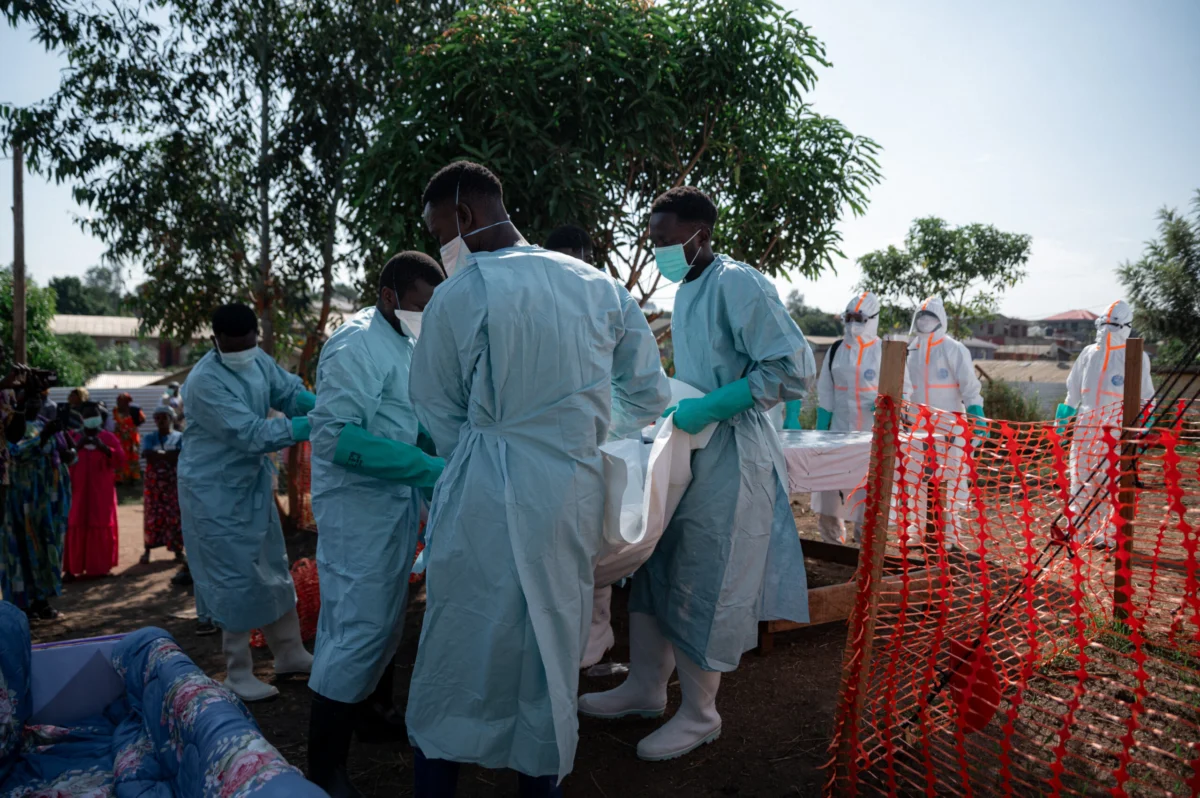
"A staggering 37 lives lost in just 24 hours underscores the dire urgency of the Bundibugyo Ebola outbreak, even as the world watches the dawn of potentially life-saving experimental treatments."
The Democratic Republic of Congo’s Ministry of Health has reported a grim milestone: 37 new deaths attributed to the Bundibugyo strain of the Ebola virus within a single 24-hour period, from Friday, July 18, to Saturday, July 19, 2026. This surge represents one of the highest single-day death tolls since the current outbreak was officially declared on May 15, 2026. The grim tally pushes the cumulative confirmed death toll to at least 930, with 2,344 laboratory-confirmed cases documented as of July 18, 2026. This dramatic increase in fatalities coincides with a pivotal moment: the commencement of the first-ever clinical trials specifically targeting the Bundibugyo strain. The convergence of record-breaking daily mortality and the initiation of these groundbreaking treatment studies marks the most consequential week to date in an epidemic that the World Health Organization (WHO) has unequivocally labeled as the fastest-growing Ebola outbreak in recorded history.
The gravity of 37 deaths in a single day extends far beyond a statistical anomaly; it paints a stark picture of the overwhelming pressure on response capacity in a region already grappling with immense challenges. Armed conflict, ongoing strikes by healthcare workers demanding unpaid wages, and persistent shortages of essential medical supplies have created a precarious environment. Each reported death signifies an individual who was identified and confirmed as infected, meaning they were known to the surveillance system, their case was logged, and yet the relentless progression of the outbreak proved fatal within a 24-hour window, outpacing the efforts to contain the virus.
Crucially, for the Bundibugyo virus, there are currently no approved treatments or vaccines. Every one of the 930 confirmed deaths has occurred without the benefit of a therapy that has been rigorously proven in human patients to reduce mortality. This unprecedented situation may begin to shift this week as experimental drugs transition from laboratory research to controlled human trials. The central clinical question now is whether these trials can generate sufficient data rapidly enough to impact the current trajectory of this rapidly evolving outbreak.
The recent spike in daily fatalities was concentrated in the outbreak’s most heavily impacted provinces: Ituri and North Kivu. Ituri Province, in particular, accounts for a significant proportion of the confirmed cases, with 2,090 out of the total 2,344 recorded infections. Within Ituri, 776 deaths have been reported across 27 of its 36 health zones, according to data compiled by the National Institute for Communicable Diseases (NICD) and the European Centre for Disease Prevention and Control (ECDC).
The ongoing response efforts have been further complicated by a series of compounding crises. Since mid-May, there have been at least 12 direct attacks targeting medical facilities and healthcare teams, creating an atmosphere of fear and hindering the delivery of care. Compounding this, healthcare workers have undertaken strikes to protest months of unpaid wages, a situation that has tragically led to the deaths of at least 36 healthcare professionals from Bundibugyo infection. The WHO has explicitly highlighted a critical concern: the majority of new cases are emerging from unknown transmission chains, indicating that contact tracing efforts are struggling to keep pace with the virus’s aggressive spread.
In a significant development, three pioneering clinical trials specifically focused on the Bundibugyo ebolavirus have commenced patient enrollment within the DRC, as reported by TechTimes. These trials are investigating promising therapeutic candidates. One trial is evaluating remdesivir, a broad-spectrum antiviral agent already utilized in the management of certain viral diseases. Another trial is focused on MBP134, a bispecific monoclonal antibody developed by Mapp Biopharmaceutical, which has demonstrated cross-reactive activity against the Bundibugyo strain in laboratory studies. The third trial is the BD-Ebov Phase 1 vaccine trial, conducted by the University of Oxford.
The significance of these trials cannot be overstated, particularly when contrasted with previous large-scale Ebola outbreak responses. Historically, interventions have relied heavily on Ervebo, the highly effective vaccine developed for the Zaire strain of Ebola. During the 2018-2020 DRC outbreak, which claimed over 2,200 lives in nearly two years, Ervebo played a crucial role in outbreak containment by providing protection to healthcare workers and their close contacts. However, Ervebo’s protective mechanism is specifically calibrated to the surface proteins of the Zaire strain. The Bundibugyo strain possesses substantially different surface proteins, rendering Ervebo ineffective for this particular outbreak. The WHO, after reviewing available scientific evidence, has formally recommended against the use of Ervebo for Bundibugyo patients outside of controlled research settings.
Similarly, other monoclonal antibody cocktails, such as ZMapp and REGN-EB3, which have been approved for the Zaire strain, are not expected to offer cross-protection against the Bundibugyo strain. Their development was not predicated on targeting the specific surface proteins of Bundibugyo, and assumptions about efficacy cannot be made. This means that, currently, the outbreak is being managed solely through supportive care. This critical care includes intravenous fluids, electrolyte management, oxygen therapy, and the treatment of any secondary infections. While supportive care has demonstrably improved outcomes in past outbreaks, its efficacy is limited without a targeted therapeutic intervention. Consequently, the case fatality rate for the Bundibugyo strain remains alarmingly high, estimated at approximately 39.7%.
The WHO’s designation of this outbreak as the fastest-growing in recorded history is a reflection not only of the sheer velocity of case accumulation but also of the complex structural factors driving its relentless spread. These include the presence of a virus for which the established medical arsenal is ill-suited, its operation within a volatile conflict zone, and a healthcare system already strained by strikes and direct attacks. The clinical trial data emerging from the studies on remdesivir and MBP134 may offer the first evidence-based indications of whether either drug can effectively reduce mortality in Bundibugyo patients. However, clinical trials are inherently time-consuming, typically requiring weeks to months to yield meaningful results. Even if positive signals emerge, the subsequent steps of manufacturing and large-scale deployment in a conflict-affected region present formidable logistical hurdles.
The recent surge in daily deaths serves as a stark confirmation that the Bundibugyo Ebola outbreak in the DRC remains in a state of active and uncontrolled transmission. This is occurring even as the first-ever clinical trials specifically targeting this distinct virus strain have just begun the crucial process of patient enrollment. The absence of an approved vaccine and a proven treatment, coupled with a response effort hampered by the pervasive realities of armed conflict, ongoing healthcare worker strikes, and repeated assaults on medical infrastructure, has created a perfect storm. The outbreak continues to expand at a pace that the WHO has described as unprecedented in Ebola’s history. For individuals in the United States, the direct risk of contracting the virus remains exceedingly low, consistent with prior assessments. However, for the populations living in eastern DRC, the outcomes of the ongoing clinical trials represent the most tangible hope for altering the current devastating trajectory of this epidemic.
The enrollment of patients in the clinical trials for remdesivir and MBP134 is now underway. Early Phase 1/2 safety data is expected to accumulate over the coming weeks and months. Should either drug demonstrate a clear signal of mortality reduction, the subsequent steps would involve seeking emergency authorization and implementing rapid scale-up of the treatment in the affected field areas. The WHO’s Emergency Committee is anticipated to reconvene to reassess the Public Health Emergency of International Concern (PHEIC) designation for the outbreak. Contact tracing coverage currently stands at 85.8% for the primary provinces, and reaching the remaining uncovered contacts is identified as the outbreak response’s most urgent operational priority. Continuous reporting on daily death tolls and clinical trial announcements will be maintained.
