
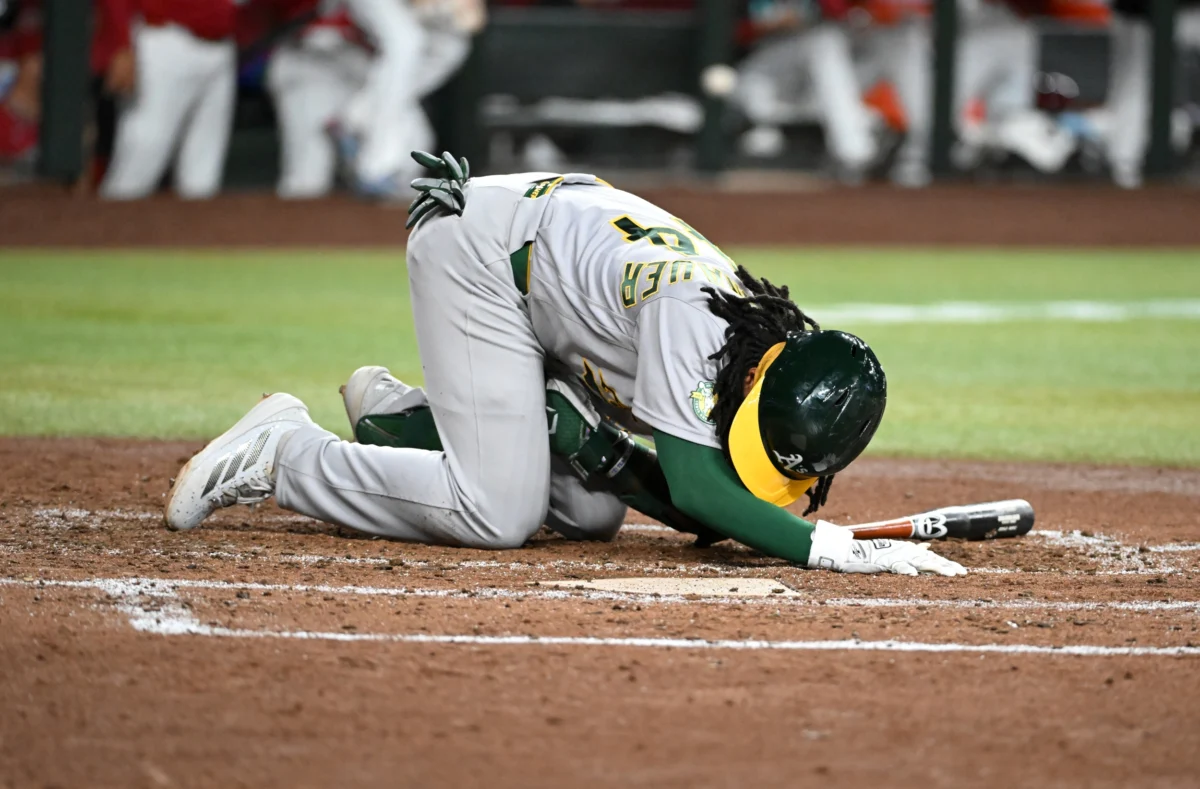
"A moment of impact can lead to a cascade of medical urgency, underscoring the vulnerability of athletes to specific types of trauma."
The routine play of fouling off a pitch during a baseball game took a severe and unexpected turn for Athletics rookie Joshua Kuroda-Grauer. The 23-year-old infielder sustained a ruptured testicle during Monday night’s 5-2 victory over the Arizona Diamondbacks, an injury that necessitated immediate emergency surgery and has temporarily sidelined his promising Major League Baseball debut season. The incident highlights the often-underestimated risks athletes face, even from seemingly common game occurrences, and the critical importance of prompt medical intervention for certain types of trauma.
Kuroda-Grauer’s injury initially presented as a testicular contusion, a term indicating bruising caused by blunt force trauma, as described by the Athletics organization. However, following his exit from the game, further medical evaluation at St. Joseph’s Hospital in Phoenix revealed the more severe nature of his injury. An ultrasound examination confirmed the rupture, prompting the urgent surgical procedure.
Despite the gravity of his situation, Athletics manager Mark Kotsay reported that Kuroda-Grauer is recovering comfortably in the hospital and remains in "good spirits." Kotsay shared a touching anecdote, noting the rookie’s resilience and positive attitude. "He was joking about it… He’s such a great kid. Unfortunate to have lost him, given the way he was performing and the way he was integrated into this group. He fit right in," Kotsay stated, emphasizing Kuroda-Grauer’s valuable presence on the team. In the immediate aftermath of the injury, the Athletics placed Kuroda-Grauer on the 10-day injured list, a procedural move that acknowledges the significant recovery time required for such an injury.
The incident serves as a stark reminder of the potential severity of direct blows to the groin area. While often associated with temporary pain, such impacts can, in some instances, lead to damage of the delicate protective structures surrounding the testicle, necessitating urgent surgical intervention to avert permanent complications.
Understanding Testicular Rupture: The Science Behind the Injury
The trajectory of a baseball in professional play can reach astonishing velocities. Pitches and batted balls frequently exceed speeds of 90 miles per hour, generating substantial kinetic energy. When such a projectile directly impacts the body, particularly in a vulnerable area, the force can be significant enough to cause severe internal damage. The testicles, positioned externally and primarily protected by the scrotum rather than the robust skeletal or muscular structures found elsewhere in the body, are exceptionally susceptible to such trauma.
While the testicles are enveloped by a resilient layer of fibrous tissue known as the tunica albuginea, this protective sheath is not impervious to extreme force. A powerful and direct impact, such as that from a high-speed baseball, can overwhelm the tensile strength of the tunica albuginea, leading to a tear. This rupture allows the internal testicular tissue to protrude or become compromised, a condition medically defined as testicular rupture. This type of injury can occur not only in baseball but also in other sports involving hard projectiles, such as cricket or even during certain types of accidents.
The Urgency of Testicular Rupture: A Urologic Emergency
Testicular rupture is classified as a urologic emergency, a designation that underscores the critical need for prompt medical attention. Delaying treatment significantly elevates the risk of permanent damage, including the potential loss of the injured testicle. The trauma can disrupt the intricate vascular supply to the testicle, leading to internal bleeding and swelling within the scrotum. If the compromised tissue is not addressed surgically in a timely manner, it can become necrotic – that is, irreversibly damaged and non-viable. In such severe scenarios, surgical removal of the testicle (orchiectomy) may become the only viable option.
Conversely, early and effective medical intervention can significantly improve the prognosis. Prompt surgical repair can allow physicians to meticulously mend the torn tunica albuginea, control internal bleeding, and remove any irreparably damaged tissue. The primary objective of surgical management is to preserve the testicle and its vital functions, including hormone production and sperm generation, whenever medically feasible. Therefore, any athlete experiencing significant trauma to the testicular area warrants immediate and thorough medical evaluation.
Recognizing the Warning Signs: Beyond Simple Bruising
Pain following a direct blow to the groin is a common experience, but certain symptoms should serve as red flags, indicating a potentially more serious underlying injury. Athletes, driven by competitive spirit, may initially dismiss or downplay such discomfort, attempting to continue playing. However, persistent or severe pain, particularly when accompanied by other symptoms, should never be ignored.
Key warning signs that suggest a possible testicular rupture or significant trauma include:
- Severe and Unrelenting Pain: While some discomfort is expected, pain that is debilitating, worsens over time, or does not subside with basic pain management warrants immediate medical attention.
- Swelling of the Scrotum: Rapid and significant swelling of the scrotum is a common indicator of internal bleeding or inflammation resulting from trauma.
- Tenderness to Touch: Extreme sensitivity to even light touch in the testicular or scrotal area is a strong sign of injury.
- A Feeling of Heaviness or Dragging: Patients may describe a sensation of the testicle feeling abnormally heavy or pulled downward.
- Nausea and Vomiting: These systemic symptoms can sometimes accompany severe pain and internal trauma.
- Discoloration: Bruising or a change in the color of the scrotum can indicate internal bleeding.
Even if an athlete can physically stand or continue to move after an impact, this does not negate the possibility of serious internal damage. The absence of an obvious external wound can be misleading, as significant structural damage can occur beneath the surface without visible signs.
Diagnostic Pathways: Uncovering the Extent of Damage
Medical professionals employ a systematic approach to diagnose testicular rupture, beginning with a comprehensive physical examination. This initial assessment helps physicians gauge the extent of pain, swelling, and tenderness. However, to accurately determine the internal damage and its severity, advanced imaging techniques are often employed.
A scrotal ultrasound, particularly one utilizing Doppler imaging, is the gold standard for evaluating testicular trauma. This non-invasive procedure allows physicians to visualize the internal structures of the testicle and scrotum. Doppler imaging specifically assesses blood flow, which is crucial for identifying signs of compromised circulation, internal bleeding (hematoma), or the characteristic appearance of a ruptured tunica albuginea. In Joshua Kuroda-Grauer’s case, the ultrasound performed at St. Joseph’s Hospital was instrumental in revealing the rupture, thereby guiding the decision for emergency surgery.
Surgical intervention is generally recommended when imaging confirms a testicular rupture or when the results of imaging are inconclusive but significant damage cannot be ruled out. The surgical procedure aims to directly address the injury. During surgery, the surgeon can meticulously repair the torn tunica albuginea, meticulously control any internal bleeding, and carefully excise any tissue that has become irreparably damaged. In instances where the testicle is too severely compromised to be salvaged, surgical removal becomes necessary to prevent further complications. The overarching goal of this surgical approach remains the preservation of the testicle and its essential functions.
For any athlete who sustains a direct blow to the testicles, especially if pain or swelling persists or escalates, seeking prompt medical evaluation is not merely advisable but crucial. The difference between timely and delayed treatment can be the distinction between preserving testicular function and facing permanent loss. The competitive drive to push through pain is a hallmark of athletic endeavor, but in cases of testicular trauma, this instinct must be tempered with an understanding of the potential for severe, long-term consequences.
