
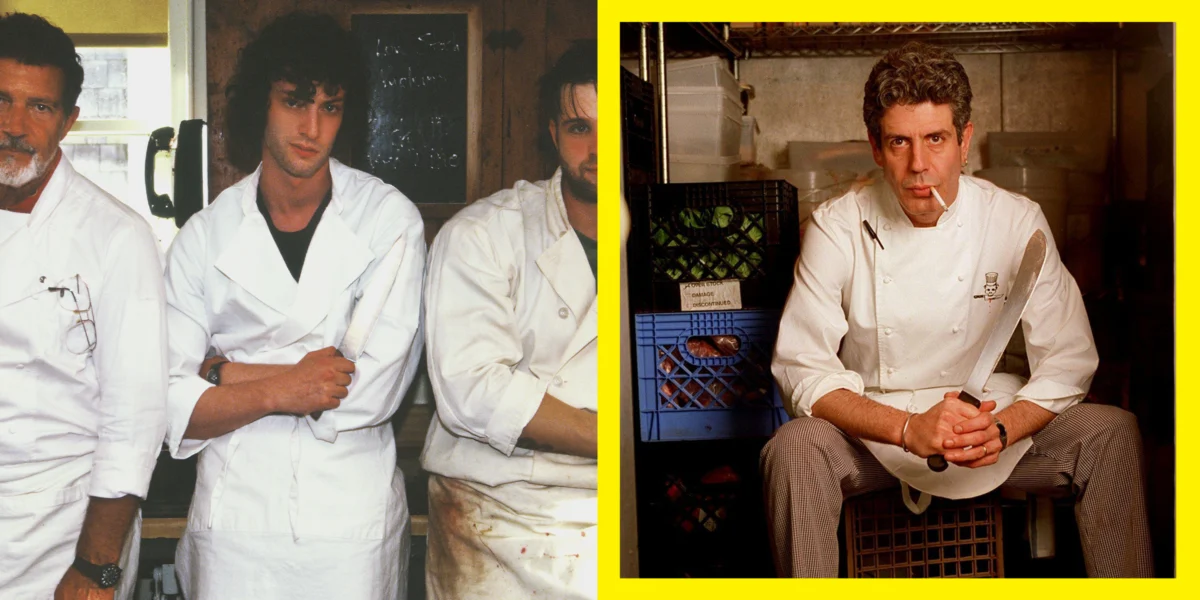
"The path to culinary greatness is often forged not in the classroom, but in the chaotic, drug-fumed heat of the dish pit, where a young Anthony Bourdain discovered that the kitchen was the only place that could discipline his restless soul."

The legendary career of Anthony Bourdain—chef, author, and global traveler—did not begin in the refined kitchens of Manhattan or the bustling markets of Vietnam, but in the salt-aired, hedonistic environment of Provincetown, Massachusetts, in the early 1970s. The upcoming A24 film Tony, directed by Matt Johnson and starring Dominic Sessa, explores this formative period, distilling the complex, drug-fueled, and often abrasive "origin story" of a man who would eventually redefine how the world views food and culture. By examining the intersection of Bourdain’s 2000 memoir Kitchen Confidential and the creative liberties taken by modern cinema, we gain a deeper understanding of the crucible that transformed a "miserable young lout" into a generational icon.
The Crucible of 1972: Provincetown as a Counterculture Haven
In the summer of 1972, Provincetown sat at the northernmost tip of Cape Cod, serving as a sanctuary for artists, writers, hippies, and those looking to disappear into the fringes of society. For an 18-year-old Anthony Bourdain, it was a place of aimless indulgence. Having graduated high school early and feeling profoundly "rudderless," Bourdain followed his girlfriend, Nancy Putkoski, to this enclave. As he would later recount in his Emmy-winning series Parts Unknown, his days were a blur of sunbathing, recreational drug use, and a burgeoning sense of dissatisfaction.

The film Tony captures this atmosphere but introduces a narrative device to heighten the stakes: a fictionalized rejection from a prestigious writing fellowship at Vassar College. In reality, Bourdain’s path was less about a failed literary ambition and more about a desperate need for structure. While the film portrays him chasing a crush who doesn’t reciprocate his feelings, the truth was perhaps more grounded: he was already deeply, if unhappily, in love with Putkoski, who would become his first wife. It was in this state of romantic and existential flux that Bourdain found himself standing at the threshold of a kitchen door.
The Flagship and the "Gods" of the Fry Station
Bourdain’s entry into the professional kitchen was anything but glamorous. He began as a dishwasher at The Flagship, a tourist-heavy seafood restaurant. In Kitchen Confidential, he describes this as his "strange climb to chefdom." The work was grueling—scrubbing blackened pots, peeling endless bags of potatoes, and cleaning shrimp until his fingers were raw. Yet, it was here that he encountered a hierarchy that finally made sense to him.

To a middle-class kid from New Jersey, the line cooks at The Flagship were not merely employees; they were "roguish renegades" and "sexual athletes." They wore gold hoop earrings, had tattoos long before they were fashionable, and operated with a pirate-like autonomy. The film Tony brings these figures to life through characters like Sal, played by Leo Woodall. Sal is a composite character, blending the real-life Dmitri from Kitchen Confidential with other toxic, magnetic mentors Bourdain encountered throughout his career. These men taught him that the kitchen was a place where one’s past didn’t matter—only your ability to "stay off the weeds" and keep up with the tickets.
The Education of a "Lout": Discipline through Pain
One of the most pivotal moments in Bourdain’s early development—and a key scene in the film—is the "sizzle platter" incident. After burning his hand on a hot pan, a young Bourdain asked for a Band-Aid, only to be met with stony silence from the veteran broiler cook, Tyrone. Tyrone simply showed Bourdain his own hands, which were a map of scars and welts, and then proceeded to pick up the hot platter without flinching.

This moment served as a brutal introduction to the kitchen’s stoic code of conduct. It was an environment that demanded physical and mental toughness, offering a sharp contrast to the "spoiled, narcissistic" attitude Bourdain admitted to having in his youth. The film emphasizes this transition, showing how the "ass-kicking" he received in the Provincetown dish pit was exactly what he needed to shed his entitlement. By the time he left the Cape, he hadn’t just acquired a tan and a drug habit; he had acquired a vocation.
The Amalgamation of Mentorship: Howard Mitcham and "Chef"
While the kitchen staff provided the grit, other figures provided the soul. In Tony, Antonio Banderas plays "Chef," a character that serves as an amalgamation of Bourdain’s real-life mentors. Chief among these was Howard Mitcham, a legendary Provincetown figure who was deaf, often intoxicated, and a master of both seafood and storytelling. Mitcham was the author of The Provincetown Seafood Cookbook, a text Bourdain revered for its blend of culinary technique and local lore.

Mitcham’s influence taught Bourdain that there was no hierarchy in the enjoyment of food. Whether it was a three-star Michelin meal or a bowl of gumbo in a fisherman’s bar, the value lay in the love and pride with which it was prepared. The film concludes with a clambake—a tribute to the "John J. Gaspie Memorial Clambake" that Mitcham hosted annually. This event represented the communal, almost spiritual power of food to bring together disparate groups of people, a theme that would become the cornerstone of Bourdain’s later work.
From Rebel to Professional: The Transition to the CIA
The film Tony avoids the "cradle-to-grave" biopic structure, choosing instead to end at a crossroads. After years of being mocked as a "pretender" by the veteran cooks in Provincetown, Bourdain decided to commit fully to the craft, largely out of a desire to prove his tormentors wrong. He famously stated that he wanted to become "better than them" and eventually break "loudmouth punks" over the wheel just as he had been broken.

This resolve led him to the Culinary Institute of America (CIA), from which he graduated in 1978. In a poignant nod to Bourdain’s real-life legacy, the film features a cameo by Eric Ripert, the world-renowned chef of Le Bernardin and Bourdain’s closest friend in his later years. Ripert plays a CIA admissions officer, symbolizing the moment Bourdain moved from the "underbelly" of the kitchen into the professional world that would eventually make him a household name.
The Enduring Legacy of the Provincetown Years
The decision by director Matt Johnson and A24 to focus on this specific, embellished "slice of life" reflects the way Bourdain himself viewed his past. He didn’t see his life as a linear progression of successes, but as a series of "flashes, colors, and feelings." Provincetown was the setting where the "Tony" the world knew began to take shape. It was where he learned that the kitchen could be a refuge for the restless, a stage for the theatrical, and a home for those who didn’t fit anywhere else.

By enriching the raw data of his memoir with cinematic narrative, Tony seeks to capture the essence of a man who was always searching for authenticity. The film reminds us that before the Emmy Awards and the bestselling books, there was just a kid in a Cape Cod kitchen, scrubbing pots and realizing, for the first time, that he had found a place where he belonged. Bourdain’s journey from a "miserable young lout" to a global ambassador of empathy began with the simple, honest labor of a summer job—a transformation that continues to inspire those who work in the heat of the kitchen today.
