
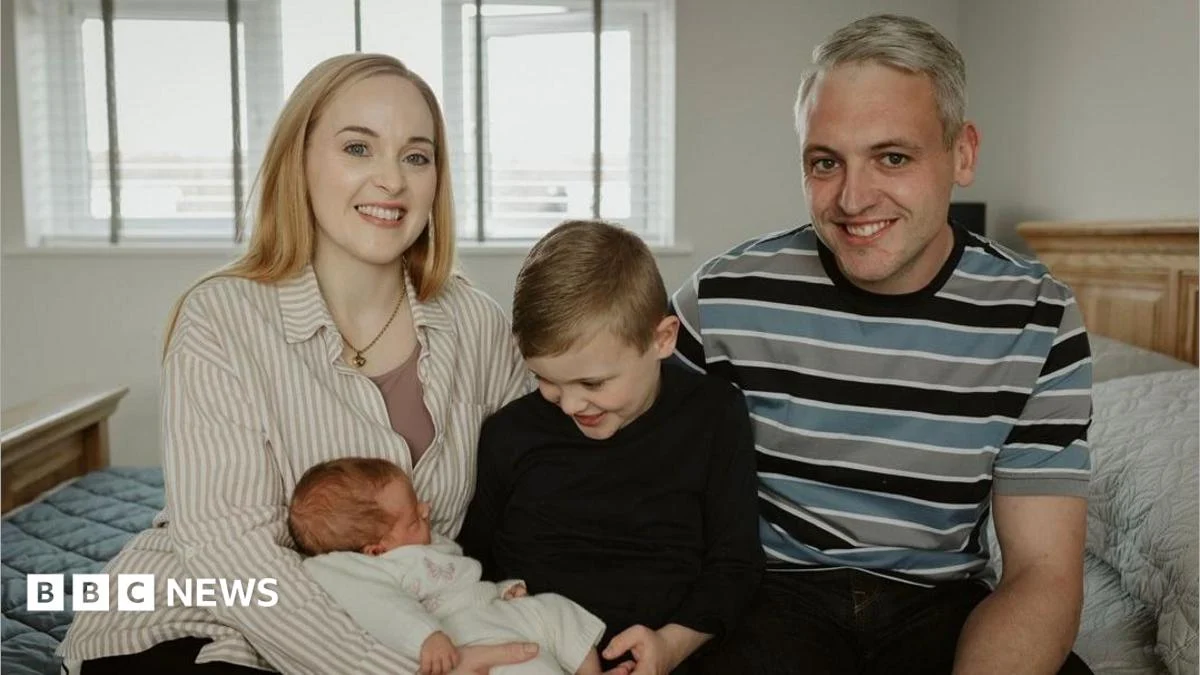
"Even after the darkest of storms, rainbows can break through. Our daughter, Hope, is living proof that healing and joy can emerge from profound grief, a testament to enduring love and the power of specialized care."
This profound sentiment encapsulates the arduous yet ultimately triumphant journey of Hayley and Mike, a couple who navigated the devastating waters of stillbirth not once, but twice, before finally welcoming their "rainbow baby." Their story illuminates the often-hidden realities of pregnancy loss, the immense emotional toll it takes on families, and the critical role of advanced medical understanding and compassionate support in transforming despair into renewed hope. It underscores the resilience of the human spirit and the enduring power of love to find light amidst the deepest shadows.
Hayley and Mike had always envisioned a bustling family home, a dream that began to materialize with the joyous arrival of their eldest son, George, in 2019. Hayley’s first pregnancy with George was unremarkable, unfolding with the textbook ease and anticipation that most expectant parents hope for. This smooth experience set a precedent, fostering a sense of security and excitement when they discovered they were pregnant again in 2023, eagerly anticipating the expansion of their family. The prospect of George becoming a big brother filled their home with renewed optimism and planning for the future.
However, this hopeful trajectory was tragically interrupted at 19 weeks and four days into Hayley’s second pregnancy. A subtle, unsettling feeling began to surface within Hayley, a maternal instinct signaling that "something wasn’t right." This vague unease soon gave way to a stark and devastating reality. An urgent ultrasound confirmed their deepest fears: their unborn son, Oscar, had died in utero.
The diagnosis plunged Hayley and Mike into an abyss of shock and sorrow. The immediate aftermath was surreal, marked by an unbearable paradox: knowing their baby was gone, yet still carrying him. "It sounds awful," Hayley recalled, articulating the desperate desire for closure, "but when you know your baby is no longer alive, you just want it all to be over." The pain was compounded by the visible reminders of their hopes – baby clothes, nursery items, toys – already accumulated for Oscar. These once joyful preparations became agonizing symbols of what was lost, too painful to look at. The heartbreaking task of explaining to George that his little brother would not be coming home added another layer of profound sadness to their grief.
The following day, Hayley was induced into labour. The experience of giving birth to a baby she knew would never cry, never breathe, was an emotionally excruciating nine-hour ordeal. "It was incredibly difficult knowing I would never hear my baby cry," she recounted, her words echoing the silent suffering of countless parents who undergo stillbirth. Unlike the celebratory atmosphere of a live birth, this was a journey through profound loss, a physical and emotional trauma that etched itself deeply into her memory.
In the weeks and months that followed Oscar’s funeral, Hayley found herself grappling with a profound sense of isolation. While initial expressions of sympathy and support were plentiful, they gradually diminished, a common yet painful reality for those experiencing stillbirth. Society often struggles with how to acknowledge and support grief that doesn’t fit conventional molds. Life, for others, simply carried on, yet for Hayley, time seemed to stand still, "consumed by grief." The lack of sustained communal acknowledgement for the loss of a child who was never seen alive in the world can leave parents feeling profoundly alone in their sorrow.
A post-mortem examination, a crucial step for many families seeking answers and for medical understanding, later revealed the tragic cause of Oscar’s death: a silent, concealed placental abruption. This condition occurs when the placenta separates from the inner wall of the uterus before birth. Unlike overt abruption, where external bleeding might be a visible warning sign, a concealed abruption means the bleeding is trapped within the uterus, often without obvious symptoms until the situation becomes critical. This "silent" nature makes it particularly insidious and difficult to diagnose in time, leaving parents like Hayley and Mike blindsided by the sudden and devastating loss. Placental abruption can be caused by various factors, including trauma, high blood pressure, or other underlying health conditions, and in some cases, the cause remains unknown. For Hayley, understanding the physiological reason behind Oscar’s death, though painful, became a critical first step in processing her grief and considering future pregnancies.
After three years marked by profound loss and an unyielding ache, Hayley embarked on a desperate quest for answers and specialized support. This period of searching led her to Tommy’s Rainbow Clinic in Manchester, a beacon of hope for families navigating the complex emotional and medical landscape of subsequent pregnancies after stillbirth or neonatal death. These specialist clinics offer a multi-faceted approach, combining advanced diagnostic capabilities, meticulous monitoring, and tailored care plans with psychological and emotional support, acknowledging the unique anxieties and challenges faced by "rainbow parents."
It was at Tommy’s Rainbow Clinic, during her next pregnancy in 2025, that Hayley received crucial insights. Early investigations revealed a problem with blood flow from her placenta to the baby, a potential recurrence or related issue to her previous abruption. Armed with this knowledge, a proactive and aggressive medical management plan was initiated. From as early as six weeks into the pregnancy, Hayley began a regimen of daily blood-thinning injections and aspirin. These medications are often prescribed in cases of placental insufficiency, recurrent pregnancy loss, or certain clotting disorders, aiming to improve blood flow to the placenta and prevent complications that could compromise the baby’s development.
Despite the diligent medical care, Hayley’s pregnancy with her third child was shadowed by immense anxiety and trepidation. The joy typically associated with pregnancy was overshadowed by a constant, visceral fear. "I was terrified throughout the pregnancy," she confessed, her voice reflecting the deep emotional scars of her previous losses. "Every single day I thought the baby was going to die." This profound fear is a hallmark of "rainbow pregnancies," where the memory of past loss casts a long shadow, making it difficult to fully embrace the present moment. "The further along I got, the more I felt there was to lose, because I already knew exactly what losing a baby felt like," she explained, highlighting the escalating emotional stakes with each passing week. The specialized care at the Rainbow Clinic, while medically reassuring, could not entirely quell the emotional trauma of past experiences.
But through unwavering perseverance, meticulous medical management, and the indomitable spirit of hope, Hayley and Mike finally reached the culmination of their arduous journey. In February, their miracle daughter, Hope, was welcomed into the world. The moment of Hope’s birth was not just a delivery; it was a profound emotional release, a moment of catharsis that washed away years of pain and fear. "Hope let out her first cry and I burst into tears," Hayley recalled, the sound of her daughter’s healthy wail a symphony of triumph and relief. "Everything was finally going to be okay." This cry, a sound so desperately longed for and tragically absent with Oscar, symbolized a new beginning, a profound affirmation of life.
Naming their daughter Hope was a deeply resonant choice, embodying the very essence of their journey. "Naming our miracle daughter Hope felt right after everything we’d been through to bring her safely into the world," Hayley affirmed. Her name serves as a living testament to the resilience required to navigate such profound sorrow and to the belief that light can always be found after darkness.
The arrival of Hope does not erase the grief for Oscar and Leo, the two sons lost too soon. "We will always carry the grief of losing Oscar and Leo with us," Hayley acknowledged, speaking to the enduring nature of parental bereavement. The love for a lost child, and the pain of their absence, remains a permanent part of a parent’s life. However, Hope’s presence offers a powerful counterpoint to that grief. She represents the potential for healing, for renewed joy, and for the possibility of a future filled with love. Her existence is a poignant reminder that "even after the darkest of storms, rainbows can break through."
Hayley and Mike’s story is a powerful narrative of resilience, a testament to the enduring human capacity for hope in the face of unimaginable sorrow. It casts a much-needed light on the realities of stillbirth and pregnancy loss, encouraging greater understanding, empathy, and the provision of specialized support services like Tommy’s Rainbow Clinic, which are vital lifelines for families navigating such profound journeys from heartbreak to the triumphant arrival of a rainbow baby.
