
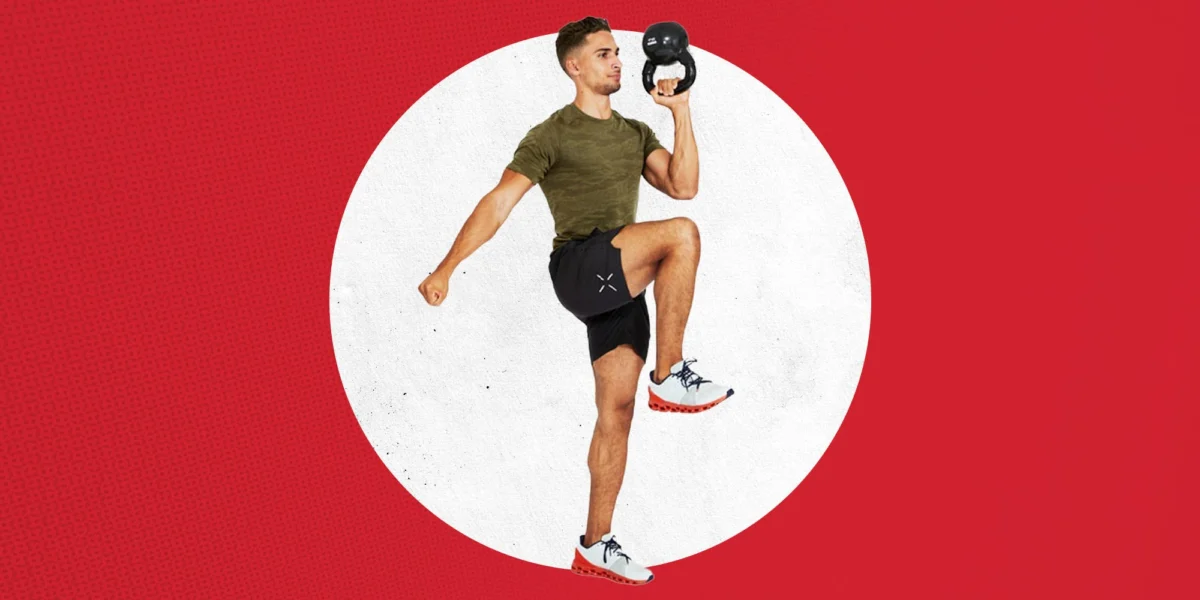
True athleticism is defined by the ability to generate explosive force and maintain stability through complex planes of motion, a goal achievable with a single kettlebell and a focused 31-day training cycle. By shifting the focus from isolated muscle hypertrophy to integrated, multi-joint power, trainees can bridge the gap between looking fit and performing with the grace and speed of a professional athlete.
The modern fitness landscape is often dominated by two extremes: the slow, heavy "grinds" of traditional bodybuilding and the high-volume, often chaotic intensity of competitive functional fitness. While both have their merits, many individuals find themselves plateauing in terms of actual movement quality. Their muscles may be growing, but their ability to sprint, jump, and rotate with fluidity remains stagnant. To address this, Marcus Martinez, C.S.C.S., a renowned kettlebell specialist, has developed a streamlined 31-day program designed to overhaul the body’s kinetic chain. Using only a single medium-weight kettlebell, this protocol prioritizes "explosive strength"—the capacity to exert maximum force in minimal time—while simultaneously "bulletproofing" the joints against the rigors of daily life.
The Philosophy of the Single-Tool Approach
The decision to limit a month-long program to a single kettlebell is not merely one of convenience; it is a tactical choice rooted in the principles of motor learning and progressive overload. When a trainee is not distracted by changing weights or complex machinery, they can focus entirely on the nuances of "leverage" and "tension." The kettlebell is uniquely suited for this because its center of mass is offset from the handle. This requires the stabilizer muscles, particularly in the shoulders and core, to work significantly harder than they would with a balanced dumbbell or barbell.
Martinez’s program is structured as a four-day-per-week commitment. This frequency is high enough to trigger neurological adaptations—teaching the brain to fire muscle fibers more efficiently—while leaving ample room for recovery. The inclusion of "active rest" days, involving 20-minute sessions of low-intensity steady-state (LISS) cardio such as walking or cycling, ensures that blood flow remains high, aiding in the removal of metabolic waste and keeping the aerobic system primed without taxing the central nervous system.

Priming the Engine: The Warmup Circuit
The program begins with a neural and physical "wake-up call." Traditional static stretching can sometimes inhibit explosive performance; therefore, Martinez utilizes a dynamic circuit to prepare the body for the loads to come.
The first movement, the Chest-Supported Good Morning, targets the posterior chain—the hamstrings, glutes, and lower back. By holding the kettlebell at the chest, the trainee creates a counterbalance that allows for a deeper hinge at the hips. This is not just a stretch; it is a rehearsal for the hip-hinge pattern that governs almost all athletic movements, from jumping to sprinting.
Following the hinge is the Bottoms-Up March. This is a masterclass in "reflexive stability." Holding a kettlebell upside down requires intense forearm engagement and forces the rotator cuff to stabilize the shoulder joint. By marching while maintaining this position, the trainee integrates the upper-body stability with lower-body movement, forcing the core to resist the rotational forces generated by the moving legs.
Building the Foundation: Strength Circuit 1
The first strength block focuses on the "Dead-Stop" principle and overhead power. Most injuries and performance failures occur during transitions or from a standstill. The Dead-Stop Swing addresses this by forcing the trainee to generate maximum power from a stationary position on the floor. Unlike a continuous swing, which utilizes the momentum of the previous rep, the dead-stop version requires a fresh "ignition" of the glutes and hamstrings for every single repetition. This builds the raw "starting strength" necessary for sprinting and jumping.
Paired with the swing is the Split Jerk. While the shoulder press is a "grind" exercise, the jerk is a "ballistic" exercise. It teaches the body to use the legs to drive a weight upward, transferring energy through a rigid core. The "split" landing—with one foot forward and one back—challenges balance and teaches the trainee how to absorb force in a staggered stance, a position common in almost every field sport, from football to tennis.

Refining Stability: Strength Circuit 2
The second strength block shifts the focus to unilateral (one-sided) strength and back health. In daily life, we rarely stand with our feet perfectly symmetrical. The Racked Reverse Lunge places the weight on one shoulder, creating an asymmetrical load that tries to pull the torso out of alignment. The trainee must resist this lateral flexion while performing a deep lunge. This builds incredible "anti-rotational" core strength and ensures that the quadriceps and hamstrings are balanced on both sides of the body.
To complement the lunge, the Staggered-Stance Deadlift targets the glutes and hamstrings with surgical precision. By elevating the rear heel, the majority of the weight is shifted to the front leg. This variation provides the benefits of a single-leg deadlift—such as improved balance and ankle stability—but with enough support to allow for heavier loading and better control. It is an essential movement for "bulletproofing" the lower back, as it teaches the spine to remain neutral while the hips do the heavy lifting.
The Metabolic Engine: The Finisher
The workout concludes with a five-minute high-intensity finisher designed to maximize caloric burn and improve rotational power. The Figure 8 to Hold is a dynamic, flowing movement that requires the kettlebell to pass through and around the legs. This mimics the chaotic, multi-directional nature of real-world movement. It builds "grip-and-go" strength and forces the core to stabilize against a weight that is constantly changing direction.
Finally, the Kettlebell Clean serves as the ultimate functional movement. It is the most efficient way to move an object from the ground to the "rack" position at the shoulder. The clean requires a violent hip snap followed by a delicate "catch," teaching the trainee how to transition from explosive power to controlled stability. Doing this under fatigue in the final minutes of a workout builds the mental and physical resilience needed for long-duration activities.
The 31-Day Outlook and Implications
While many programs promise rapid transformation, the Martinez protocol focuses on "quality over quantity." Over the course of 31 days, the primary goal is not just to move more weight, but to move the same weight with more speed, better form, and less perceived effort. This "movement efficiency" is the hallmark of a high-level athlete.

For the average fitness enthusiast, the implications of this training are profound. By prioritizing explosive movements and functional stability, they reduce the risk of common injuries associated with aging, such as lower back strains or shoulder impingements. For the experienced lifter, this 31-day "pivot" away from heavy barbells can provide a necessary deload for the joints while sparking new neural adaptations that can lead to PRs when they return to their standard programming.
In an era of over-complicated fitness gadgets and endless supplement cycles, the Martinez program is a reminder that the most effective tool is often the simplest one. A single kettlebell, when combined with the principles of biomechanics and consistent effort, is all that is required to transform a physique from a collection of muscles into a high-performance machine. As the 31 days conclude, the trainee often finds that they don’t just look better in the mirror; they move through the world with a newfound sense of power, balance, and confidence.
