
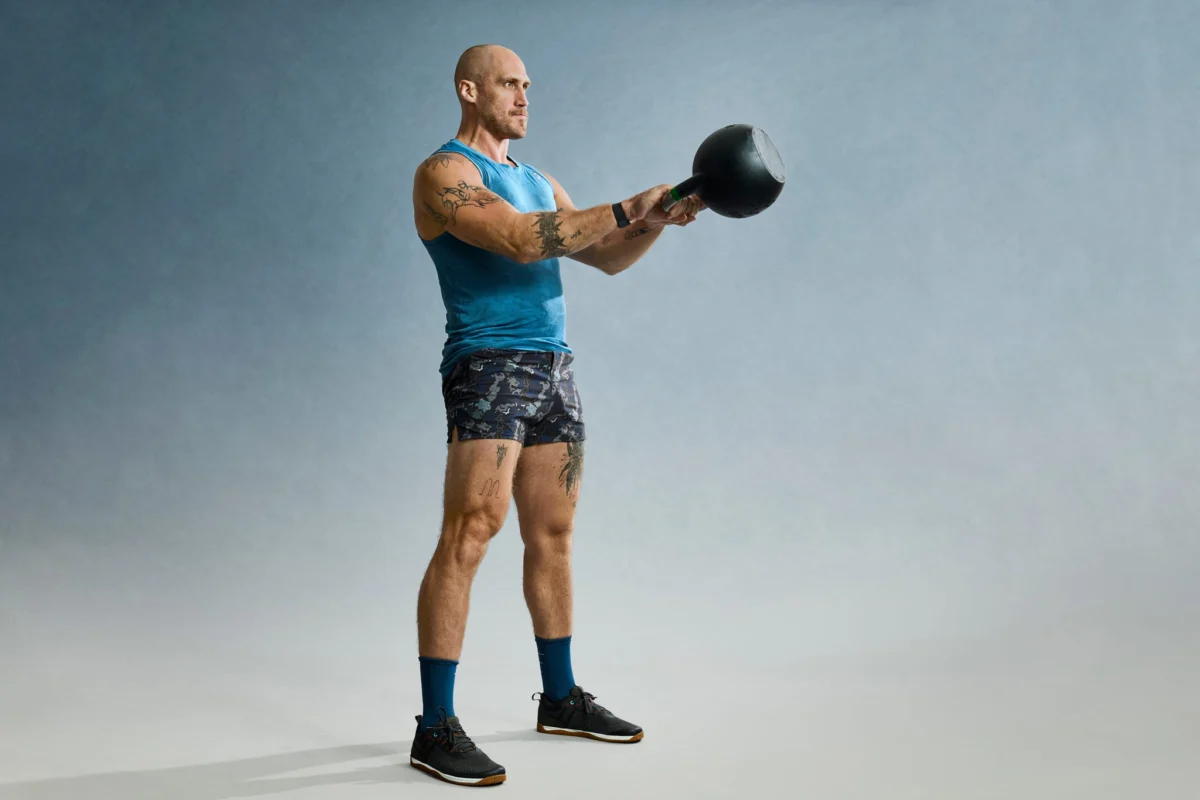
"The kettlebell swing is not a shoulder exercise or a squat, but a ballistic hip-hinge movement that transforms raw hip extension into functional, explosive athleticism."
While the kettlebell swing is often the first movement beginners attempt when picking up the cast-iron implement, its apparent simplicity masks a highly technical foundation that requires precise coordination between the posterior chain and the core. Far from being a mere rhythmic waving of weight, a correctly executed swing serves as a fundamental builder of power, teaching the body to generate force from the hips while maintaining a rigid, protected spine. By mastering the nuances of the hinge, the "hike," and the glute squeeze, lifters can unlock a level of metabolic conditioning and athletic explosiveness that few other single exercises can provide.
The Anatomy of the Hinge
To understand the kettlebell swing, one must first understand the hip hinge. Unlike a squat, which is a knee-dominant movement characterized by vertical displacement of the torso, the hinge is a horizontal movement. It involves pushing the pelvis backward, stretching the hamstrings, and then explosively driving the hips forward to a neutral standing position. This action, known as hip extension, is the primary engine of human locomotion, essential for sprinting, jumping, and lifting heavy objects from the floor.
In the context of the kettlebell swing, the weight acts as a pendulum. The goal is not to lift the bell with the arms, but to project it forward using the momentum generated by the hips. Fitness experts Ebenezer Samuel, C.S.C.S., and Brett Williams, NASM-CPT, emphasize that the swing is the ultimate expression of this hip extension. When performed correctly, it corrects the postural "gluteal amnesia" often caused by sedentary lifestyles, forcing the largest muscles in the body to take over the workload.
The Great Debate: Russian vs. American Swings
The fitness world generally recognizes two primary variations of the swing: the "Russian" (or standard) swing and the "American" swing. The standard swing involves driving the bell to approximately chest or eye height. At this apex, the bell becomes momentarily weightless before the lifter "tames the arc" and guides it back down between the legs.

The American swing, popularized within CrossFit circles, requires the lifter to swing the bell all the way overhead, with the bottom of the bell pointing toward the ceiling. While this increases the range of motion, many experts, including Samuel, caution against it for the general population. The overhead position requires exceptional shoulder mobility; without it, lifters often compensate by arching their lower back, which significantly increases the risk of lumbar injury. Furthermore, the height of the bell should be a byproduct of hip power, not a target reached by pulling with the arms. For most, the Russian swing remains the superior choice for safety and power development.
Identifying and Correcting Common Technical Flaws
Because the swing looks like a simple "up and down" motion, beginners often fall into several technical traps that diminish the exercise’s effectiveness and increase injury risk.
The "Squat-Swing"
Perhaps the most common error is turning the swing into a squat and a front deltoid raise. In this scenario, the lifter drops their hips toward the floor and uses their quads to stand up, then uses their shoulders to pull the bell to chest height. This removes the focus from the hamstrings and glutes and places undue stress on the rotator cuffs. A true swing involves minimal knee bend—just enough to allow the hips to push back deeply.
The "Romanian Deadlift" Swing
Conversely, some lifters keep their legs too straight, performing what looks like a rhythmic Romanian Deadlift. While this hits the hamstrings, it lacks the explosive "snap" required for a ballistic movement. The hamstrings work most efficiently when the knees and hips bend in tandem, allowing for a coiled, spring-like release of energy.
Rounding the Back
The spine must remain in a neutral, "braced" position throughout the entire movement. Rounding the upper back (thoracic spine) or, more dangerously, the lower back (lumbar spine) indicates a failure of the core and lats to stabilize the torso. This often happens during the "drop" phase of the swing when the lifter fails to keep their chest up.
Expert Cues for a Perfect Swing
To bridge the gap between theory and execution, Ebenezer Samuel suggests several internal cues that help lifters internalize the correct mechanics.

1. The Upper Body as a Sturdy Lever:
While the legs provide the power, the upper body must remain rigid. Think of the torso as a solid plank. By "setting the lats"—essentially trying to squeeze oranges in your armpits—you create a stable connection between the arms and the torso. This prevents the weight of the bell from pulling the shoulders out of position.
2. Arms Like Ropes:
One of the most transformative cues for beginners is to imagine the arms as nothing more than ropes or chains connecting the bell to the shoulders. The hands are merely hooks. If you find yourself "muscling" the bell up, you are likely using your upper body too much. The bell should feel weightless at the top of the swing, floating momentarily because of the power of your hips.
3. Body Follows Bell:
Timing is everything. A common mistake is hinging too early as the bell descends. Instead, wait for the bell to almost hit you in the groin before you push your hips back. Let the bell’s momentum dictate when you hinge. As it comes back down, let your upper arms make contact with your ribcage before you "break" at the hips to catch the weight.
4. The Explosive Stand-Up:
The "up" portion of the swing should be violent and fast. Samuel notes that you should focus on two things: standing up and squeezing your glutes as hard as possible. This "plank" position at the top—where your glutes, abs, and quads are all tight—is the finish line of the movement.
The Role of Breathing and Bracing
Breathing is the secret to maintaining internal pressure and protecting the spine. An explosive movement requires an explosive breath. Experts recommend a forceful "sharp" exhale at the moment of hip extension. This creates a "bracing" effect in the abdominal wall, ensuring that the force generated by the legs is transferred efficiently through the torso without the spine buckling.
Muscular Engagement and Benefits
The kettlebell swing is a full-body powerhouse, but its primary targets are the posterior chain muscles: the glutes (maximus and medius), the hamstrings, and the spinal erectors. However, the secondary stabilizers are equally important. The core must work overtime to prevent spinal rotation and flexion, while the forearms and grip are taxed by the centrifugal force of the bell wanting to fly out of the hands.
Beyond muscle building, the swing is a premier tool for cardiovascular health. Because it involves large muscle groups and explosive movements, it elevates the heart rate rapidly, providing a "metabolic hit" that rivals high-intensity sprinting but with lower impact on the joints.
Integrating the Swing into a Training Program
The versatility of the kettlebell swing allows it to fit into almost any workout routine, depending on the desired outcome.
- For Metabolic Conditioning: Try a "30 on, 30 off" protocol. Perform as many high-quality swings as possible in 30 seconds, followed by 30 seconds of rest, for a total of five to ten minutes. This builds work capacity and burns significant calories.
- For Power and Strength: Use a heavier bell for lower volume. Sets of 10 to 12 reps, focusing on maximum explosive intent with each rep, will build raw hip power.
- As a Finisher: Pair swings with a movement like broad jumps or push-ups. The contrast between the weighted hinge and the bodyweight explosive movement creates a potent stimulus for the nervous system.
Ultimately, the kettlebell swing is more than an exercise; it is a fundamental skill. By prioritizing the hinge over the pull and the glutes over the shoulders, lifters can develop a resilient, powerful physique capable of performing at the highest levels of sport and daily life.
