
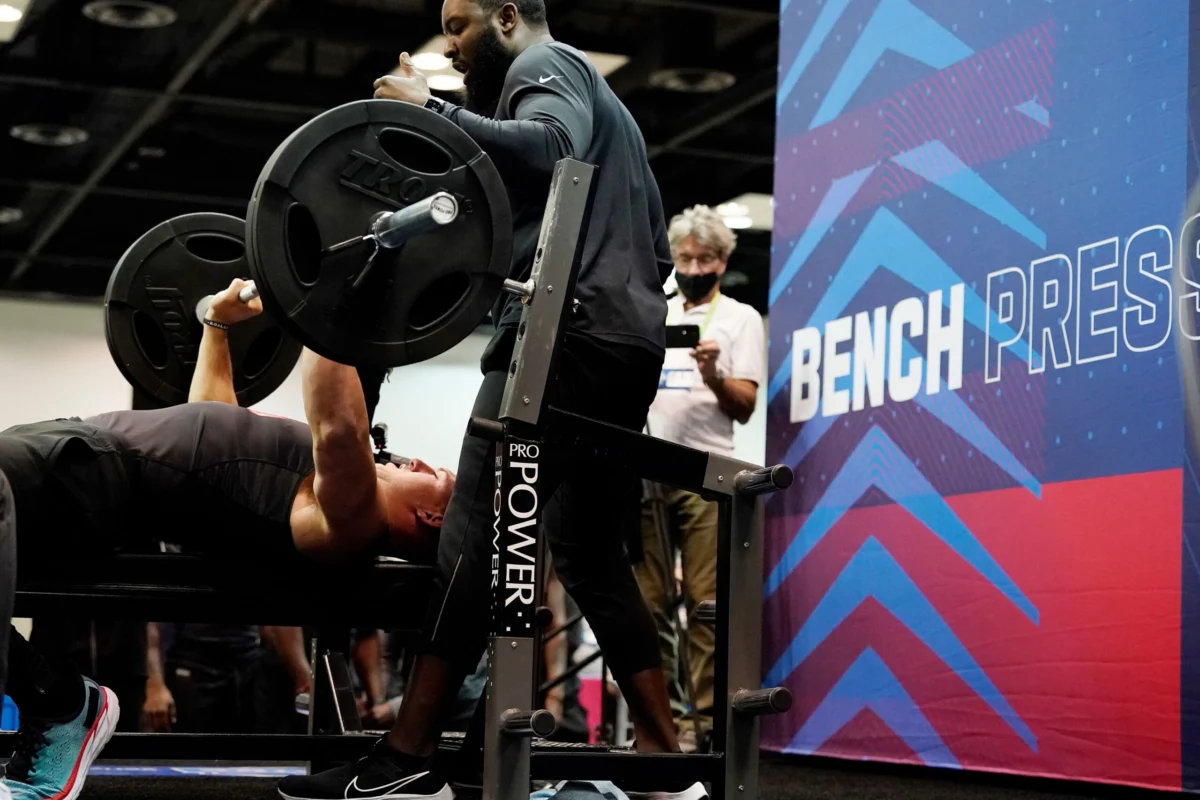
"Success at the NFL Combine’s bench press is less about raw power and more about the fusion of endurance, technical precision, and the mental fortitude to treat every rep as a singular battle."
The NFL Scouting Combine is often described as the most high-stakes job interview in professional sports, where every second on the clock and every pound on the bar can dictate a prospect’s draft stock and earning potential. While the 40-yard dash captures the headlines for its pure speed, the 225-pound bench press remains the definitive barometer for upper-body functional strength and muscular endurance. Far from a simple test of "how much can you lift," this specific drill requires a sophisticated blend of biomechanical efficiency, core stability, and psychological resilience—elements that performance coach Travelle Gaines has spent decades refining with the league’s elite.
The Prestige of the Bench Press
For decades, the 225-pound bench press has served as a rite of passage in Indianapolis. It is a grueling test of attrition where the goal is simple but the execution is anything but: lift the "two-plate" barbell as many times as possible until total muscular failure. For scouts, the test isn’t just about identifying who is the strongest; it’s about identifying who has the work capacity to maintain power throughout four quarters of a professional football game.
Travelle Gaines, the founder of Athletic Gaines, has become a master of this specific domain. Having prepared over 50 NFL first-round picks—including generational talents like Myles Garrett and Kayvon Thibodeaux—Gaines understands that the difference between 20 reps and 25 reps can be the difference between the first and second rounds of the NFL Draft. In a recent collaboration with Men’s Health fitness director Ebenezer Samuel, C.S.C.S., Gaines pulled back the curtain on the methodology used to turn elite prospects into combine legends at facilities like Max Impact Training in White Plains, New York.
The Psychology of the Platform
The bench press at the Combine is conducted in a pressure-cooker environment. Prospects are surrounded by NFL general managers, head coaches, scouts, and a phalanx of cameras. This atmosphere creates a psychological burden that can cause even the strongest athletes to "tighten up," leading to inefficient breathing and premature fatigue.
"It’s all mental because anyone can do good when you’re by yourself," Gaines notes. "When you have the scouts, the GMs, the cameras, everybody’s there… it really comes into play. So you’ve got to lock in everything."
To combat this, Gaines trains his athletes to adopt a "single rep mindset." When the burn of lactic acid sets in around rep 15 or 20, the athlete must stop thinking about the total number and focus exclusively on the mechanics of the next individual lift. This shift in focus prevents the overwhelming nature of the test from compromising the athlete’s form.
The Anatomy of the Setup: Precision Over Power
Before the bar even leaves the rack, the battle is often won or lost in the setup. Gaines emphasizes that comfort and consistency are the foundations of performance. Because the Combine test is a high-repetition drill, any minor inefficiency in the setup is magnified with every rep, leading to wasted energy.
The Gaines checklist for a perfect setup includes:
- Head and Neck Positioning: Whether an athlete prefers their head near the top of the bench or slightly lower, the key is to maintain that position throughout. Changing the neck angle mid-set can disrupt the spinal line and affect power output.
- The Specificity of Grip: Hand placement is highly individual. A long-armed offensive tackle may require a wider grip to reduce the range of motion, whereas a smaller skill player might opt for a narrower grip to maximize triceps engagement. Gaines advises against making radical changes to grip width in the weeks leading up to the Combine; familiarity is the safest route to success.
- The Grounded Base: A common mistake is "active feet." Gaines insists on keeping the feet flat and driven into the floor. This creates a "total body" tension that allows power to be transferred from the floor, through the legs and core, and into the chest and arms.
- The Glute Rule: Perhaps the most critical technicality at the Combine is the "butt on the pad" rule. If a player’s glutes lose contact with the bench in an attempt to arch their back for more leverage, the scout will immediately disqualify that rep. Gaines recounts stories of athletes who believed they hit 30 reps, only to find seven were discounted because their hips rose during the struggle.
Specialized Drills for Functional Power
To build the specific kind of strength required for the 225-pound test, Gaines utilizes three primary exercises that go beyond the standard bench press. These drills are designed to address the specific needs of a football player: shoulder stability, core integration, and rotational power.
1. Neutral Grip Incline Dumbbell Press
This variation is essential for shoulder health and football-specific mechanics. By using a neutral grip (palms facing each other), the athlete mimics the "punch" used by linemen and linebackers when engaging an opponent.
"If your hands are ever in a traditional bench grip position on the field, you’re probably holding," Gaines explains. "But when you’re blocking, your hands are coming from a neutral position. You’re building power from here, which translates directly to the field." This drill also places less strain on the rotator cuff, allowing for higher volume training without the risk of shoulder impingement.
2. Bosu Ball Pushup
While the bench press is often viewed as a chest exercise, Gaines views it as a core exercise. The Bosu ball pushup forces the athlete to stabilize their entire trunk while performing a pressing motion. To increase the difficulty, Gaines often places a small ball on top of the Bosu ball, challenging the athlete to keep it from rolling off. This creates "active stability," teaching the nervous system to remain calm and controlled even when the supporting surface is unstable—a common occurrence in the trenches of the NFL.
3. Keiser Machine Push-Pull
The final piece of the puzzle is the Keiser Machine Push-Pull, which focuses on the back and rotational strength. In football, power is rarely generated in a vacuum; it is usually the result of one side of the body pushing while the other pulls or stabilizes. This drill works the posterior chain and the obliques, ensuring that the athlete has the "back power" to support a heavy bench press. Because the Keiser machine uses pneumatic resistance, it allows for explosive movements without the momentum-based "cheating" often found with traditional iron weights.
The Endurance Factor: From Strength to Stamina
While a "one-rep max" measures the absolute peak of an athlete’s strength, the 225-pound test measures "strength-endurance." This requires the body to efficiently clear metabolic byproducts like hydrogen ions while continuing to fire fast-twitch muscle fibers.
Training for this involves high-volume sets that push the athlete into the "red zone" of fatigue. Ebenezer Samuel noted during his session with Gaines that these stability-focused drills—like the Bosu pushups and neutral grip presses—actually cause fatigue faster than traditional movements. This is intentional. By training the body to maintain stability under extreme fatigue, Gaines ensures that when the athlete gets to the Combine, the 225-pound bar feels lighter and the stability feels second nature.
Conclusion: The Road to the Draft
The NFL Combine’s 225-pound bench press is a unique intersection of sport-specific training and traditional weightlifting. Through the expertise of coaches like Travelle Gaines, prospects learn that the path to a high rep count is paved with more than just chest flys and heavy triples. It is a holistic endeavor that requires a rock-solid base, a stable core, and the ability to block out the noise of a thousand watching eyes.
As the NFL continues to evolve into a game of inches and split seconds, the metrics provided by the bench press remain a vital piece of the scouting puzzle. For the athletes under Gaines’ tutelage, the goal is clear: lock in the mechanics, settle the mind, and keep the glutes on the pad. In the world of the NFL Combine, every rep is a statement of intent.
