
"Elite performance in the NFL is defined by the ability to maintain explosive power under extreme metabolic stress, ensuring that a player’s first step in the fourth quarter is as lethal as their first step of the game."
The transition from a standout collegiate career to the professional ranks of the National Football League (NFL) is a gauntlet that demands more than just raw talent; it requires a specialized physiological peak that can only be achieved through rigorous, sport-specific conditioning. Travelle Gaines, the founder of Athletic Gaines and a veteran performance coach at Max Impact Training, has mastered this transition, having guided 54 first-round draft picks through the grueling preparation process. His "5 Minutes of Hell" workout, a cornerstone of his "Metabolic Fridays" sessions, serves as a high-stakes simulation of the physical and mental demands of the NFL Combine and the professional gridiron, focusing on the intersection of cardiovascular endurance, explosive power, and functional strength.
The Architect of Elite Performance
Travelle Gaines has built a reputation as one of the premier performance specialists in the world of professional sports. His client roster reads like a Pro Bowl ballot, featuring defensive stalwarts like Myles Garrett and Kayvon Thibodeaux, as well as legendary power runners like Marshawn Lynch. The success of these athletes is not accidental; it is the result of a training philosophy that prioritizes efficiency and gameday applicability over traditional, static gym movements.
At Max Impact Training in White Plains, New York, Gaines implements a methodology that prepares athletes for the "burst-and-recovery" nature of football. In a sport where plays typically last between four and seven seconds, followed by brief periods of rest, the ability to recover quickly and repeat high-intensity efforts is the difference between a first-round selection and a late-round gamble. The "5 Minutes of Hell" is designed to push athletes to their anaerobic threshold, forcing them to operate in a state of fatigue that mimics the closing minutes of a high-stakes game.
The Anatomy of "Metabolic Fridays"
The "5 Minutes of Hell" is not merely a test of willpower; it is a carefully curated sequence of seven moves designed to elicit specific physiological adaptations. While the ultimate goal for Gaines’ NFL prospects is to complete three full rounds of this circuit by the end of their summer program, the intensity is scaled as they progress. The workout is a microcosm of the "Metabolic Friday" philosophy, which focuses on flushing the body with lactic acid and teaching the nervous system to remain functional under duress.
1. The Assault Bike: 30 Seconds of Maximum Output
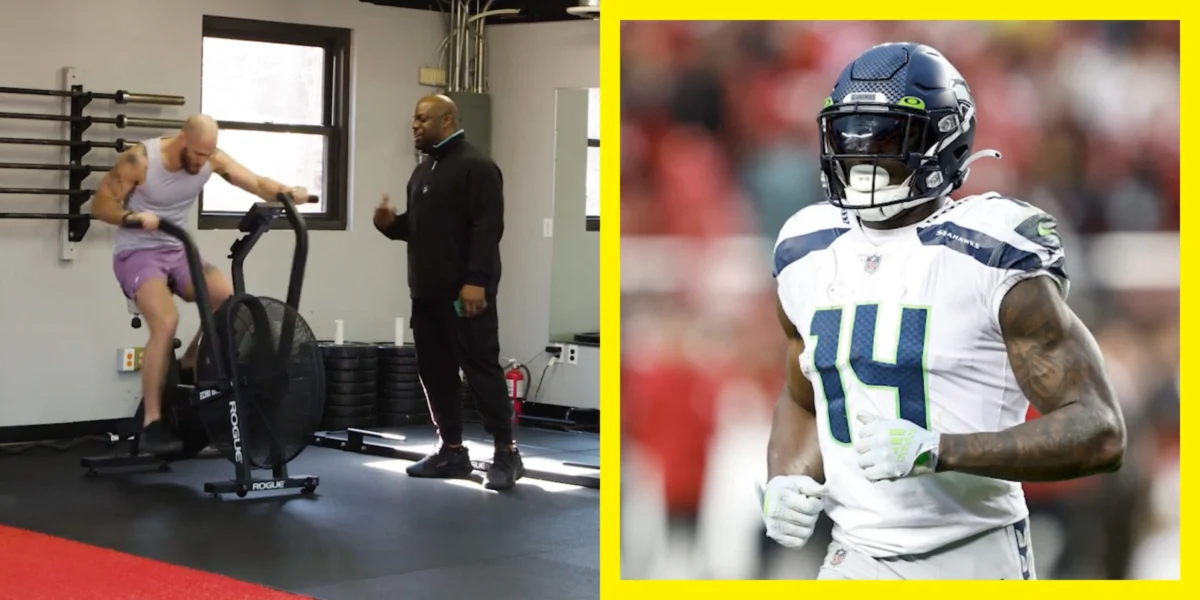
The circuit begins with the Assault Bike, often referred to in fitness circles as the "devil’s tricycle." Unlike a standard stationary bike, the Assault Bike uses a fan to create air resistance—the harder the athlete pedals, the greater the resistance becomes. By engaging both the arms and legs, the bike demands a total-body cardiovascular effort.
Gaines utilizes this as the lead-off exercise to immediately spike the heart rate. For a football player, this mimics the initial burst of energy required at the snap. The 30-second all-out sprint forces the heart to pump oxygenated blood to the entire musculoskeletal system, setting a high metabolic baseline for the exercises that follow.
2. Medicine Ball Slams: The Power of Triple Extension
Following the bike, athletes move directly into 10 repetitions of medicine ball slams. This movement is critical for developing "triple extension"—the simultaneous extension of the hips, knees, and ankles. Triple extension is the fundamental mechanic behind sprinting, jumping, and exploding off the line of scrimmage.
By reaching high and violently slamming the ball into the turf, athletes are training their posterior chain to generate force rapidly. Gaines emphasizes the "violent" nature of the slam; it is not just about moving the weight, but about the speed and intent behind the movement. This translates directly to the "pop" a linebacker needs to shed a block or the verticality a wide receiver needs to win a 50/50 ball.
3. Sled Push (High Handle): North-South Driving Power
The sled push is perhaps the most "football-specific" movement in the circuit. Pushing a weighted sled with a high-handle grip simulates the mechanics of a lineman or a lead blocker engaging an opponent. It requires immense lower-body drive and core stability to keep the sled moving in a straight "north-south" line.
This exercise serves a dual purpose: it builds the leg drive necessary for short-yardage situations while simultaneously acting as a "weighted" form of cardio. The friction of the sled against the turf provides a constant resistance that never relents, forcing the athlete to maintain a consistent power output even as their legs begin to burn.
4. Medicine Ball Slams (Repeat)
The circuit returns to another 10 reps of medicine ball slams. This repetition is intentional. By returning to an explosive movement immediately after the grinding effort of the sled push, Gaines is testing the athlete’s ability to recruit fast-twitch muscle fibers while under significant fatigue. This mimics the reality of a long drive on the field, where a player may be asked to make an explosive tackle after several plays of sustained physical contact.
5. Sled Push (Low Handle): The "Low Man Wins" Philosophy
The second iteration of the sled push utilizes the low handles, which fundamentally changes the leverage and mechanics of the movement. In football, the adage "the low man wins" refers to the advantage gained by the player who can get their center of gravity beneath their opponent’s.
The low-handle sled push forces the athlete into a deep crouch, requiring them to drive from a position of mechanical disadvantage. This targets the quads and glutes differently than the high-handle push and emphasizes "pad level." Training at this lower height ensures that when an athlete is tired in the fourth quarter, they don’t "stand up" and lose their leverage on the field.
6. Keiser Biceps Curl: Strength for Ball Security
The inclusion of the Keiser Biceps Curl might seem counterintuitive for an NFL Combine prep workout, which usually focuses on the "Big Three" lifts (bench, squat, deadlift). However, Gaines views the biceps and forearms through the lens of functional utility rather than aesthetics.
Using the Keiser machine, which utilizes pneumatic (air) resistance, provides a constant tension throughout the entire range of motion. For a football player, bicep and forearm strength are the primary components of grip strength. This is essential for ball security—preventing defenders from stripping the ball—and for defensive players who must grab and shed blockers. Stronger arms allow a player to maintain control of their "workspace" during the hand-fighting that occurs at the line of scrimmage.
The Progression to Professional Readiness
The "5 Minutes of Hell" is a progressive protocol. As Gaines notes, his athletes do not start at the peak of intensity. The summer program is a journey of conditioning: athletes begin with a single round in the early weeks, gradually building the work capacity to handle two rounds, and finally reaching the three-round milestone just before they depart for training camp.
When Brett Williams, the Men’s Health fitness editor, attempted the circuit, he found himself exhausted after just two rounds. This result is expected; the workout is designed to find the "breaking point" of even highly fit individuals. For the NFL prospect, the goal is to push that breaking point further and further back until they can sustain elite levels of performance for the duration of a professional game.
The Broader Implications of Metabolic Conditioning
The success of Gaines’ program highlights a shift in professional sports training away from pure hypertrophy (building muscle size) and toward metabolic efficiency. Being "jacked" is a byproduct of the work, but the primary objective is the "cardiovascular component."
In the modern NFL, the pace of play is faster than ever. No-huddle offenses and high-tempo schemes demand that players be more than just strong; they must be metabolically resilient. The "5 Minutes of Hell" ensures that when an athlete walks onto the field for the NFL Combine, they aren’t just showing off their physique—they are demonstrating a refined engine capable of performing at the highest level of human athletics.
Ultimately, Travelle Gaines’ "Metabolic Fridays" are about more than just physical stats. They are about building the mental toughness to endure "hell" for five minutes so that the sixty minutes on a Sunday afternoon feel like a walk in the park. For the 54 first-rounders who have come before, and the many who will follow, this grueling preparation is the price of admission to the elite ranks of the NFL.
