
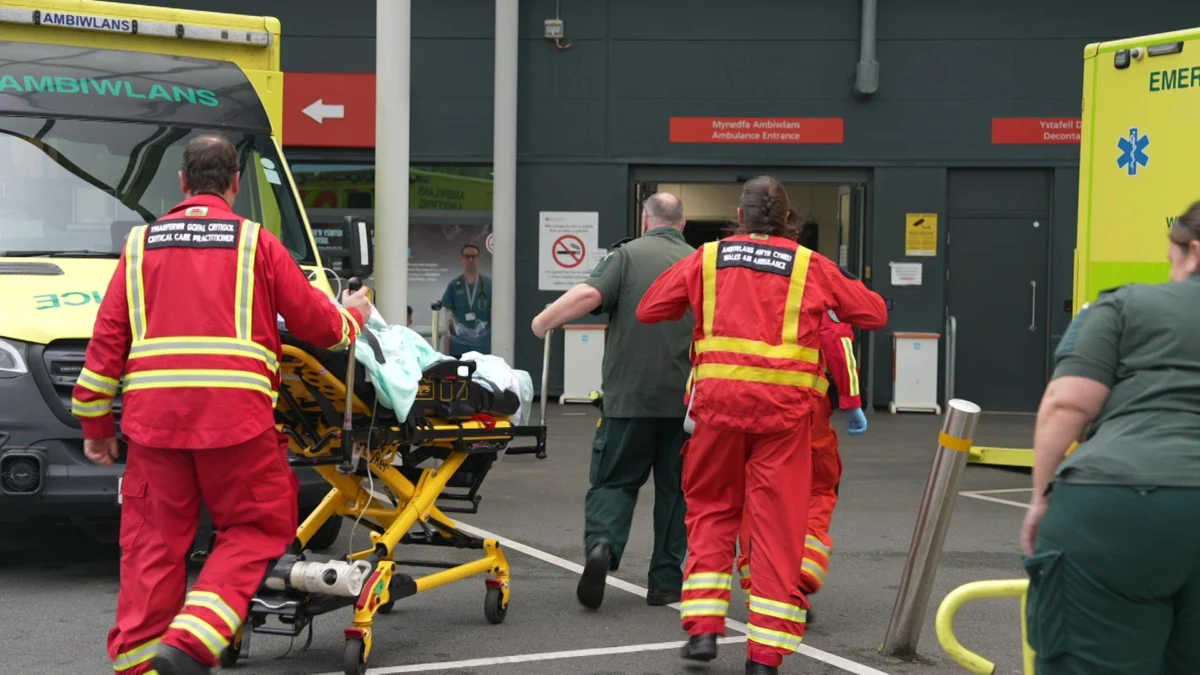
"Despite public criticisms branding it ‘dangerous’ and ‘dreadful,’ the Grange University Hospital asserts its position among the safest healthcare facilities in the country, citing superior patient safety and survival rates. Senior staff underscore the devastating impact of online negativity on morale and public confidence, urging critically unwell patients not to delay seeking essential care."

Wales’ newest and most technologically advanced hospital, the Grange University Hospital in Cwmbran, Torfaen, finds itself at the centre of a fierce debate concerning its operational effectiveness and patient safety. Since its accelerated opening in September 2020 to confront the burgeoning COVID-19 pandemic, the £350m facility has been plagued by an onslaught of public criticism, particularly across social media platforms. These online commentaries frequently paint a grim picture, with allegations of dangerously long delays, severe overcrowding, critical staff shortages, and a concerning decline in the overall quality of care. Some comments have even escalated to the point of actively dissuading individuals from seeking treatment at the hospital, dubbing it "dangerous" and "dreadful." In stark contrast, the hospital’s senior leadership vehemently defends its safety record, asserting that the Grange not only meets but often exceeds national benchmarks for patient safety, including impressive survival rates. This divergence between public perception and institutional data presents a significant challenge for the hospital, as its dedicated staff grapple with the demoralizing effect of such widespread negativity while striving to reassure the public of their unwavering commitment to patient well-being.
The Grange University Hospital was conceptualized as a "super hospital," a modern hub designed to centralize highly specialized care, including intensive care, complex surgery, and acute emergency services, which were previously distributed across existing hospitals in Newport and Abergavenny. The underlying premise of this centralization model was to enhance efficiency, consolidate expertise, and provide a higher standard of specialized treatment. However, this model inherently relied on the strength and capacity of community health services to absorb the slack, managing less critical cases and facilitating patient discharge. The pandemic’s unexpected onset and the subsequent premature opening of the hospital undoubtedly amplified the pressures on this nascent system, challenging its foundational assumptions from day one.

A typical autumn day at the Grange paints a vivid picture of the relentless demands faced by its healthcare professionals. As the sun rises over the picturesque Cwmbran valley, revealing the imposing structure of the hospital, the serene exterior belies the intense activity within. The Emergency Department (ED) is a crucible of urgent care, where life-and-death decisions are made moment by moment. On this particular day, the PA system crackles with an urgent "Red call" – indicating a patient in critical condition, mere minutes away by ambulance. Yet, all eight beds in the ED’s resuscitation unit, the designated area for the most severely ill, are already occupied.
Dr. Zoe Morgan-Pittard, an ED doctor whose arms bear strategically placed stickers to help her track patient assessments amidst the chaos, describes the daily struggle. "We’re currently over capacity," she explains, highlighting the difficult "fluid decisions" staff must make to prioritize the sickest patients. This often means moving individuals who are arguably not yet stable enough, simply to make room for new arrivals. The department struggles with a pervasive "block and very little flow," a systemic issue where patients cannot be moved efficiently to inpatient wards, creating a bottleneck in the ED. With over 90 patients in the department and some facing waits of up to 18 hours, Dr. Morgan-Pittard starkly concludes, "Everybody is working hard, but unfortunately the hospital isn’t big enough."

The human toll of this overcrowding is evident in the experiences of patients like Margaret Giles, an 84-year-old from Croesyceiliog. After slipping and injuring her hip, Margaret spent nine hours on a trolley in one of the "extra spaces" – a makeshift area behind the main cubicles in A&E. While she pragmatically notes, "It’s not satisfactory – but needs must," her husband Alan expresses a more profound anger. He recounts his frustration when, upon requesting assistance for Margaret to use the toilet, a staff member questioned if she could walk, despite a suspected broken hip. Though X-rays eventually bring relief, confirming her hip is not broken, the couple’s experience underscores the emotional and physical strain placed on patients and their families by such conditions. "We’ve never been in here before," Alan states, "it’s the first time for me – and hope it’s the last. I don’t think it’s the staff, it’s the system."
A critical component of alleviating the internal pressure is improving ambulance handover times. During the visit, at least eight ambulances were observed queuing outside the ED. Historically, ambulance crews could face entire 12-hour shifts waiting to transfer patients. Significant efforts have been made to reduce this, with a target of releasing ambulances within 45 minutes. While 33% met this target on the day of the visit, the previous 30 days saw a much-improved 67%. Darren Panniers of the Welsh Ambulance Service acknowledges this "vast improvement," noting quicker responses to critical calls like strokes and heart attacks in the community.

These improvements are not solely due to ED efficiency but also broader hospital-wide strategies. Surgical teams now proactively assess patients in A&E to identify those who can be treated more swiftly, while urgent patients requiring same-day care are diverted to alternative departments. A major innovation is the "Transfer Lounge," a portacabin facility equipped with 10 beds and 15 chairs, designed to comfortably accommodate patients awaiting discharge or transfer to other care settings. Senior nurse Sian Williams emphasizes its value: "It allows us to free up beds quickly and it’s somewhere quieter, more comfortable for patients to wait. I always say even one bed makes all the difference to the ambulances outside." The lounge also facilitates better coordination with families and social services to expedite patient flow out of the hospital.
Despite these concerted efforts and the dedicated work of its staff, the Grange has remained under intense scrutiny. The Aneurin Bevan University Health Board, which operates the hospital, is currently under Level 4 measures – the second-highest level of Welsh government oversight – specifically due to ongoing concerns regarding urgent and emergency care performance.

Chief Operating Officer Leanne Watkins robustly defends the strategic decision to centralize services, particularly for historically "fragile services" like paediatrics and obstetrics and gynaecology, where concentrated expertise offers significant safety benefits. She acknowledges, however, that the hospital "could have benefited from some additional beds" – a critical insight into the capacity challenges. Watkins directly confronts the social media criticisms, which she believes are often driven by a small number of complaints but have a disproportionate impact on public confidence. "I don’t believe that [those criticisms] are fair," she states. "We have amongst the best mortality rates in Wales, and in fact, for some procedures, things like fractured neck or femur (hip) and emergency surgery, we rate right up there with the best in the UK." She insists, "If you’re unwell, critically unwell, it is a great place to be… It absolutely is a safe hospital." The emotional toll on staff is palpable, with Watkins noting it is "devastating to read what’s been said."
The health board’s own internal data supports Watkins’ claims, indicating that death rates at the Grange are lower than those at comparable hospitals across Wales, even when factoring in the complex patient demographic and the severity of cases. Furthermore, the proportion of patients who die within the Grange’s emergency department has shown consistent improvement and remains below the Welsh average. Dr. Seema Srivastava urges the public to "look at the facts," while Lorna Lear, deputy head of nursing, acknowledges that while "care is less than what we expect" in some instances, feedback is always valued for service improvement. Consultant and Director of Urgent Care, Owain Chandler, empathizes with patient frustration over long waits, calling it "understandable."

By the end of a seven-hour observation period, the A&E department had attended to 274 patients. Nurse in charge, Sam Taylor-Harley, recounts a day filled with "more heart attacks, myocardial infarctions, a couple of trauma calls, admissions to the ITU upstairs, and some infection prevention control issues." As the day concludes, the arrival of a patient with life-threatening wounds, escorted by air ambulance medics, underscores the critical nature of the hospital’s mission. Over a dozen staff members are immediately on hand, ready to provide immediate, life-saving intervention. Such cases, deemed critically ill, will always receive immediate attention, but this undeniable necessity inevitably means that patients with less severe conditions face even longer waits.
The Welsh government, while commending NHS staff for their "incredibly hard" work and outlining plans for a challenging winter, reiterated that the Aneurin Bevan health board must demonstrate tangible improvements. Its Level 4 escalation status demands "clear improvement plans, better unscheduled care performance, a stronger grip on urgent and emergency care concerns, and clearer information for patients on how to access care." The complex interplay of public perception, operational realities, and systemic pressures continues to define the journey of the Grange University Hospital, a facility striving to deliver high-quality, centralized care amidst the relentless demands of modern healthcare.
