
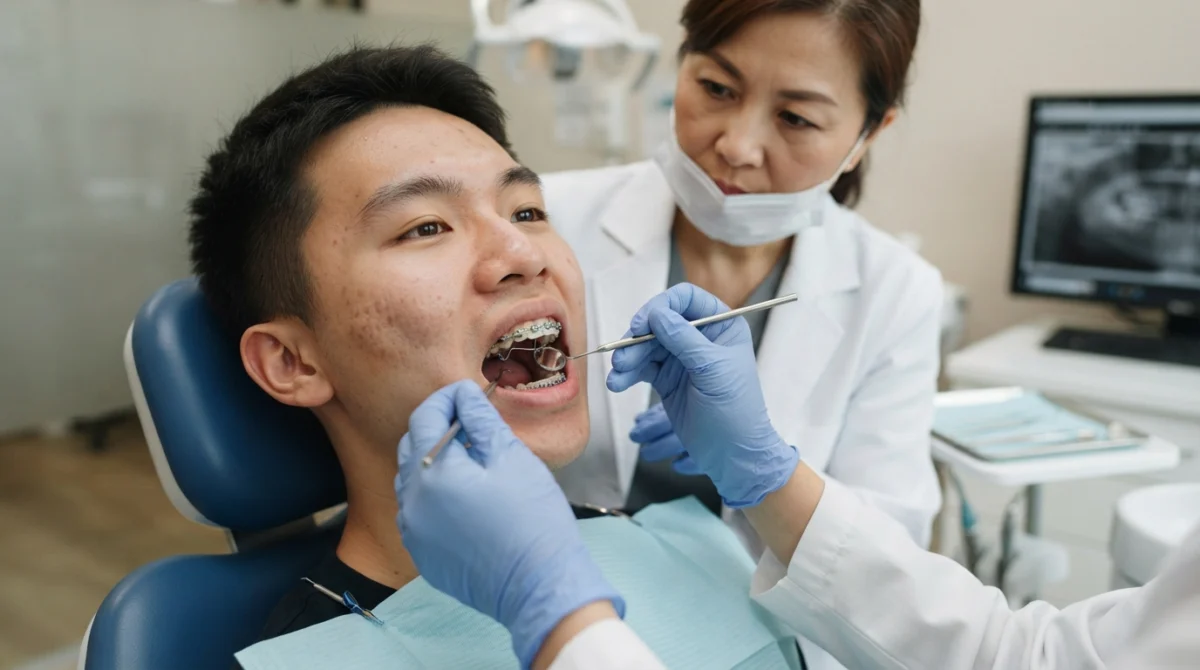
“A routine meal turned into a medical emergency when a young orthodontic patient swallowed a significant portion of his dental appliance, highlighting the often-underestimated risks associated with oral hardware and the importance of prompt medical attention.”
A startling incident involving a 19-year-old orthodontic patient in India, who inadvertently swallowed a broken transpalatal arch, has brought to light the potential dangers of even common dental appliances. The young man was consuming a firm traditional delicacy when the metal wire, designed to stabilize his upper molars, fractured and was swallowed along with his food. This case, meticulously documented by orthodontist Mohammad Sharif and his team at the Armed Forces Medical College in Pune, and published in the April 2024 issue of the Journal of Indian Orthodontic Society, underscores the critical need for patient awareness regarding the fragility of orthodontic hardware and the potential consequences of their failure.
The transpalatal arch, a crucial component in complex orthodontic treatments, is a wire that spans the palate, connecting the upper first molars. Its primary function is to provide anchorage and facilitate precise tooth movement, particularly in cases requiring expansion or stabilization of the upper arch. In this particular patient’s case, the arch was secured within small sheaths attached to bands on his first molars, and it had been specifically contoured to aid in adjusting the position of these teeth. The sudden fracture, likely exacerbated by the force of chewing a firm food item, meant that a significant piece of the appliance detached and was ingested.
Following the incident, the patient experienced immediate throat discomfort, both at rest and during swallowing. Fortunately, this symptom subsided on its own within approximately 20 minutes. However, upon examination by clinicians about 30 minutes post-ingestion, the absence of the transpalatal arch was confirmed. To assess the situation and rule out more severe complications, chest and abdominal X-rays were ordered. The chest X-ray was crucial in excluding the far more perilous scenario of the metal wire having entered the patient’s airway, a potentially life-threatening event. The subsequent abdominal X-ray provided definitive evidence, revealing two distinct segments of the broken wire lodged within his stomach.
The patient was promptly referred to the gastroenterology department for intervention. Before proceeding with retrieval, the stomach contents were first cleared via a tube. The larger fragment of the broken transpalatal arch was then successfully located and extracted using an endoscope, a minimally invasive procedure that involves inserting a flexible tube with a camera and instruments into the digestive tract. The smaller segment, deemed less likely to cause immediate harm, was left to pass through the digestive system naturally. This approach was guided by the understanding that a significant majority of swallowed foreign bodies, particularly smooth metallic objects, pass without complication. Follow-up X-rays were employed to meticulously track the smaller piece as it traversed the colon, ultimately being eliminated from the body.
This case aligns with broader clinical experience regarding swallowed foreign bodies. Medical literature suggests that between 80% and 90% of ingested foreign objects pass through the gastrointestinal tract without requiring surgical intervention. However, the authors emphasize that sharp objects located in the stomach or upper small intestine warrant endoscopic retrieval when it can be performed safely, due to their potential to cause perforation or other internal injuries.
Orthodontic appliances, while invaluable for correcting dental misalignments, represent a recognized category of ingested foreign bodies. A 2019 report published in the Turkish Journal of Orthodontics identified them as the second most common type of dental foreign body ingested, contributing to a significant percentage of all swallowed or inhaled objects. The Pune case authors further noted a striking disparity: objects entering the mouth are far more likely to be swallowed (approximately 85%) than inhaled (around 15%).
Fractures of palatal wires, while not commonplace, are a documented phenomenon within orthodontics. A 2003 report in the Journal of Orthodontics by Hussam Abdel-Kader, a professor of orthodontics in Egypt, detailed a similar incident where a patient swallowed a broken transpalatal arch wire. Abdel-Kader highlighted the potential severity of such events, stating that swallowing a major component of an orthodontic appliance could indeed endanger a patient’s life. His research also indicated that a substantial majority of orthodontic ingestion or inhalation cases (85%) occur outside the orthodontist’s office, with fixed appliances being present in a majority of these instances (71%). This observation led to the suspicion that such cases might be underreported, prompting a recommendation for orthodontic offices to provide patients with emergency contact numbers for immediate guidance.
Further bolstering this understanding, a 2022 literature review in the Journal of Orthodontic Science cataloged 19 case reports of swallowed orthodontic components, ranging from wires and molar bands to expansion keys, quad-helix appliances, and transpalatal arches. A separate systematic review within the Journal of Indian Orthodontic Society also compiled data from 29 published case reports and series, underscoring the recurring nature of these incidents.
The metallic composition of orthodontic appliances, such as the transpalatal arch in this case, significantly aids in diagnosis. Metal exhibits high radiopacity, meaning it shows up clearly on X-rays. This clarity was instrumental in confirming that both segments of the wire were indeed within the stomach and had not entered the respiratory system, thereby averting a more immediate and critical medical crisis.
In contrast, the detection of clear plastic orthodontic components can be considerably more challenging. A 2024 case report in BMC Oral Health described a 31-year-old woman in Shanghai who swallowed a 2-centimeter piece of a cracked clear aligner while drinking water. The fragment lodged in her upper esophagus and was difficult to visualize on initial CT scans. It was only after radiologists adjusted imaging parameters that the piece became apparent, and it was subsequently removed endoscopically. This incident serves as a stark reminder for patients to discontinue using fractured or ill-fitting clear aligners and to seek professional consultation from their orthodontist immediately.
While this case represents a single instance, it powerfully illustrates how orthodontic appliances can fail during everyday activities, even when consuming seemingly manageable foods. Orthodontists routinely advise patients to exercise caution and avoid hard, sticky, or extremely firm foods during treatment to minimize the risk of appliance damage. To mitigate such occurrences, the Turkish authors of the aforementioned study recommended specific preventive measures for clinicians. These include securing transpalatal arches, quad-helix appliances, molar bands, and expansion keys with dental floss during adjustment appointments. Furthermore, they suggested the use of radiopaque acrylic, which would render lost or broken pieces more visible on X-rays, thereby facilitating their detection and retrieval.
The overarching message from this incident and the supporting literature is clear: any orthodontic patient who realizes a part of their appliance is missing, regardless of the presence or absence of symptoms, should contact their orthodontist or seek prompt medical attention. A timely X-ray can accurately pinpoint the location of the displaced appliance, guiding appropriate management. In instances where symptoms such as coughing, wheezing, difficulty breathing (indicating a potential airway obstruction), chest pain, difficulty swallowing, vomiting, or abdominal pain arise, immediate emergency medical care is paramount. These symptoms signal a potentially serious complication that requires urgent evaluation and intervention. The proactive management of such incidents, driven by both patient vigilance and clinical diligence, is essential for ensuring patient safety and successful orthodontic treatment outcomes.
