
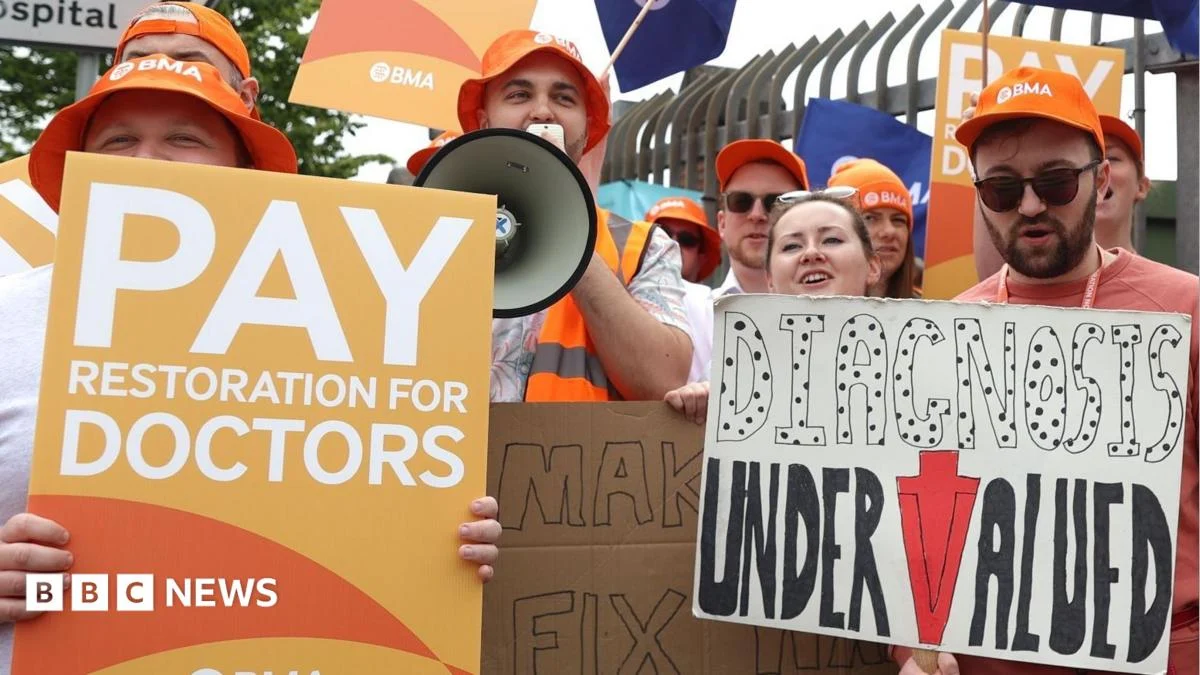
"Northern Ireland’s healthcare system faces escalating pressure as resident doctors launch their second strike this year over pay, highlighting a deep-seated dispute rooted in real-terms salary erosion and a critical struggle to retain vital medical talent."
This ongoing industrial action by resident doctors underscores a broader crisis within Northern Ireland’s health service, where medical professionals argue their salaries have failed to keep pace with inflation and demand. The strike not only disrupts crucial healthcare services but also exposes the challenging political landscape, with the Health Minister citing the absence of a Stormont budget as a significant barrier to resolving the dispute. At its core, the conflict represents a battle for "pay restoration" for doctors and a critical test for the future sustainability of the region’s public health provision.
Resident doctors across Northern Ireland returned to picket lines on Friday, initiating a full 24-hour strike that commenced at 07:00 GMT. This marks their second industrial action this year, signifying an escalating dispute over pay with health authorities. The British Medical Association (BMA), representing the striking doctors, confirmed that its members overwhelmingly voted in favour of industrial action after rejecting a recommended 3.5% pay rise proposed by an independent pay body. This latest walkout signals a deepening chasm between medical professionals and the government, with profound implications for patient care and the future of healthcare in the region.
The BMA’s primary demand is for "pay restoration," a concept that goes beyond simply matching current inflation rates. It seeks to reverse years of significant real-terms salary erosion experienced by doctors. The union argues that during a prolonged period following the 2008 financial crisis, which saw national austerity measures implemented, doctors received below-inflation pay rises, including numerous 0% and 1% uplifts. Dr. Alan Stout, chair of the BMA’s Northern Ireland Council, highlighted the stark disparity: "If you actually total up inflation since 2008 it comes to somewhere between 65% and 73% but the real-term pay has only increased by 40-45%, so we’re miles behind." This substantial gap, according to the BMA, has created an unsustainable situation where doctors’ purchasing power has dramatically diminished.
Beyond the financial imperative, the striking doctors articulate a profound sense of burnout and emotional distress, directly attributed to escalating work pressures and a remuneration package that fails to reflect the demands placed upon them. Dr. Steven Montgomery, chair of the BMA’s Northern Ireland Resident Doctors Committee, articulated this sentiment, stating, "Our pay is eroding and we need to address that in order to retain young doctors in Northern Ireland." He emphasized that the cumulative effect of long hours, intense responsibility, and inadequate pay is driving talented medical professionals away from the region’s health service. The retention crisis is not merely an inconvenience but a fundamental threat to the capacity and quality of future patient care.
Resident doctors, formally known as junior doctors in other parts of the UK, are fully qualified medical practitioners. Their role is critical within the healthcare system, as they undertake postgraduate clinical training in hospitals or general practice settings under the supervision of more senior colleagues. They form the backbone of hospital services, often being the first point of contact for patients, managing wards, assisting in surgery, and contributing significantly to emergency care. Their extensive training, which typically lasts many years after medical school, culminates in their ability to become consultants or general practitioners. The disruption caused by their absence therefore impacts a vast array of clinical services, from routine appointments to complex medical procedures.
On the government side, Health Minister Robbie Butler expressed his commitment to delivering the recommended 3.5% pay award this year, stating he would "do everything in my power" to implement it. However, he maintained that his hands were tied by the absence of a functioning Stormont budget. Northern Ireland has faced prolonged periods without a fully operational devolved government and an agreed budget, leading to significant financial constraints across all public services. This political deadlock directly impacts the Department of Health’s ability to allocate funds for pay increases, irrespective of the Minister’s personal commitment. Butler further pointed out that the 3.5% recommended rise was already higher than that offered to other healthcare professionals working within Northern Ireland’s health system, implicitly suggesting a need for parity across the sector.
The Minister also cautioned against exceeding the recommended offer, warning of "significant repercussions for nurses, teachers, police officers and indeed the entire public sector workforce." This highlights a broader governmental concern about maintaining a coherent public sector pay policy and avoiding a ‘domino effect’ where a higher award for one group could trigger similar demands from others, potentially destabilizing public finances. Butler also cited average cumulative pay uplifts over the last three years, noting 30% for resident doctors, 25% for speciality, associate specialist, and specialist doctors, and 24% for consultants. While these figures indicate some increases, the BMA’s argument focuses on the real-terms erosion over a much longer period, rather than recent nominal uplifts.
The immediate impact of the strike on healthcare services is significant, though emergency provisions remain in place. Senior doctors are continuing to work, ensuring that emergency care, urgent surgery, and most GP services remain operational. Hospital emergency departments are open, and patients experiencing severe illness or perceiving themselves to be unwell are still advised to attend or contact their GP. However, the absence of resident doctors has led to the cancellation or postponement of a substantial volume of planned hospital outpatient appointments and elective care, including scheduled surgeries and diagnostic procedures like scopes. Hospital trusts, having been notified of the industrial action well in advance, have taken steps to inform affected patients. The advice to patients with appointments remains to attend unless they have been directly advised by their trust not to.
Dr. Alan Stout critically challenged the narrative that local politicians are powerless to resolve the pay dispute. Speaking on the BBC’s Good Morning Ulster programme, he conveyed the deep frustration, weariness, and anger among doctors regarding their pay situation. Stout characterized the political response as a "pass the parcel of blame," where "The health minister can’t deliver it so he blames the Executive. The Executive can’t deliver it so they blame the Treasury." This perceived lack of accountability and the continuous deflection of responsibility further exacerbate the doctors’ disillusionment and prolong the impasse.
Stout robustly argued that the current crisis engulfing the health service is fundamentally driven by workforce issues and a critical inability to attract and retain medical staff. In a globalized world, medical professionals have increasing opportunities to work internationally in systems that offer better pay, working conditions, and career progression. "It’s a worldwide market at the moment and we have brilliant young doctors in Northern Ireland that are simply looking elsewhere," he stated. The departure of these highly skilled individuals represents an existential threat to Northern Ireland’s healthcare infrastructure. Without sufficient investment in its medical workforce, Stout warned, "If we don’t keep them, our future looks really, really bleak." This highlights the broader strategic challenge of ensuring a sustainable and capable healthcare system for the population.
The historical context of this pay dispute is crucial to understanding its current intensity. As Dr. Stout articulated, the roots of the BMA’s grievances extend back to the aftermath of the 2008 financial crisis. During the subsequent years of austerity, doctors, like many other public sector workers, experienced pay freezes and minimal increases that consistently lagged far behind inflation. While governments at the time pleaded fiscal necessity, the cumulative effect of these decisions has been a substantial erosion of real-terms earnings. The BMA calculates that while inflation has risen by 65-73% since 2008, doctors’ real-term pay has only increased by 40-45%. This long-term disparity forms the bedrock of the "pay restoration" demand, making it more than just a request for a current inflationary adjustment but a rectification of historical undervaluation.
The ongoing political instability in Northern Ireland, marked by the frequent collapse or suspension of its devolved institutions and the subsequent absence of a functioning Stormont Executive and budget, creates a particularly challenging environment for resolving such industrial disputes. The Health Minister’s inability to commit to a pay award without adequate funding from an agreed budget places the Department of Health in an unenviable position. This political deadlock not only affects doctors’ pay but has broader ramifications for the funding and delivery of all public services, leading to uncertainty and exacerbating existing pressures. Finding a resolution requires not only a commitment to fair pay but also political will to overcome entrenched institutional challenges and secure stable governance.
In conclusion, the strike by Northern Ireland’s resident doctors is more than a simple pay dispute; it is a critical symptom of deeper systemic issues facing the region’s healthcare. It represents a clash between a medical workforce demanding recognition for its value and a government constrained by both fiscal realities and profound political dysfunction. The BMA’s call for pay restoration, rooted in years of real-terms salary erosion, is intertwined with a desperate plea to retain talented doctors crucial for the health service’s survival. As industrial action continues to disrupt patient care, the long-term consequences of an unresolved dispute threaten to further destabilize an already fragile healthcare system, leaving Northern Ireland at a critical juncture for its medical future.
