
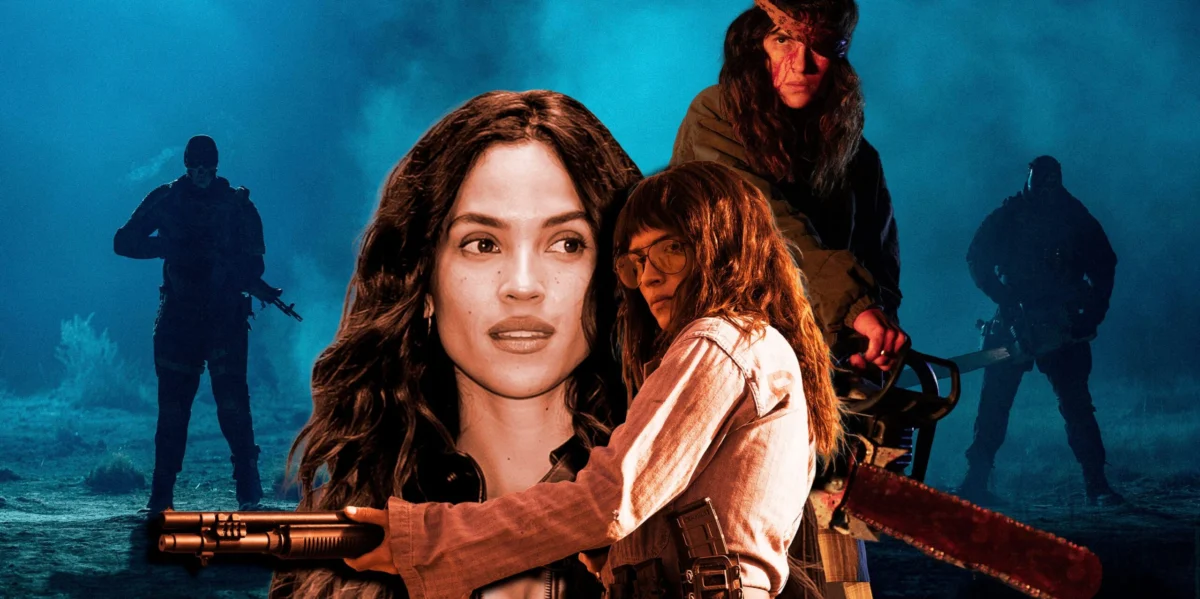
"Playing a powerful version of yourself on screen is contagious; it allows an actor to carry that strength into their real life, transforming performance into personal empowerment."

This sentiment captures the transformative journey of Adria Arjona as she leads Adam Wingard’s latest A24 thriller, Onslaught. By stepping into the role of a combat-hardened Marine, Arjona not only challenges the traditional boundaries of the action-horror genre but also dismantles cultural stereotypes, positioning herself as a central figure in the next generation of cinematic storytellers.
The landscape of modern action cinema is increasingly defined by a shift toward "lived-in grit"—a move away from the polished, CGI-heavy spectacles of the last decade toward something more visceral and tactile. At the forefront of this movement is director Adam Wingard, whose latest collaboration with A24, Onslaught, serves as a testament to the power of practical filmmaking. For lead actress Adria Arjona, the project represents more than just another credit; it is a grueling, transformative experience that required her to inhabit a world where the line between movie magic and harsh reality was frequently blurred.

When Arjona arrived on the set of Onslaught, she did not find the sanitized environment of a Hollywood backlot. Instead, the production was staged in an actual, dilapidated trailer park—a setting so authentic that certain structures were deemed too dangerous for the cast and crew to enter. This commitment to realism is a hallmark of Wingard’s directorial style. Known for cult classics like the home-invasion thriller You’re Next and the high-octane Godzilla x Kong franchise, Wingard has built a career on "down-and-dirty" filmmaking. Onslaught marks a return to his roots, offering a compact, intense narrative that centers on Celeste (Arjona), a former Marine who must defend her community and her young daughter from a trio of genetically enhanced super-soldiers escaped from a corrupt government laboratory.
The film carries a significant narrative weight for genre enthusiasts, as it serves as a covert spinoff to Wingard’s 2014 cult favorite The Guest. That film famously subverted the "returning hero" trope by asking what would happen if a Captain America-style soldier was actually a psychopathic killing machine. Onslaught expands this universe, shifting the perspective to the civilian and veteran survivors who must face the consequences of such clandestine military experimentation. For Arjona, stepping into this established mythos required a level of physical and emotional preparation that exceeded her previous work in high-profile projects like Andor and Hit Man.

The physicality of the role was paramount. To portray a Marine convincingly, Arjona underwent a rigorous training regimen that included heavy weightlifting and specialized weapons handling. The role demanded proficiency with a diverse arsenal, ranging from sniper rifles to chainsaws. Arjona has been vocal about the challenges of this preparation, noting that the sheer weight of the machinery, combined with the freezing temperatures of the shoot, required a level of functional strength that went beyond mere aesthetics. Her approach to weapons was rooted in a desire for authenticity and safety; working closely with a stunt department comprised of ex-Marines and a dedicated armorer, she focused on recreating the organic movements and the "extra shock" of recoil, even when using non-lethal props. This dedication ensures that Celeste is viewed not as a stylized action figure, but as a capable, tactical survivor.
One of the most significant technical challenges on the set involved the film’s use of practical gore. Wingard, a devotee of 1980s action and horror aesthetics, insisted on a specific visual palette for the film’s violence. Arjona recalls the director’s obsession with achieving a blood color identical to that used by Quentin Tarantino in Kill Bill. However, the sub-zero filming conditions created a logistical nightmare: the standard water-based fake blood would freeze upon contact with Arjona’s skin, leading to genuine physical discomfort and mild frostbite. The solution was a creative pivot—mixing the pigment with oil to prevent freezing while maintaining the vibrant, cinematic hue Wingard demanded. This attention to detail highlights the intersection of art and chemistry in modern practical effects.

Beyond the technical demands, Onslaught represents a pivotal moment in Arjona’s career regarding the subversion of industry stereotypes. As a Latin American actress, Arjona has frequently navigated an industry that often attempts to pigeonhole talent into narrow, culturally specific roles. She credits the science fiction and action genres—realms often characterized by their "out-there" stories—with providing the freedom to play characters defined by their skills and agency rather than their ethnicity. Whether playing a mechanic in the Star Wars universe or a veteran in a trailer park, Arjona uses these genre-focused roles to build a resume that prioritizes utility, strength, and emotional depth.
The aesthetic of Onslaught is deeply rooted in the 1980s, drawing inspiration from the works of John Carpenter and the iconic "final girl" evolution seen in Sigourney Weaver’s portrayal of Ellen Ripley in Alien. This influence extends to the film’s sonic landscape. Wingard utilized a synthy, rhythmic soundtrack to set the pace of production, often providing the music to Arjona the night before a scene to help her internalize the rhythm of a sequence. This technique—using music as a directorial tool—is something Arjona has found success with previously, notably during the filming of Zoë Kravitz’s Blink Twice, where a Beyoncé track was used to establish the tempo of a pivotal scene. In Onslaught, the music serves as a heartbeat, driving the tension of the film’s compact 30-day shooting schedule.

Arjona’s trajectory following Onslaught suggests she is becoming a mainstay in major studio franchises. She is set to star alongside Michael B. Jordan in the upcoming remake of The Thomas Crown Affair, a project Jordan is also directing. The experience of moving from Wingard’s fast-paced, indie-style set to a massive studio production provided Arjona with a unique perspective on the varying rhythms of Hollywood filmmaking. While Onslaught was defined by a "bam-bam-bam" efficiency, Thomas Crown offered a more deliberate pace, though Arjona notes that she carried the momentum and discipline of the Wingard set with her.
Furthermore, her relationship with filmmaker James Gunn continues to evolve. Having first worked together on The Belko Experiment, the two have reunited for the upcoming Superman sequel, Man of Tomorrow. Arjona describes her collaboration with Gunn as one built on "full trust," a rarity in an industry where relationships are often transactional and fleeting. This trust allows her to approach complex, high-stakes genre roles with a sense of security, knowing that the directorial vision is aligned with her performance.

As Onslaught arrives in theaters, it stands as a reminder of the enduring appeal of gritty, character-driven action. For Adria Arjona, the film is a celebration of the "badass" archetype—not as a caricature, but as a powerful extension of self. By embracing the fake blood, the heavy machinery, and the freezing trailer parks, she has carved out a space for herself as a formidable lead who is as comfortable with a chainsaw as she is with a nuanced emotional arc. The open-ended nature of the film’s conclusion suggests that the world Wingard has built is far from finished, and if Arjona has her way, she will remain at the center of the carnage for years to come.
