
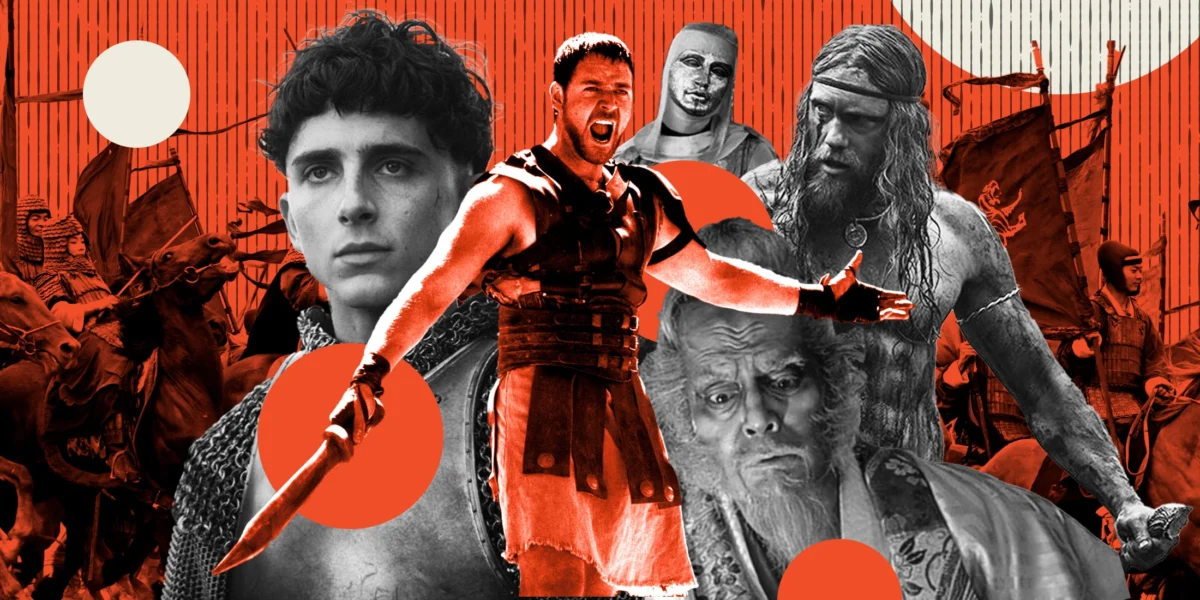
"The resurgence of the high-budget historical epic signals a return to grand-scale storytelling that prioritizes mythic resonance and human sacrifice over standard franchise spectacle."

Christopher Nolan’s $250 million adaptation of The Odyssey represents a pivotal moment for modern cinema, marking the return of the "prestige epic"—a genre characterized by its immense scale, structural ambition, and serious-minded exploration of historical or mythological themes. As audiences rediscover the power of Homer’s ancient narrative through Nolan’s signature lens of time, sacrifice, and the arduous journey home, there is a renewed appetite for films that utilize the full breadth of the cinematic canvas to tell stories of warriors, kings, and the elemental forces of destiny.
The Evolution of the Modern Epic
In the current Hollywood landscape, the "four-quadrant" blockbuster often prioritizes non-offensive, franchise-ready content over the grit and gravity of the classical epic. However, the success of Nolan’s recent work, specifically following his Academy Award-winning Oppenheimer, suggests that audiences are hungry for "difficult" journeys. The Odyssey is the first true blockbuster adaptation of the poem in the 21st century, but it stands on the shoulders of several modern classics that have kept the flame of the historical action genre alive since the studio boom of the 1960s. To fully appreciate the lineage of the mythic hero, one must look at the films that balanced visceral combat with profound philosophical inquiry.

1. Excalibur (1981)
Directed by John Boorman, Excalibur remains the definitive cinematic treatment of the Arthurian legend. Following the disastrous reception of his Exorcist sequel, Boorman poured his creative energy into a surreal, hyper-stylized vision of Britain’s origin myth. The film tracks Arthur (Nicol Williamson) from the moment he pulls the sword from the stone to his final departure for Avalon.
What sets Excalibur apart is its refusal to sanitize the myth. It is a film of "stenches of death" and "wicked sorcery," featuring a young Helen Mirren as the calculating Morgana. The production design is a masterclass in the "vitality versus decay" aesthetic, using shimmering, oversized armor and lush Irish landscapes to create a world that feels both ancient and hallucinatory. For fans of Nolan’s structural complexity, Excalibur offers a narrative that realizes its own mythical significance in real-time, treating the Grail Quest not just as a mission, but as a spiritual necessity for a dying land.

2. Ran (1985)
Akira Kurosawa’s late-career masterpiece is perhaps the most visually stunning depiction of war ever committed to celluloid. Inspired by William Shakespeare’s King Lear and the legends of the daimyo Mōri Motonari, Ran (meaning "chaos" or "turmoil") depicts the catastrophic downfall of warlord Hidetora Ichimonji after he abdicates his power to his three sons.
Nolan himself has cited Ran as a primary influence on The Odyssey, specifically noting Kurosawa’s masterful use of landscape and elemental forces. The film is famous for its "silent" battle sequences—where the sounds of war are replaced by a haunting orchestral score—and its use of vibrant, primary colors to distinguish warring factions against the gray smoke of a burning castle. It is a bleak, authoritative look at how human ambition and madness can erase a legacy, providing a somber counterpoint to the heroism found in Homeric tales.

3. Gladiator (2000)
If any film can be credited with reviving the "sword-and-sandal" genre for the 21st century, it is Ridley Scott’s Gladiator. The film follows Maximus Decimus Meridius (Russell Crowe), a betrayed Roman general who rises through the ranks of the gladiatorial arenas to avenge his family and the true Emperor, Marcus Aurelius.
Gladiator succeeded because it grounded its massive digital recreations of Ancient Rome in a deeply tactile, visceral reality. Maximus is a protagonist defined by "strength and honor," a stoic hero who sells the emotional stakes of the script through sheer conviction. While the film takes significant liberties with Roman history, it captures the spirit of the epic: the idea that one man’s virtue can be a lever long enough to move an empire.

4. Troy (2004)
Until Nolan’s The Odyssey, Wolfgang Petersen’s Troy was the only major studio attempt to adapt Homeric poetry this century. Interestingly, Nolan was originally considered for the director’s chair before Petersen took over. Troy is a fascinating "secular" adaptation; it removes the gods entirely, choosing to frame the Trojan War as a conflict driven by human ego, geopolitical maneuvering, and the pursuit of eternal fame.
The film boasts a staggering ensemble, including Brad Pitt as Achilles, Eric Bana as Hector, and Sean Bean as Odysseus—the very character Nolan has now brought back to center stage. The duel between Achilles and Hector remains a high-water mark for choreographed cinematic combat, emphasizing the tragedy of two "good" men forced into a lethal confrontation by the whims of kings.

5. Kingdom of Heaven (2005)
While the theatrical cut of Ridley Scott’s Crusades epic was met with a lukewarm response, the three-hour Director’s Cut is widely regarded as one of the greatest historical films ever made. It follows Balian (Orlando Bloom), a blacksmith who travels to Jerusalem during the fragile peace between the Christian King Baldwin IV (Edward Norton) and the Ayyubid Sultan Saladin (Ghassan Massoud).
Kingdom of Heaven is a thorny, skeptical look at religious war and colonial conquest. It mirrors the grand scope of David Lean’s Lawrence of Arabia while addressing modern anxieties regarding diplomatic tolerance and the folly of extremism. It is a robust, intellectually demanding epic that asks what it truly means to be a "knight" in a world devoid of moral clarity.

6. Beowulf (2007)
Robert Zemeckis’s motion-capture adaptation of the Old English poem is an experimental anomaly in the genre. Using fluid, if occasionally "uncanny," CG animation, Zemeckis created a world where a giant-slaying hero (Ray Winstone) could battle Grendel and dragons with a scale that live-action budgets of the time couldn’t afford.
Written by Neil Gaiman and Roger Avary, the film is a serious revision of the source material, exploring the "hero’s lie" and the cyclical nature of violence. It portrays the gods and monsters as physical manifestations of human failings, making it a compelling, if bizarre, companion to the more traditional mythological narratives.

7. Red Cliff (2008-2009)
John Woo’s return to Chinese-language cinema resulted in a two-part, four-and-a-half-hour epic based on the 14th-century novel Romance of the Three Kingdoms. Focusing on the Battle of Red Cliff in 208 AD, the film is a maximalist celebration of military strategy and "dudes rock" camaraderie.
The central relationship between Viceroy Zhou Yu (Tony Leung) and strategist Zhuge Liang (Takeshi Kaneshiro) provides the emotional heart, but the film’s true draw is its virtuosic action. Woo applies his "gun-fu" sensibilities to ancient naval warfare, resulting in explosive, kinetic sequences that demonstrate how strategic brilliance can overcome an imperial army of overwhelming size.

8. Immortals (2011)
Tarsem Singh brought an intensely stylized, "Renaissance-painting-come-to-life" aesthetic to the story of Theseus (Henry Cavill). Immortals is a visual feast that combines heavy digital effects with bold costume design to portray the sheer power of the Greek gods.
Unlike many adaptations that keep the divine at a distance, Immortals features chiseled, golden deities who intervene in mortal affairs with devastating violence. It is a film that treats mythology as a series of grand, iconic tableaus, emphasizing the "superheroic" nature of ancient legends long before the current comic book movie saturation.

9. The King (2019)
David Michôd’s The King serves as a gritty, mud-caked reimagining of Shakespeare’s Henriad. Timothée Chalamet plays Hal, the wayward prince who must transform into King Henry V to lead a thunderingly disorienting invasion of France.
The film eschews Shakespearean dialogue for a modern, morose tone, focusing on the court intrigue and the physical toll of leadership. The Battle of Agincourt is depicted not as a glorious victory, but as a claustrophobic, terrifying slog through the mud. It provides a grounded look at the "burden of the crown," a theme that resonates deeply with the conflicted protagonists often found in Nolan’s filmography.

10. The Northman (2022)
Robert Eggers’s Viking saga is perhaps the most "elemental" film on this list. Adapting the Scandinavian legend of Amleth—the precursor to Hamlet—Eggers creates a world that is bleakly spiritual and bone-crunchingly violent. Alexander Skarsgård’s Amleth is a man driven entirely by a singular fate: "Avenge father, save mother, kill Fjölnir."
The Northman is a searing exploration of destiny. It treats the supernatural as an objective reality, where Valkyries and ancient blades guide the hero toward an inevitable confrontation in the heart of an Icelandic volcano. It is the perfect modern bookend to the epic genre, proving that there is still room for stories that are earthy, grisly, and profoundly mythic.

Conclusion
As Nolan’s The Odyssey redefines the boundaries of the prestige blockbuster, these ten films offer a roadmap of the genre’s evolution. They remind us that the "Epic" is more than just a large budget; it is a commitment to exploring the grandest questions of human existence against the backdrop of history and myth. Whether through the mud of France or the high seas of Ithaca, the journey home remains the most powerful story cinema can tell.
