
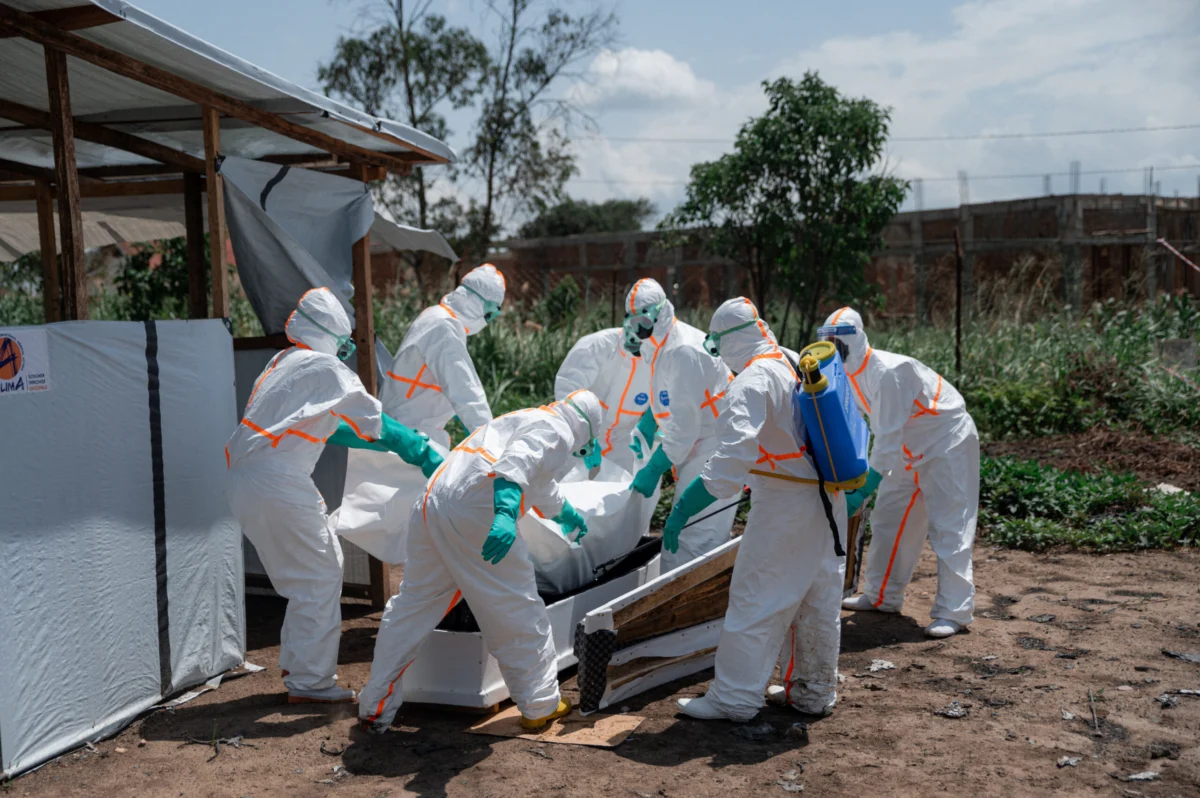
"This is the fastest fatal surge of Ebola we’ve ever seen, driven by a lack of vaccines and treatments, and compounded by a significant funding shortfall. While direct risk to Americans remains low, the global implications demand urgent international attention."
The Ebola epidemic currently unfolding in the Democratic Republic of the Congo (DRC) has surpassed a grim milestone, claiming over 1,000 lives and marking the most rapid and fatal surge of the virus in recorded history. As of July 23, 2026, health authorities in the DRC have reported a staggering 1,033 deaths and 2,536 confirmed cases. While 506 patients have recovered and 738 remain in isolation, the relentless progression of the outbreak signals a profound public health crisis with far-reaching implications. The agent behind this devastating epidemic is the Bundibugyo strain of the Ebola virus, a less common variant than the Zaire strain responsible for the catastrophic West Africa outbreak of 2014-2016. Critically, the absence of an approved vaccine or specific treatment for the Bundibugyo strain leaves healthcare professionals reliant on fundamental containment strategies: case isolation, rigorous contact tracing, and supportive care. This void in medical countermeasures is precisely what international health experts are identifying as the primary driver of this unprecedented crisis, demanding a swift and robust global response.
The gravity of the situation extends beyond the immediate borders of the DRC, underscoring the interconnectedness of global health security. While an Ebola outbreak in central Africa might seem geographically distant for many in the United States, this particular epidemic has already demonstrated its capacity to cross national boundaries. A stark reminder of this reality came with the diagnosis of an American citizen, an employee of a humanitarian organization operating in the DRC, who tested positive for the Bundibugyo virus. On July 10, 2026, the U.S. Centers for Disease Control and Prevention (CDC) confirmed the infection, and the individual was medically evacuated to Germany on July 13 for specialized care, highlighting the complex logistical and medical challenges associated with managing such outbreaks.
Furthermore, the contagion has not been contained within the DRC. Uganda has reported 20 confirmed cases and two deaths attributed to the outbreak, and a separate imported case has been confirmed in France, underscoring the virus’s potential for international spread. In response to the escalating threat, the World Health Organization (WHO) declared this a Public Health Emergency of International Concern (PHEIC) in May 2026, the organization’s highest alert designation. For U.S. residents, this designation signifies an increased need for vigilance at airports, among global health travelers, humanitarian workers, and healthcare providers who may encounter patients returning from affected regions. While health authorities maintain that the likelihood of widespread transmission within the U.S. remains very low, the confluence of an unapproved vaccine, a rapidly expanding case count, and confirmed cases in Europe and Uganda presents a scenario that warrants sustained and heightened attention.
The initial declaration of this outbreak on May 15, 2026, pinpointed Ituri Province in eastern DRC as the epicenter. This region is already characterized by extreme instability, exacerbated by ongoing militia conflicts and significant population displacement, creating an environment ripe for the rapid spread of infectious diseases. WHO Director-General Tedros Adhanom Ghebreyesus has posited that the virus may have been circulating undetected for months, potentially as early as January 2026. The speed at which the outbreak surpassed 1,000 confirmed cases—within 40 days of response activation—stands in stark contrast to the approximately 235 days it took for the 2018 North Kivu outbreak to reach the same threshold, illustrating the unprecedented velocity of the current epidemic.
Epidemiological data from the CDC indicates that the Bundibugyo virus carries a case fatality rate estimated to be between 25 and 50 percent. This strain has a limited history of documented outbreaks, with only two previous instances: one in Uganda’s Bundibugyo District from 2007 to 2008, and another in Isiro, DRC, in 2012. Neither of these earlier outbreaks approached the scale and severity of the current epidemic, emphasizing the unique and alarming nature of the present situation. As of mid-July, more than 2,124 confirmed cases had been reported in the DRC alone, with additional cases surfacing in Uganda, France, and Germany. A joint response plan, spearheaded by the WHO and the Africa CDC, has been formulated with a budget of $518 million. However, this ambitious plan faces a formidable funding shortfall exceeding $400 million, posing a significant impediment to effective containment and mitigation efforts.
The epicentre of the outbreak in eastern DRC, particularly in Ituri Province and parts of North Kivu, presents a complex web of challenges for public health responders. These regions are under the control of armed groups, experiencing ongoing population displacement, and suffer from severely limited health infrastructure. The situation has been further complicated by recent strikes among health workers in Ituri over unpaid wages, with some abandoning Ebola wards. Such disruptions directly undermine the critical capacity to isolate and treat patients and to effectively trace contacts, thereby impeding containment efforts.
Compounding these operational difficulties is significant community resistance. In some instances, local populations have denied the existence of Ebola, attacked healthcare workers, or evaded quarantine measures, substantially hindering containment strategies. This pattern of distrust towards external health interventions is a recurring theme in previous DRC outbreaks and represents one of the most persistent barriers to mounting an effective response. For travelers and health workers venturing into the DRC or Uganda, the European Centre for Disease Prevention and Control (ECDC) classifies the infection risk for individuals within the EU and EEA as very low. However, the ECDC explicitly notes that humanitarian and healthcare workers operating in affected zones face a substantially elevated risk of exposure.
Experts are voicing grave concerns about the escalating crisis. Jean Kaseya, Director-General of the Africa Centres for Disease Control and Prevention (Africa CDC), articulated the dire situation at a recent health conference in Ghana, stating, "These are people dying. They are dying because we don’t have vaccines, we don’t have medicine, we don’t have funding." Kaseya has also publicly urged U.S. Health Secretary Robert F. Kennedy Jr. to reconsider Ebola-related travel restrictions on Uganda, highlighting that the country had not reported new infections for over a month. Thierno Balde, the WHO incident manager for the Bundibugyo response in the DRC, conveyed the ongoing struggle to control the epidemic, telling reporters, "We are still in a phase of catching up," indicating that the outbreak is outpacing response capabilities despite containment efforts. Analysts at the Council on Foreign Relations concur, noting that while the immediate global risk remains low, there is growing concern that this outbreak could evolve into a broader regional health crisis if the substantial funding gap is not addressed and community trust is not rebuilt.
Understanding the transmission dynamics of Ebola is crucial for effective containment. The Bundibugyo virus spreads through direct contact with the blood or bodily fluids of infected individuals, including those who have died from the disease. It is not airborne, nor does it spread through water or casual contact. Crucially, Ebola is not contagious before the onset of symptoms, making contact tracing an indispensable tool for containment. Unlike the Zaire strain, for which an approved vaccine is available and has been deployed in previous outbreaks, the Bundibugyo strain lacks a licensed countermeasure. While experimental vaccines have undergone testing in non-human primates and early-stage human trials, none have achieved full regulatory approval. Consequently, the current outbreak is being managed using the same fundamental tools available since the virus was first identified in the 1970s. The observed case fatality rate in the current outbreak, approximately 40 percent based on reported confirmed cases and deaths as of July 22, aligns with the known range for the Bundibugyo species. It is possible that the true fatality rate may be slightly lower, as not all patients may have been identified or tracked through to their outcome.
The individuals facing the greatest risk are primarily healthcare workers and humanitarian aid workers deployed in the affected areas of Ituri Province, North Kivu, and surrounding zones in the DRC and Uganda. Those who have had direct physical contact with infected individuals or their bodies, including family members involved in traditional burial practices, are also at an elevated risk of exposure. For international travelers who have not visited affected areas, and U.S. residents who have not traveled to the DRC or Uganda, the risk of exposure is considered very low. The United States possesses Biosafety-Level-4 treatment facilities capable of safely managing Ebola patients, and established protocols for medical evacuation and treatment of returning aid workers, as evidenced by the current case in Germany, provide a robust safety net.
The manifestation of Ebola symptoms typically occurs between two and 21 days after exposure. Initial signs can include a sudden onset of fever, severe headache, muscle and joint pain, profound weakness, fatigue, diarrhea, vomiting, and abdominal pain. In later stages, patients may experience unexplained bleeding or bruising. Any individual exhibiting these symptoms, particularly those with recent travel history to affected regions in the DRC or Uganda, requires immediate medical evaluation and adherence to isolation precautions. It is imperative for individuals with relevant travel history who develop symptoms to contact healthcare providers in advance of seeking emergency care, enabling the facility to implement appropriate infection-control measures.
For U.S. travelers contemplating journeys to the DRC, Uganda, or neighboring countries, consulting the latest CDC Travelers’ Health guidance before departure is strongly advised. Registering with the State Department’s Smart Traveler Enrollment Program (STEP) is also recommended. Humanitarian and health workers deploying to active outbreak zones must adhere to all personal protective equipment (PPE) and decontamination protocols without exception. Upon returning from any affected area, individuals should monitor themselves for symptoms for 21 days and report any fever or illness immediately to a healthcare provider, disclosing their travel history. Healthcare providers in the United States who treat patients returning from DRC or Uganda should maintain a high index of suspicion for Ebola in those presenting with compatible symptoms and contact the CDC Emergency Operations Center for guidance on testing and isolation protocols.
The logistical and financial complexities of managing this outbreak are substantial. Medical evacuation from the DRC to a specialized care center can cost tens of thousands of dollars and requires intricate coordination between employers, government agencies, and specialized hospitals. U.S. government and military personnel traveling to the region under official orders are typically covered by mission health programs. Non-governmental organization (NGO) and humanitarian workers should verify with their employers whether their travel insurance covers medical evacuation from Ebola-affected zones prior to deployment. Within the United States, care for Ebola patients is provided at designated Regional Ebola Treatment Centers across the country, coordinated through the CDC and state health departments.
The global health community is actively engaged in addressing the significant challenges posed by this outbreak. WHO and Africa CDC officials are urgently seeking to close the $400 million funding gap for the joint response plan. Continuous monitoring is underway to ascertain whether the outbreak expands to additional provinces within the DRC or to new countries. The WHO provides weekly situation reports on its disease outbreak news page, updated every Tuesday, offering vital real-time information.
The current Ebola outbreak in the Democratic Republic of the Congo has irrevocably etched itself into the annals of public health as the deadliest Bundibugyo outbreak on record, and its acceleration is unprecedented for this virus. For the majority of readers in the United States, the direct personal risk remains low. However, the critical combination of factors—the absence of an approved vaccine, a substantial $400 million funding deficit, persistent community resistance, and the confirmed presence of the virus in Europe—mandates sustained international attention and a robust, coordinated global response. Humanitarian workers, travelers, and healthcare providers serving populations in affected regions face real and documented risks that underscore the urgency of the situation.
