
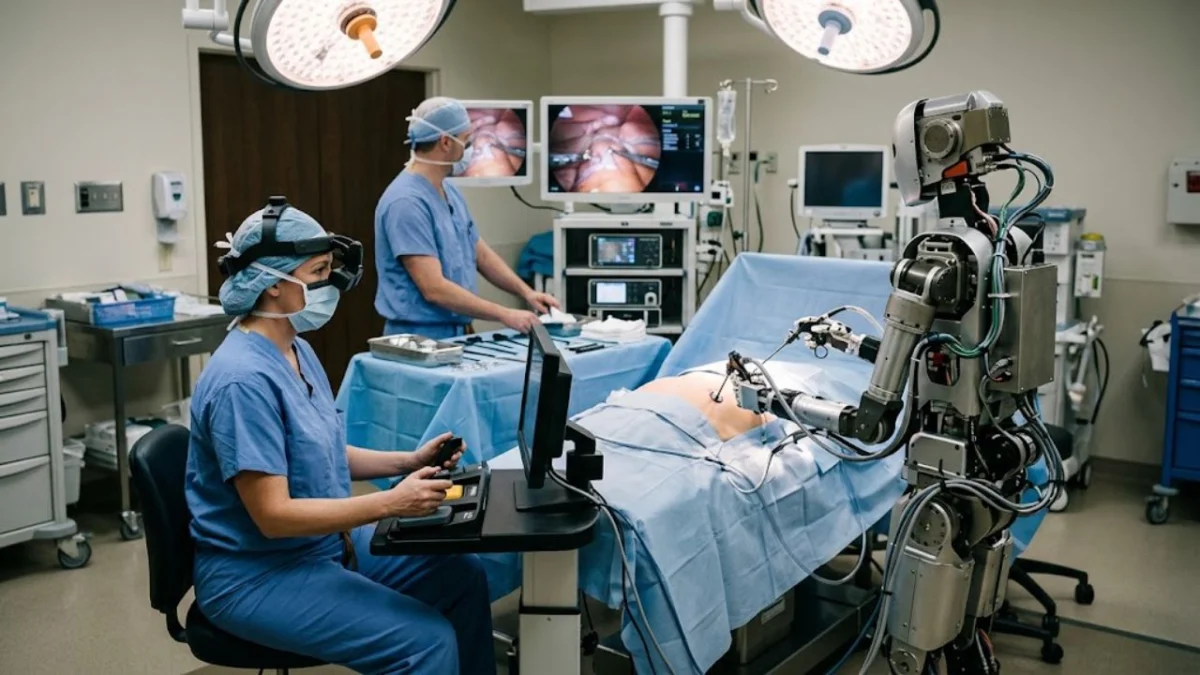
"Humanoid robots, controlled by surgeons from a distance, have successfully performed gallbladder removal on pigs, demonstrating a novel approach to surgical assistance that could eventually extend care to remote or underserved areas."
In a groundbreaking development within the field of surgical robotics, researchers at the University of California San Diego have successfully utilized teleoperated humanoid robots to perform two laparoscopic gallbladder removal procedures on live pigs. This pioneering study, detailed in publications such as Nature and highlighted in Nature Medicine, marks a significant advancement in the exploration of robotic assistance in the operating room. Unlike existing, cumbersome surgical systems, these newly developed robots, nicknamed "Surgie," are mobile, significantly lighter, and capable of wielding standard laparoscopic instruments, offering a more adaptable and potentially cost-effective alternative for surgical environments. The critical distinction of this research lies in the teleoperation aspect; the robots, while performing intricate surgical tasks, were entirely guided by human surgeons in real-time, underscoring that the milestone achieved is not yet one of surgical autonomy but rather of enhanced remote surgical capability.
The significance of this advancement is amplified when compared to the current landscape of surgical robotics. Conventional surgical robot systems are often imposing structures, weighing approximately 1,800 pounds, with specialized arms and proprietary software that necessitate significant modifications to operating room infrastructure. In stark contrast, the Surgie robots, standing at five feet tall and weighing a mere 60 pounds, offer unparalleled mobility and a significantly smaller footprint. This portability, coupled with the ability to adapt and utilize ordinary laparoscopic tools through custom-built adapters, presents a compelling argument for their integration into diverse surgical settings. The research team emphasized how seamlessly Surgie integrated into their existing workspace and workflow, a sentiment echoed by Ryan Broderick, interim director of UC San Diego’s Center for the Future of Surgery. He noted that the lack of the substantial space constraints associated with traditional robotic surgery allowed the humanoid robots to function as a more intuitive, human-like bedside assistant, fitting into familiar surgical layouts.
The study meticulously documented two distinct operational configurations. In the first procedure, a single teleoperated humanoid robot managed the surgical instruments while a human surgeon provided direct bedside assistance. The second operation saw a brief, experimental pairing of two humanoid robots: one controlling the instruments and the other assisting with camera manipulation and tissue retraction. However, it is crucial to reiterate that in both instances, the human assistants played a predominant role in bedside tasks, and the robots themselves did not initiate any autonomous actions. Each procedure followed a standard cholecystectomy protocol, involving essential steps such as tissue retraction, meticulous dissection, confirmation of the critical view of safety to prevent accidental injury to vital structures, and the precise clipping of the cystic duct before separating the gallbladder from the liver bed. At no point did the robots deviate from their programmed or teleoperated instructions, highlighting that the pursuit of autonomous surgical capabilities remains a future objective, not a present achievement.
Michael Yip, a faculty member in electrical and computer engineering at UC San Diego and a senior author on the study, articulated the team’s long-term vision: "One of our goals is to develop the autonomous surgical assistant." He pointed to the persistent challenges of staffing shortages in surgical teams, which can lead to patients being unable to receive timely treatment. This overarching ambition for autonomous surgical assistance is being pursued on parallel tracks. For instance, a separate research initiative at Johns Hopkins University, led by Axel Krieger and featuring Ji Woong Kim as lead author, has demonstrated a system trained on surgical videos that successfully completed the clipping and cutting phases of a gallbladder removal in pig cadavers without direct human control. This Johns Hopkins system, however, was not humanoid in design. The UC San Diego robots, while humanoid, are not yet autonomous, and the confluence of both humanoid form and autonomous function in a living animal has yet to be achieved.
The research paper distinguishes itself through its candid assessment of operational challenges encountered during the procedures, offering invaluable insights into the practical hurdles that must be overcome before such technology can be widely adopted in clinical settings. The robots required repeated recalibration and repositioning, leading to interruptions exceeding three minutes as the team realigned the robotic arms with the surgical ports. Consequently, both operations took considerably longer than would be expected with established surgical platforms. A latency of approximately 156 milliseconds was recorded between the operator’s hand movement and the robot’s response, a delay that exceeds the generally accepted desirable threshold of under 150 milliseconds for optimal surgical precision. While straight tool movements exhibited accuracy to within 1.3 millimeters, curved motions demonstrated a drift of more than that. Furthermore, surgeons reported intermittent issues with overheating, limitations in arm strength, and restricted range of motion.
Despite these challenges, the first operation concluded without significant complications. During the second procedure, minor bile leakage and bleeding from the liver bed occurred, both of which were effectively managed by the surgical team using suction and electrocautery. Crucially, neither case met the study’s predefined criteria for conversion to alternative surgical approaches, such as conventional laparoscopy or open surgery. Shanglei Liu, an assistant professor of surgery who served as a teleoperator during the study, offered a perspective that frames these operational delays not as definitive setbacks, but as developmental stages. He drew a parallel to the early days of robotic laparoscopic surgery, which initially took six hours to complete, a stark contrast to the approximately 30 minutes now required. This historical context suggests that the current inefficiencies of the Surgie robots may be overcome with further refinement and experience.
The fundamental rationale behind introducing a mobile, humanoid robot into the operating room is not necessarily superior cutting ability, but rather its capacity to access and function in environments where bulky, stationary equipment cannot. Liu elaborated on this point, stating, "It’s a fraction of the cost, and it takes a fraction of the space in an operating room. So it’s easy to deploy, anywhere from rural areas to the battlefield, and even to space." Yip further highlighted the potential applications in remote communities with limited surgical staffing and in disaster response scenarios where rapid deployment of medical capabilities is paramount.
It is imperative to maintain a balanced perspective on the implications of this research. This study represents a feasibility assessment conducted on two animals within a controlled surgical simulation center, a facility already equipped with comprehensive laparoscopic infrastructure and manned by an experienced surgeon at the console. Several critical areas require substantial development before these robots can be considered for human use. Sterility remains a significant, unsolved challenge. The team employed glove coverings on the robot arms, a method that does not meet the stringent sterilization standards for human surgery. Moreover, current commercial humanoid robots lack components that are autoclavable. No human has yet undergone surgery with these specific machines, and regulatory approval from bodies such as the U.S. Food and Drug Administration is a prerequisite for any clinical application. Surgical robotics adheres to a formal evaluation pathway known as the IDEAL framework, and this current work sits at the earliest stage of that framework, indicating that extensive further research and testing are necessary.
The research was supported by grants from the National Science Foundation and the National Institutes of Health. Among the authors are two practicing surgeons, and Yip is also a co-founder of a robotics company, underscoring the interdisciplinary nature of this endeavor.
What this study definitively establishes, albeit within its narrow scope, is that general-purpose humanoid hardware, largely composed of off-the-shelf components, can be adapted to manipulate ordinary surgical instruments and successfully execute a real surgical procedure within a living organism when guided by a trained human surgeon. This foundational success opens avenues for future research and development aimed at enhancing robotic surgical capabilities and expanding access to care.
