
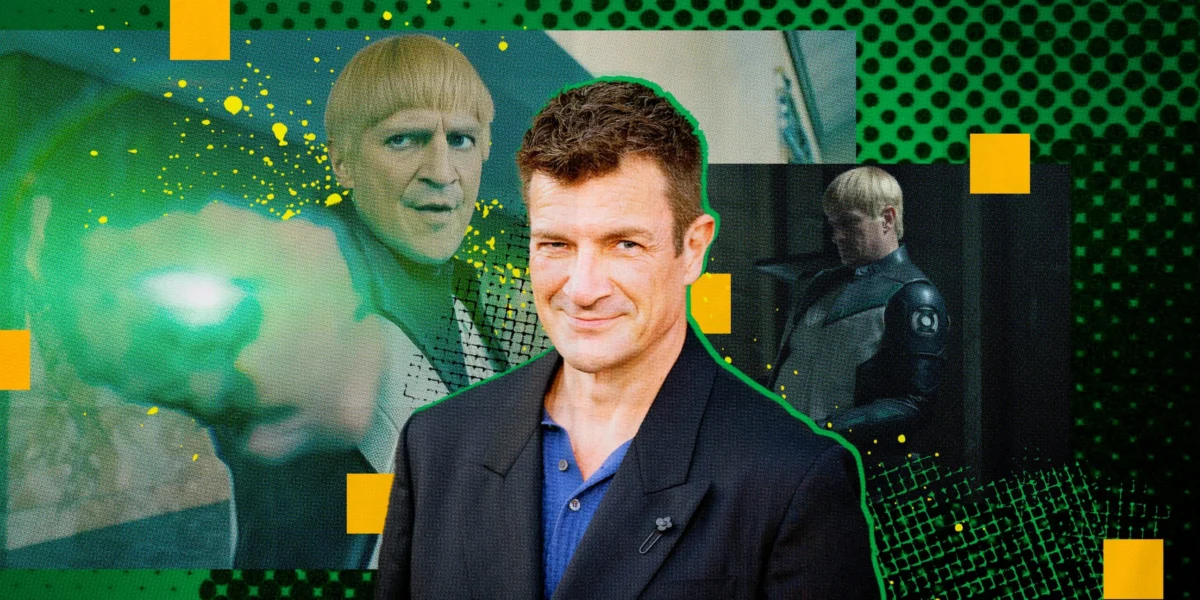
“Guy Gardner is a hero driven not by altruism, but by a pathological need to prove he is the ‘biggest ring in the room,’ transforming deep-seated insecurities into a brand of abrasive, unfiltered justice.”
As James Gunn’s new DC Universe (DCU) begins to take shape, the introduction of the Green Lantern Corps marks a significant shift toward a more complex, multi-layered exploration of cosmic peacekeeping. At the center of this expansion is Nathan Fillion’s portrayal of Guy Gardner, a character traditionally defined by his arrogance and bowl cut, now reimagined as a brand-conscious, unfiltered force of nature. In the HBO series Lanterns, Gardner’s arrival in the aftermath of a catastrophic failure by his predecessors, Hal Jordan and John Stewart, provides a stark look at the intersection of superheroics, personal trauma, and the modern obsession with public image.
The Evolution of an Anti-Hero
The Green Lantern Corps has always been a pillar of the DC mythos, represented by individuals capable of overcoming great fear. However, Guy Gardner has rarely fit the "paragon" mold. First introduced in 1968’s Green Lantern #59 by John Broome and Gil Kane, Gardner was initially a secondary backup for Hal Jordan. It wasn’t until the mid-1980s, under the pen of Steve Englehart and artist Joe Staton, that he was reinvented as the abrasive, egotistical jerk that fans love to hate.
Nathan Fillion, an actor whose career is built on the foundation of the "charming rogue"—from the space-faring Malcolm Reynolds in Firefly to the wisecracking Richard Castle—is uniquely positioned to navigate Gardner’s contradictions. Fillion’s Gardner is not just a hero; he is a man with a "raw wound" and a "pathological need to prove himself." This version of the character debuted with a memorable cameo in the 2025 Superman film, where he notably "upgraded" a rescue mission, subtly slighting the Man of Steel in the process. This interaction established the core of Fillion’s interpretation: Guy Gardner is always the protagonist of his own story, even when standing next to a god.
Grounded Mystery in "Lanterns"
While Gardner’s previous appearances in Superman and Peacemaker leaned into his comedic and competitive nature, the HBO series Lanterns places him in a far more somber context. Styled as a gritty, terrestrial mystery in the vein of True Detective, the show follows veteran Hal Jordan (Kyle Chandler) and recruit John Stewart (Aaron Pierre) as they investigate a dark alien conspiracy in Rushville, Nebraska.
The narrative reaches a breaking point in episode 5, when the manipulation of the Guardians of the Universe and the hidden agendas of Sinestro (Ulrich Thomsen) and an incognito Manhunter (Poorna Jagannathan) lead to the destruction of the town. Following the subsequent expulsion and eventual death of Hal Jordan, the series utilizes a significant time jump in episode 6, titled "Bad Optics." It is here that Guy Gardner steps into the vacuum left by his peers.

Fillion notes that in the world of Lanterns, Gardner functions differently than he does in the broader DCU. In a world of "normal" people and grounded stakes, Gardner is a "god among men." This power dynamic feeds into his narcissism, allowing him to operate without the checks and balances usually provided by his fellow Lanterns.
The "No Filter" Psychology
One of the most striking aspects of Fillion’s approach to the character is his use of a unique psychological anchor: the "Golden Girls" theory. In comic book lore, Gardner’s personality shift is often attributed to a head injury and a subsequent coma. Fillion likens this to Estelle Getty’s character, Sophia Petrillo, whose stroke "short-circuited" her brain’s social filter.
For Gardner, this lack of a filter means that every insecurity, every spark of anger, and every ounce of self-importance is broadcast to the world. Fillion describes Gardner as a man who was "overlooked more than once" before receiving his power ring. That history of being second-best has left him with a permanent chip on his shoulder—a "lemon-coated stick" constantly poking at his ego. Consequently, Gardner doesn’t just want to save the day; he wants to be recognized for it.
This manifests in a modern, meta-commentary on superheroism: branding. Fillion’s Gardner is acutely aware of social media trends and public perception. He isn’t just a peacekeeper; he is a product. While Hal Jordan represents the "prototypical hero" of yesteryear—handsome, stoic, and altruistic—Gardner represents the modern celebrity hero, concerned with "LordTech meetings" and his status within the "Justice Gang."
The Craft of Becoming a Lantern
To inhabit the physicality of a man who can manifest anything he imagines, Fillion employed a meticulous preparation process. He describes standing before a full-length mirror, using wax crayons to draw the Green Lantern logo on his chest and surrounding it with notes on Gardner’s traits. This exercise allowed him to visualize how a man of Gardner’s immense ego would carry himself.
"It’s this sort of self-importance," Fillion explains, "like he’s trying to show us that he doesn’t care what anyone thinks about him, even though he’s constantly thinking about his posture or how he looks in that jacket." This duality—the projection of strength masking deep insecurity—is what makes Gardner a "flawed character," and therefore a rewarding one to play.
Even the props Fillion commissioned for the production reflect this attitude. He created custom Zippo lighters featuring the Green Lantern logo and the inscription "From Guy," which, when opened, revealed a translucent green middle finger. It is a perfect distillation of the character: a mix of genuine power and juvenile defiance.

Contrast and Conflict: Jordan vs. Stewart vs. Gardner
The dynamic between the three primary human Green Lanterns—Hal, John, and Guy—serves as the emotional backbone of the Corps’ presence on Earth. In Lanterns, John Stewart is portrayed as a military strategist, a "precise" man who views Gardner as a "blunt object." Stewart understands Gardner’s psychological triggers, successfully manipulating him into retrieving Hal Jordan’s uniform and ring for a funeral by questioning his courage.
Gardner’s relationship with the Guardians of the Universe is equally telling. While Jordan and Stewart grow increasingly suspicious of their otherworldly bosses, Gardner remains loyal. From his perspective, the Guardians’ decision to choose him as a Lantern is proof of their wisdom. "If the Guardians were smart enough to pick him, then clearly they’ve got their heads on straight," Fillion remarks, highlighting the character’s circular logic and inability to see past his own validation.
The Heroic Question
Despite his arrogance and lack of compassion, Fillion maintains that Guy Gardner is, at his core, a hero. However, he is a hero of last resort. Fillion famously quips that if a Green Lantern is needed, things are bad, but if they send Guy Gardner, the response is usually, "Is there anyone else? Maybe that squirrel?" (a reference to Ch’p, the squirrel-like Lantern).
Gardner’s heroism is not "altruistic" in the traditional sense. He does the right thing because it serves his brand and reinforces his self-worth. Yet, in the high-stakes, "Bad Optics" world of the DCU, his willingness to be a "blunt object" is often exactly what is required. He provides a necessary contrast to the idealism of Superman and the stoicism of John Stewart, reminding audiences that even those with the greatest power are often driven by the most human of flaws.
As Lanterns continues to explore the darker corners of the DC Universe, Nathan Fillion’s Guy Gardner stands as a testament to the franchise’s new direction: one where the heroes are as layered, damaged, and image-conscious as the world they are sworn to protect. Through Fillion’s lens, Gardner is no longer just a "backup" Lantern; he is a complex study in how insecurity, when fueled by cosmic power, can create a hero who is as frustrating as he is indispensable.
