
"Tesamorelin’s FDA-approved status offers a well-characterized molecule for researchers, but this distinction is often misunderstood. The critical factor for laboratory procurement is not the drug’s approval, but a supplier’s consistent, lot-by-lot demonstration of material identity and quality."
The landscape of peptide research is often a complex one, where scientific inquiry hinges on the reliability and authenticity of the materials used. Tesamorelin, a synthetic analog of growth hormone-releasing hormone (GHRH), presents a unique case within this domain. Its history includes an FDA-approved therapeutic application, a fact that can both benefit and mislead researchers seeking the compound for laboratory investigations. While this approved status provides a robust foundation of data regarding tesamorelin’s structure and behavior, it is crucial for procurement professionals and researchers to understand that research-grade material is distinct from the pharmaceutical product. The true measure of a research supplier’s value lies not in the molecule’s therapeutic history, but in their ability to consistently verify, through rigorous lot-specific documentation, that the powder within each vial precisely matches its advertised identity and purity. This article aims to demystify tesamorelin, delineate the critical differences between its approved drug form and research-grade material, outline essential quality checks for procurement, and illustrate how a reputable U.S. supplier substantiates its product’s integrity.
Understanding Tesamorelin: From Natural Hormone to Research Tool
Tesamorelin is a synthetic peptide engineered as an analog of human growth hormone-releasing hormone (GHRH). Its molecular architecture comprises 44 amino acids, mirroring the natural GHRH sequence, with a critical modification: the addition of a trans-3-hexenoyl group at the N-terminus. This structural alteration imbues tesamorelin with enhanced resistance to enzymatic degradation compared to its naturally occurring counterpart. This characteristic was a significant factor in its development as a therapeutic agent and continues to make it a valuable reference compound for studies investigating the GHRH receptor pathway.
The pharmaceutical journey of tesamorelin culminated in its FDA approval in 2010 under the brand name Egrifta. This approval was for a specific therapeutic indication: the treatment of HIV-associated lipodystrophy in adults. The approved drug product is manufactured under stringent pharmaceutical manufacturing controls and is dispensed through regulated pharmacy channels. This established pharmaceutical pedigree distinguishes tesamorelin from many other peptides that are currently in earlier stages of investigation, such as retatrutide, which lacks an approved product and exists solely as an investigational compound. For researchers, tesamorelin’s documented history translates into a practical advantage. Its molecular structure, biochemical properties, and analytical profiles have been extensively characterized, facilitating a more informed evaluation of whether a supplier’s research-grade material aligns with these established parameters.
The Crucial Distinction: Approved Drug vs. Research-Grade Material
The most significant point of potential confusion in the procurement of tesamorelin lies in the distinction between the FDA-approved drug product and research-use-only (RUO) material. The FDA’s approval is highly specific, pertaining to a particular manufacturer, a defined formulation, a precise manufacturing process, and a regulated label. In stark contrast, research-grade tesamorelin, while containing the identical molecule, is produced under entirely different manufacturing standards. It is not subject to pharmaceutical drug manufacturing regulations, does not carry approved labeling, and is explicitly designated for laboratory research, not for human or veterinary consumption. This fundamental difference means that while the chemical identity might be the same, the quality control, purity standards, and documentation frameworks diverge significantly. Researchers must exercise due diligence to ensure they are acquiring material appropriate for their intended in vitro applications, recognizing that the pharmaceutical approval does not automatically guarantee the quality or suitability of any given batch of research-grade tesamorelin.
Essential Specifications for Research-Grade Tesamorelin
For any laboratory considering the purchase of tesamorelin for research purposes, the fundamental question revolves around the supplier’s ability to provide verifiable, lot-specific documentation. The compound’s identity and purity are paramount, and these should be supported by a consistent analytical profile.
A critical identifier for tesamorelin is its Chemical Abstracts Service (CAS) number. This unique numerical identifier serves as a globally recognized reference for chemical substances. For tesamorelin, the CAS number is typically 21898-19-1. Beyond the CAS number, molecular weight serves as another key verification point. Tesamorelin has a molecular weight of approximately 5136 g/mol. Any discrepancy in these fundamental identifiers should serve as an immediate red flag, prompting further scrutiny of the supplier and their documentation.
A Seven-Point Checklist for Sourcing Tesamorelin
Laboratories engaged in in vitro research with tesamorelin commonly rely on a standardized set of checks to ensure the quality and reliability of their procured material. Adhering to this checklist acts as a robust filter against substandard or misrepresented products.
-
Lot-Specific Certificate of Analysis (COA): The cornerstone of reliable procurement is a COA that is tied to the specific lot number of the vial being received. A generic or unchanging "sample COA" provides no assurance about the material in hand. The COA must clearly display the lot number, which should precisely match the label on the purchased vial. This document is the primary evidence of the material’s tested characteristics for that particular production batch.
-
Independent, Third-Party Testing: While in-house testing can provide some level of assurance, results from an independent, accredited laboratory carry significantly more weight. Such external validation demonstrates a commitment to objective quality assessment. Furthermore, the availability of published testing data for past batches indicates that rigorous testing is a routine practice for the supplier, rather than an ad-hoc measure for a single sale.
-
Purity by HPLC and Identity Confirmation: High-Performance Liquid Chromatography (HPLC) is the standard method for determining peptide purity. For research-grade tesamorelin, a purity benchmark of ≥99% is considered reasonable. However, purity alone is insufficient. The COA must also confirm the identity of the compound. This is typically achieved through methods such as comparing the HPLC retention time against a certified reference standard or through mass spectrometry analysis. These techniques verify that the molecule is indeed tesamorelin and not an unrelated compound or a significantly degraded form.
-
Net Content Verification: The label on a vial should accurately reflect the amount of active peptide present. A vial labeled as containing 10 mg of tesamorelin should contain precisely 10 mg of the peptide, not 10 mg of powder that includes counterions, salts, or residual moisture. Accurate net content is crucial for the precise quantification and accurate execution of downstream experimental procedures.
-
Endotoxin, Sterility, and Heavy Metals Testing: Beyond purity and identity, it is essential to assess potential contaminants that can significantly impact experimental outcomes. Endotoxins, bacterial byproducts, can trigger inflammatory responses in cell-based assays, leading to misleading results that are unrelated to the peptide’s intended action. Sterility testing ensures the absence of microbial contamination, and heavy metal analysis confirms that levels are within acceptable limits for research applications. These tests address critical aspects of biological safety and assay integrity that HPLC alone does not cover.
-
Transparent Pricing: A reputable supplier will offer clear, upfront pricing for their products. The cost per vial should be readily available, along with any applicable volume discounts. Pricing that fluctuates based on negotiation or individual inquiry can obscure true value and hinder objective comparison between suppliers.
-
Appropriate Shipping and Storage Recommendations: Lyophilized peptides are generally more stable than their liquid counterparts, but they remain susceptible to degradation from heat, light, and moisture. Suppliers should ship sealed, lyophilized powder, not pre-mixed solutions, and utilize rapid domestic shipping carriers to minimize transit time. Clear guidance on storage conditions—typically cool, dry, and protected from light—is also indicative of a supplier’s understanding of peptide stability.
Potential Red Flags in Procurement
Several warning signs should immediately deter a potential buyer. A supplier’s inability or unwillingness to provide a lot-specific COA is a primary concern. Vague or evasive answers regarding testing methodologies, purity levels, or storage conditions are also problematic. Furthermore, pricing that appears exceptionally low compared to market standards might indicate compromised quality or an attempt to misrepresent the product. A lack of detailed product information, including CAS number and molecular weight, or the presence of overly aggressive or misleading marketing claims should also raise suspicion.
Strategic Considerations for Order Quantity
The most common packaging for research-grade tesamorelin is in 10 mg vials. The decision then becomes the optimal quantity to purchase at one time, balancing cost-effectiveness with the need for batch consistency.
-
1 Vial: Ideal for initial pilot assays, method development, or as a preliminary test of a new supplier. This approach minimizes upfront expenditure and allows for an initial assessment of the COA against the received vial before committing to larger quantities.
-
3 Vials: Suitable for short series of experiments or for conducting replicate work within a limited study. When purchasing multiple vials, it is advisable to request them from the same production lot whenever possible to ensure experimental consistency.
-
5 Vials: Recommended for longer-term research protocols where maintaining batch-to-batch consistency is critical for the validity of the results. Purchasing a larger quantity from a single lot minimizes the risk of introducing variability due to lot changes midway through a study. Storing unopened vials properly—sealed, dry, and protected from light—is crucial for preserving their integrity over time.
Ultimately, if experimental consistency is a paramount concern, acquiring a sufficient quantity of material from a single lot at the outset often proves more cost-effective and scientifically sound than chasing marginal per-vial savings across multiple, potentially different, production batches.
HEEZ Research’s Approach to Documenting Tesamorelin Quality
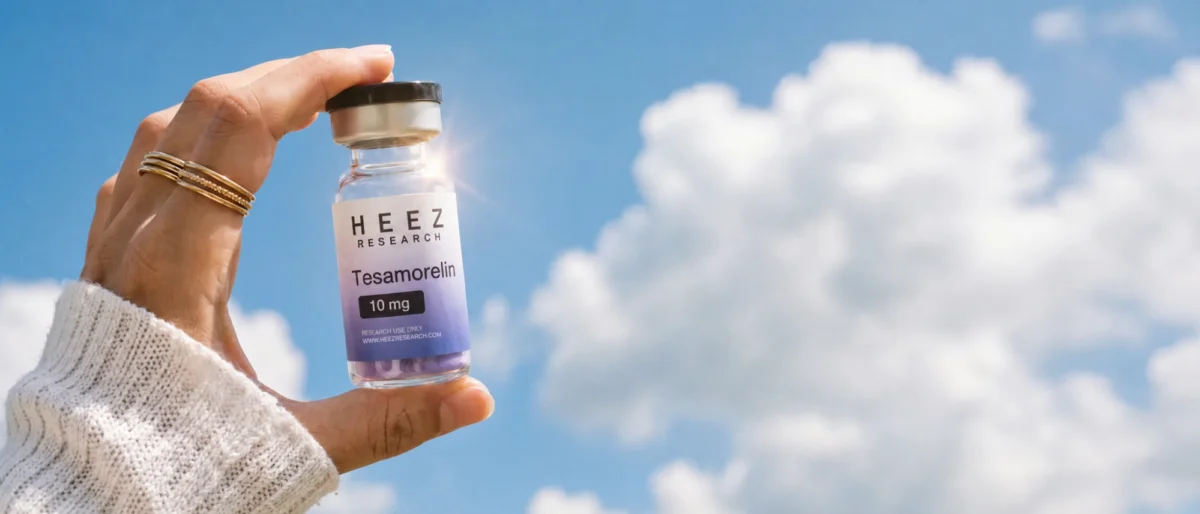
HEEZ Research, a U.S.-based supplier specializing in tesamorelin for in vitro research, demonstrates a commitment to transparency and quality control by adhering to the outlined checklist. Their tesamorelin product is presented as a lyophilized white powder in a sealed glass vial, typically in a 10 mg size, aligning with industry standards for stability and ease of use.
The company emphasizes rigorous testing by independent laboratories, with a stated purity standard exceeding 99% by HPLC. For instance, their currently published lot, HZ-1008-TES10-01, achieved a purity of 99.84%. Identity confirmation is performed through HPLC retention time analysis against a reference standard. Their testing panel also comprehensively covers net content, heavy metals, sterility, and endotoxin levels, providing a holistic view of the material’s quality.
HEEZ Research publishes lot-specific COAs for each batch, including data from previous batches. This practice empowers buyers to directly match the results on the COA with the vial they receive, fostering trust and accountability. Storage guidance provided with the product recommends keeping the vial sealed and protected from light, consistent with best practices for lyophilized peptide preservation.
In terms of pricing, a single 10 mg vial is listed at $115. The supplier also offers volume discounts, structured to incentivize larger, single-lot purchases, thereby supporting the principle of experimental consistency. For example, a two-tier discount structure might be in place for quantities of 3 or 5 vials.
Shipments are typically processed promptly, with orders placed before 12 PM ET on weekdays usually shipping the same day, or the next business day at the latest. Domestic shipments are dispatched via UPS 2nd Day Air or UPS Overnight, originating from the USA. Lyophilized vials are shipped at ambient temperature, with no weekend dispatches.
HEEZ Research enforces buyer requirements to ensure responsible distribution. Purchasers must be 21 years of age or older, and checkout necessitates the use of an institutional email address that corresponds to the stated organization. All sales are final, reinforcing the product’s designation for research purposes only and its non-returnable nature. The product is strictly intended for in vitro research use and is not for human or veterinary application.
Conclusion: Informed Procurement in Peptide Research
Tesamorelin’s established presence in the pharmaceutical realm offers a valuable scientific foundation for researchers. However, this therapeutic history should not be conflated with the quality assurance of research-grade material. The critical determinant of success in acquiring usable research tesamorelin lies in the supplier’s commitment to transparency, robust analytical documentation, and rigorous quality control. By diligently applying a comprehensive checklist—prioritizing lot-specific Certificates of Analysis, independent third-party testing, verified purity and identity, accurate net content, and thorough contamination analysis—laboratories can confidently source tesamorelin that meets their experimental needs. This informed approach transforms the procurement process from a potential gamble into a strategic investment in the reliability and validity of scientific research.
Frequently Asked Questions
-
Is tesamorelin FDA-approved?
A specific tesamorelin drug product, Egrifta, received FDA approval in 2010 for a particular medical indication. However, research-use-only tesamorelin sold for laboratory investigations is a distinct product and is not FDA-approved for any use. -
Is research-grade tesamorelin the same as the prescription drug?
While both are the same molecule, they are not the same product. The prescription drug is manufactured and labeled under strict FDA pharmaceutical regulations. Research material is produced for in vitro research and does not undergo these stringent controls. -
What purity should I look for in research-grade tesamorelin?
A purity level of ≥99% as determined by HPLC, with identity confirmed on the same certificate, is generally considered a reasonable benchmark for research-grade tesamorelin. -
What constitutes a lot-specific COA?
A lot-specific Certificate of Analysis is a document that is uniquely tied to a single production batch of a substance. It includes a lot number that must precisely match the label on the vial of material received. This is the only document that accurately reflects the tested characteristics of the specific batch purchased. -
Should tesamorelin arrive as a powder or a liquid?
For research purposes, tesamorelin is typically supplied as a lyophilized powder sealed in a vial. This form is significantly more stable during transit and storage compared to pre-mixed liquid solutions. -
Who is eligible to purchase tesamorelin from HEEZ Research?
Purchasers must be at least 21 years of age and must provide an institutional email address that corresponds to their stated organization during the checkout process. The product is exclusively sold for in vitro research use, and all sales are final.
