
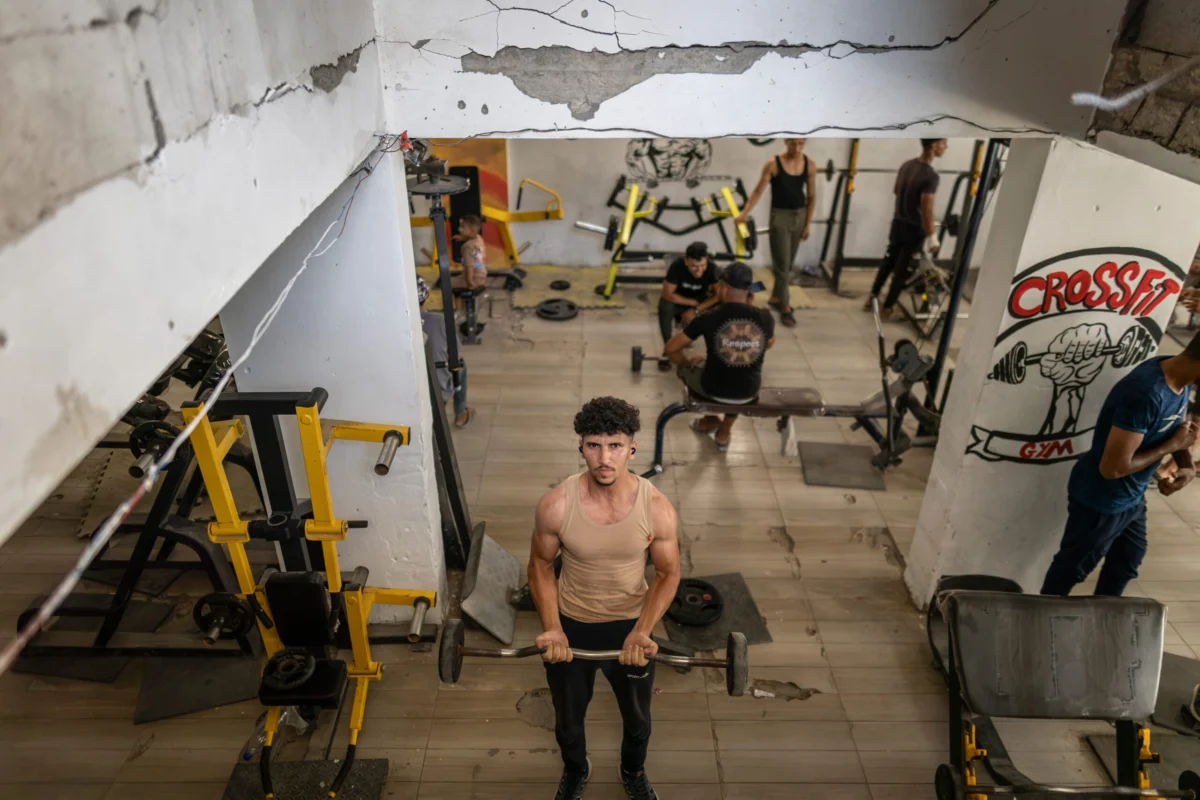
"In the Gaza Strip, sport is not a luxury but a fundamental necessity; it is the only way for us to release negative energy, reclaim our mental health, and rebuild ourselves from the inside out."

This sentiment, shared by those training within the skeletal remains of the Champions Factory Gym in Khan Younis, highlights a profound shift in the role of physical fitness during prolonged conflict. For the men who gather in this basement facility, bodybuilding is no longer merely about aesthetic gain or athletic competition; it has become a vital mechanism for psychological resilience and a rare remaining conduit for hope. As the physical infrastructure of their city lies in ruins, the act of lifting weights serves as a defiant assertion of agency and humanity against the crushing weight of displacement, famine, and loss.
The Sanctuary in the Basement
The journey to the Champions Factory Gym is a literal trek through the wreckage of modern warfare. Located in Khan Younis, a city that has seen some of the most intense engagements of the conflict, the path to the gym is defined by jagged concrete slabs and the twisted skeletons of reinforced steel. The building that once stood three stories high above the gym has been reduced to rubble, a casualty of the ongoing war that has ravaged the Gaza Strip for nearly three years. Yet, the stairs leading down to the basement remain remarkably clear.

Inside, the environment is a stark contrast to the traditional high-tech fitness centers found elsewhere in the world. There is no electricity, meaning the facility can only operate during the narrow window of daylight. Sunlight does not come from windows but pours through massive, jagged holes in the walls created by munitions. This natural light illuminates a collection of stationary bikes and "old-school" weight racks, casting long shadows across a floor that has been painstakingly cleared of debris.
Captain Mohamed Ziad al-Biss, the owner and head coach, is a man whose physical stature matches his reputation. A trainer capable of a 419-pound bench press, al-Biss has become a symbol of the gym’s survival. In May 2024, he gained international attention after sharing videos of his training sessions while surrounded by the dust and stones of a fresh bombardment. Since then, he has worked to make the space functional again. "The inside of the gym still needs renovation, but we work with the circumstances," al-Biss explains. For a membership fee of approximately 40 ILS (roughly $13 USD), he provides a space where the men of Khan Younis can attempt to reconstruct their lives.

The Diverse Faces of Resilience
The membership of Champions Factory is a cross-section of Gazan society: tailors, electricians, plumbers, and cart drivers. Each brings a unique story of loss, but all share a common motivation for training.
Mohammed Walid Al-Salami, a 26-year-old tailor and appliance repairman, had been a dedicated bodybuilder for two years before the war began. To him, the gym was his "only hobby." When the conflict intensified, he lost his shop, his neighborhood, and his ability to train. "We stopped doing sports for a long time because our bodies and minds couldn’t handle anything more," Al-Salami says. For many in Gaza, the initial phase of conflict is about pure survival, leaving no room for the "luxury" of exercise. However, as the conflict persists, the mental toll becomes as dangerous as the physical one. Returning to the gym was, for Al-Salami, a sign of returning hope. He now balances four training sessions a week with the grueling demands of his tailoring work, which he uses to cover household expenses in an economy where food is both scarce and prohibitively expensive.

For 24-year-old Abdullah Ahmed Khalil Al-Farra, the gym is the only alternative to the "suffocation" of a life without work or movement. "The Gaza Strip is finished," he says bluntly, reflecting the despair of a generation facing total unemployment. "We spend the entire day at home. There’s no source of income." In this vacuum of opportunity, Al-Farra views physical training as a form of preparation. He advises others to "strive" regardless of the circumstances, suggesting that if a job opportunity were to ever arise, one must be physically capable of seizing it. This pragmatic view of fitness—as a tool for future utility—is a recurring theme among the younger members.
The Nutritional Crisis and the Will to Train
One of the most significant hurdles for the athletes at Champions Factory is the lack of proper nutrition. Bodybuilding is a sport traditionally dependent on high-protein diets and caloric surpluses, both of which are impossible to maintain in the current Gazan climate. The region has been plagued by what many residents describe as famine-like conditions.

"Food is extremely difficult to obtain," Al-Farra notes. "Even chicken breast—the cheapest option—is still beyond the reach of many people." Abdulrahman Mohamed Jadallah, 22, echoes this sentiment, explaining that they simply "make do with what we’ve got." The absence of nutritional supplements and reliable meat sources means that the physical gains these men make are hard-won and fragile. Yet, the lack of food has not deterred them. Ibrahim Amer, a 29-year-old plumber, argues that "not having enough food or water" is not a valid reason to give up on one’s health. To Amer and others, health is the only asset they have left that hasn’t been destroyed by the war.
A Psychological Necessity
Captain al-Biss views his gym not just as a business, but as a public service. He notes that several gyms have attempted to reopen across Khan Younis to meet a "huge demand." This surge in interest suggests that the population is increasingly turning to physical activity to manage the "psychological stress" of living in a war zone.

"Sport represents a fundamental pillar for the whole world," al-Biss says. "But in Gaza, it needs to be a priority because it is a form of recreation." In a territory where "there are no trips with friends and no places to go," the gym offers a rare social outlet. It is a place where men can "release energy" and "build dreams" in a controlled environment, providing a temporary escape from the "atmosphere of war and pressure."
This sentiment is shared by Ibrahim Tamim Al-Lahham, 40, who uses a combination of weightlifting and cardio to maintain focus. "We are a people who deserve life, and exercise is one way of holding on to it," he says. His words frame bodybuilding as an act of resistance—a way to maintain the integrity of the self when the external world is in a state of collapse.

The Limits of Ambition
Despite their determination, the athletes of Champions Factory face systemic barriers that no amount of training can overcome. Captain al-Biss, who has competed in championships across the Gaza Strip, continues to prepare for international competitions. However, with the border crossings closed, his ambitions remain confined to the basement of his ruined building. The lack of mobility is a constant reminder of their isolation from the global athletic community.
Al-Biss is currently seeking donations to fully rebuild the gym, hoping to restore it to its former three-story glory. For now, he and his members continue to work within the cracks. The presence of the gym serves as a visual testimony to the resilience of the human spirit. As documented by photojournalist Mahmoud Abu Hamda, whose work focuses on how people protect their dignity amid loss, the gym is a place where "human presence" is restored beyond the statistics of war.

Conclusion: The Factory of Hope
The Champions Factory Gym is aptly named, though the "champions" it produces are not defined by medals or trophies. Instead, they are defined by their ability to maintain their health, their sanity, and their community under conditions that would break many others. Whether it is 17-year-old Nassim Khattab, who comes every day except Friday to avoid the "suffocation" of home, or 39-year-old Shaaban Al-Sheikh, who trains to maintain the strength needed for construction work, these men are using the iron to forge a sense of normalcy.
In the shattered landscape of Khan Younis, the sound of clanging weights and the sight of men straining against gravity offer a powerful counter-narrative to the destruction. It is a reminder that even when the walls fall, the drive to build—both muscle and mind—remains. For the members of Champions Factory, exercise is more than a hobby; it is a lifeline, a form of therapy, and a testament to the fact that they "deserve life."
