
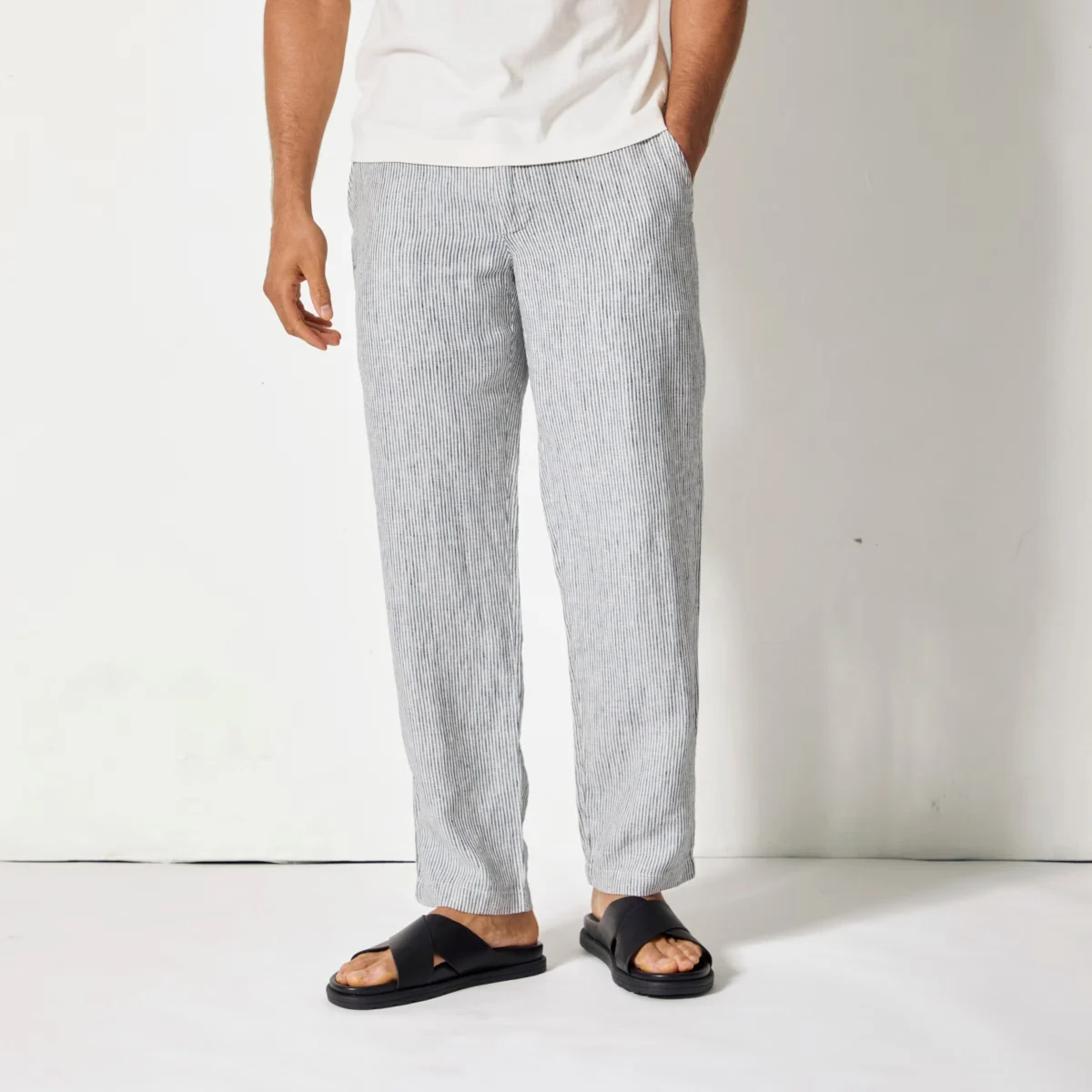
"Linen has evolved from a vacation-only staple into a high-performance textile, utilizing modern blends and technical treatments to bridge the gap between beachside relaxation and corporate professionalism."

While linen is one of the world’s oldest textiles, derived from the resilient flax plant, its reputation has historically been marred by a tendency to wrinkle and a perceived lack of structure. However, contemporary menswear has undergone a "linen renaissance," where innovative fabric blends—incorporating rayon, cotton, and spandex—and advanced finishing techniques have transformed these trousers into versatile essentials. No longer restricted to the tropics, the modern linen pant is now engineered for the humid subway commute, the summer wedding, and the high-stakes boardroom, offering a thermal regulation that cotton and synthetic chinos simply cannot match.
The Science of Summer Comfort: Why Linen Reigns
To understand the enduring appeal of the linen pants featured in current market rotations, one must look at the cellular structure of the flax fiber. Linen fibers are hollow, allowing for high air permeability and moisture-wicking capabilities. This "natural air conditioning" is the primary reason why brands like Quince and J.Crew continue to prioritize 100% linen for their summer collections. Pure linen can absorb up to 20% of its weight in moisture before even feeling damp, making it the ideal defense against the "swampy" conditions of high-summer urban environments.

However, the modern consumer often demands more than just breathability. They require durability and "recovery"—the ability of a fabric to return to its original shape after being sat upon or folded in a suitcase. This demand has led to the rise of performance blends, such as those found in the Sailwind and Coofandy collections, which mix linen with viscose and polyester to create a fabric that drapes like a trouser but feels like a pajama.
The Entry-Level Powerhouse: Sailwind and Coofandy
For many men, the transition into linen begins with versatility and price point. The Sailwind Drawstring Linen Pants ($30) have become a benchmark for the "everywhere" pant. By blending linen with rayon and viscose, Sailwind addresses the primary complaint of pure linen: the scratchiness. This blend creates a soft-hand feel and introduces a degree of mechanical stretch. In practical testing, these pants excel in travel scenarios. Utilizing the "ranger roll" packing technique, these trousers can be compressed into a carry-on and emerge without the deep, structural creases that typically plague 100% flax garments.

Similarly, Coofandy has disrupted the "budget" category with a performance-heavy blend of 67% viscose, 20% polyester, and 12% linen. This specific ratio is designed for the man who wants the aesthetic of a chino with the weight of a feather. Unlike traditional linen, which often requires delicate care, these are low-maintenance and machine-washable, making them a staple for those who prioritize ease of ownership over traditional textile purity.
The Professional Pivot: J.Crew, Uniqlo, and Suitsupply
The most significant shift in menswear is the acceptance of linen in the office. This transition is led by J.Crew’s Classic-fit Linen Trouser ($89). By focusing on a tailored cut and a crisp drape, J.Crew has removed the "slouchy" stigma. A key insight for professional wear is the use of patterns; a subtle fine stripe, as seen in the J.Crew and Banana Republic offerings, provides a visual distraction that camouflages minor rumpling, allowing the wearer to maintain a polished appearance from the morning meeting to the evening cocktail hour.

Uniqlo offers a different approach to the professional linen pant by utilizing a 66% cotton and 34% linen blend. This "best of both worlds" construction provides the structural integrity and opacity of cotton with the cooling properties of linen. Added spandex ensures that the pants do not "bag out" at the knees or seat—a common failure point in cheaper linen garments. For those seeking a more elevated, sartorial experience, Suitsupply’s pure linen trousers utilize a wide-leg silhouette and a textured weave. This design choice leans into the "Old Money" aesthetic, pairing perfectly with a travel blazer or a knit polo for summer weddings.
Technical Innovations and Performance: The Ably Factor
Perhaps the most impressive advancement in the category comes from Ably. At a $120 price point, these are not merely pants but pieces of wearable technology. Ably’s linen is engineered to be odor-resistant, stain-repellent, and quick-drying. In high-humidity environments or during sudden summer downpours, these features are transformative. While traditional linen can become heavy and transparent when wet, Ably’s treated fibers repel liquids, maintaining the garment’s structure and the wearer’s dignity. This makes them the ultimate choice for the "one-bag" traveler who needs a single pair of pants to survive a week of varied activities without a laundry run.

Fit and Aesthetics: From Slim to Relaxed
The silhouette of men’s linen pants has diversified to accommodate different body types. Banana Republic and Alex Crane ($158) have mastered the slim-tapered fit. Alex Crane’s "Bo Pants," made from slub linen, offer a coastal-inspired vibe that elongates the leg. However, these are specifically designed for slimmer builds; men with "athletic" or "beefy" quads may find the lack of stretch in these slim cuts restrictive.
Conversely, the relaxed fits offered by Quince and the loose cuts from Coofandy cater to a broader range of motion. The Quince 100% European Linen Pants ($54) provide a "vacation energy" that is elevated enough for a resort dinner. The key to wearing a relaxed linen pant without looking sloppy lies in the waistband; a button closure or a high-quality drawstring with metal aglets signifies that the garment is intentional fashion rather than loungewear.

Sustainability and Longevity
Beyond comfort, the shift toward linen is a win for the environmentally conscious consumer. Flax is a remarkably sustainable crop, requiring significantly less water and fewer pesticides than cotton. It is also a resilient fiber that actually softens with every wash, meaning a high-quality pair of linen pants from a brand like Suitsupply or J.Crew can potentially last for a decade if cared for properly.
To maximize the lifespan of these garments, experts recommend avoiding over-washing. Because linen is naturally antibacterial and moth-resistant, a simple air-dry or a light steam is often enough to refresh the piece. When washing is necessary, cold water and air-drying are essential to prevent the fibers from becoming brittle.

Conclusion: The New Summer Uniform
The data suggests that the modern man no longer views linen as a compromise. Whether it is the $30 budget-friendly versatility of Sailwind or the $158 artisanal quality of Alex Crane, linen trousers have become the strategic choice for navigating a warming planet. By selecting the right blend—cotton for structure, rayon for softness, or pure flax for maximum cooling—men can build a summer wardrobe that is as functional as it is fashionable. As the boundaries between casual and professional attire continue to blur, the linen pant stands as the definitive garment of the season: breathable, resilient, and undeniably sharp.
