
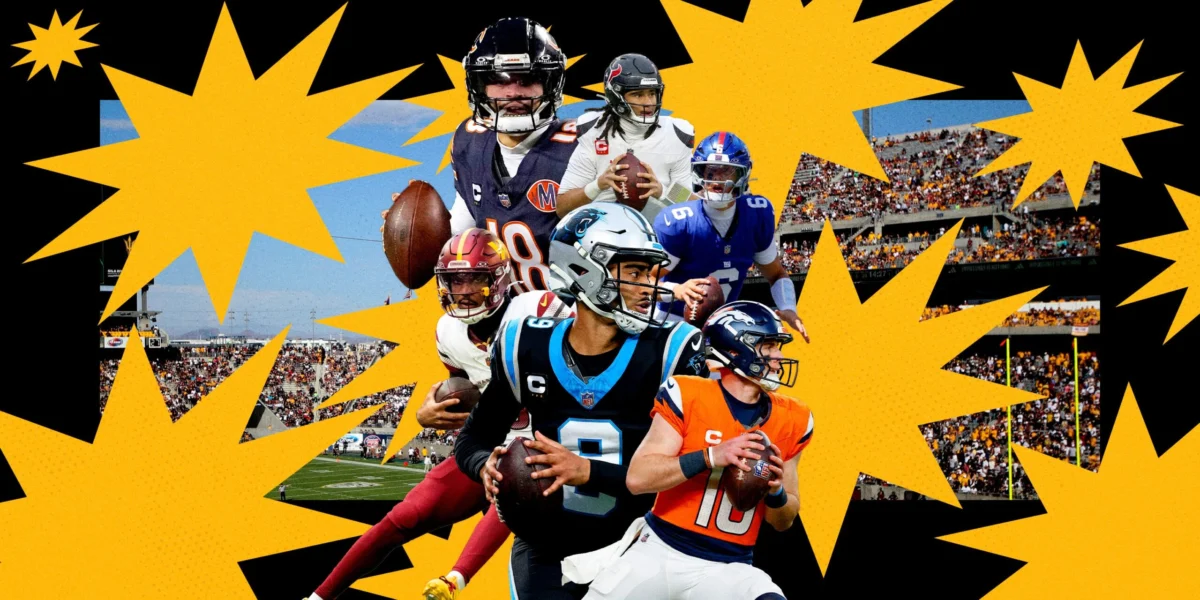
"The modern NFL quarterback is no longer just a passer, but a hyper-efficient kinetic machine, blending specialized scientific programming with the rapid-fire neuro-processing required to dismantle the most sophisticated defensive schemes in history."
As the 2026 NFL season approaches, the league finds itself in the midst of a fundamental transformation in how the most critical position in sports is played and prepared for. The traditional mold of the pocket passer has been replaced by a new generation of "scientific" athletes who have been groomed from adolescence using detailed biomechanical data and cognitive conditioning. This evolution, exemplified by the rise of young stars like Drake Maye and Jayden Daniels, represents a shift toward a more holistic approach to performance—one where grip strength, spinal mobility, and environmental awareness are treated with the same rigor as playbook memorization.

The Scientific Evolution of the Signal-Caller
When Drake Maye propelled the New England Patriots to Super Bowl LX in February 2026, it was more than just a victory for a storied franchise; it was a validation of a new developmental philosophy. Today’s elite quarterbacks are the first generation to have grown up entirely within an ecosystem of high-performance sports science. As Tom Gormely, DPT, head of sports science at Gormely Performance Systems, notes, these athletes are the beneficiaries of programming built specifically around the efficiency of their skill group. They are not just "football players" who happen to throw; they are specialized kinetic engines designed to process information at the speed of light while maintaining physical integrity under extreme duress.
Jayden Daniels: The Foundation of Ball Security
At 25, Washington Commanders quarterback Jayden Daniels has already established himself as a model of efficiency. His rookie campaign in 2024, where he completed 69 percent of his passes, set a high bar that he managed to maintain even through a challenging 2025 season. Despite a significant elbow dislocation that sidelined him for ten games, Daniels’ return demonstrated a remarkable lack of "rust," a testament to his focus on fundamental mechanics during his rehabilitation.
One of the most striking statistics of Daniels’ young career is his ball security: just 14 total turnovers through 24 games. While many attribute this to decision-making, his trainers point to a more literal foundation: grip strength. Working with Ryan Porter of Cali Power, Daniels utilizes a deceptively simple "plate hold" drill. By gripping a 25-pound weight plate by its edge for extended intervals, a quarterback develops the forearm and hand endurance necessary to maintain control of the ball during sack attempts or in inclement weather. This "spicy" drill, as Porter calls it, builds the functional tension required to ensure that the ball remains a protected asset, even when the pocket collapses.

Caleb Williams: Stoicism and Aquatic Mobility
In Chicago, 24-year-old Caleb Williams has become the face of the Bears’ resurgence. His hallmark is a "stoic" demeanor—a mental toughness noted by opponents like Raiders defensive end Maxx Crosby. Williams remains unshaken by the chaos of the NFL pocket, a trait that allowed him to lead six fourth-quarter comebacks last season. However, his mental fortitude is matched by a physical "freakishness" that allows him to deliver accurate passes from nearly any platform.
The secret to Williams’ ability to throw with his feet unset lies in his exceptional mobility, specifically in the T-spine, hips, and ankles. To maintain this, Williams utilizes cross-training in the pool. According to trainer Danny Hernandez, swimming provides a unique environment where rhythm, tempo, and "lag" can be refined without the joint impact of field work. By alternating between the crawl, breaststroke, and kicking drills, Williams develops a level of total-body coordination and fluid mobility that translates directly to his "off-platform" throwing success on Sundays.
C.J. Stroud: The Mechanics of Rotational Power
C.J. Stroud’s tenure with the Houston Texans has been defined by consistency and postseason appearances. Leading the team to three straight playoff berths, Stroud has proven that he can handle the pressure of January football. His success is built on explosive rotational power, the engine behind his ability to drive the ball deep downfield with minimal effort.

To cultivate this power, Stroud works with Adam Dedeaux of 3DQB on rotational medicine ball slams. This exercise isn’t about mere strength; it is about the kinetic chain—the transfer of energy from the ground, through the hips, and out through the arm. By explosively slamming a ball from an overhead position toward the opposite foot, Stroud trains his core to rotate with the violence and precision required to beat NFL secondaries. This movement mimics the torque of a deep post or a comeback route, ensuring that his arm talent is backed by a powerful physical foundation.
Bo Nix: Total-Body Explosiveness
In Denver, Bo Nix has quickly ascended the ranks, drawing comparisons to Patrick Mahomes for his athletic versatility. Nix recently tied the record for the most victories by a quarterback in his first two regular seasons, a feat achieved through a combination of high-level arm talent and elite lower-body mechanics.
Nix’s training focuses on the "hitch slam," a medball drill designed by David Morris of QB Country. This exercise requires the athlete to shuffle explosively before hurling a ball at a wall, mimicking the footwork of a quarterback stepping up in the pocket to deliver a strike. The drill bridges the gap between the weight room and the field, teaching the body to generate maximum force while in motion. For Nix, this translates to a playing style that is both unpredictable and highly efficient, allowing him to win high-stakes duels against established veterans like Josh Allen.

Bryce Young: Sharpening the Mental Processor
The career of Bryce Young in Carolina has been a study in perseverance. After two inconsistent years, Young finally guided the Panthers back to the playoffs in 2025, setting career highs in every major statistical category. While his physical tools are evident, his greatest asset is his "mental talent"—the ability to anticipate windows before they open.
To sharpen this processing speed, Young engages in environmental awareness drills. These exercises, often performed in chaotic or crowded settings, require the quarterback to recall minute details from a brief moment of observation. By training the brain to notice and process more information in less time—such as identifying the color of a passing car or the specific position of a teammate’s hands—Young has enhanced his ability to "read" a defense. In the split-second world of the NFL, this superior processing speed is the difference between a touchdown and an interception.
Jaxson Dart: Reactive Decision-Making
As the newest leader of the New York Giants, 23-year-old Jaxson Dart has endeared himself to the New York faithful with a physical, fearless style of play. In just 12 starts, he accounted for 24 total touchdowns, proving that he possesses the grit required for the NFC East.

Dart’s preparation involves high-intensity reaction drills designed by Taylor Kelly. By standing with his back to a target net and reacting to color-coded commands the moment he turns, Dart trains his brain to make instant decisions under pressure. This mimics the reality of a collapsing pocket, where a quarterback must identify a target, calculate the risk, and execute the throw in a heartbeat. These drills ensure that Dart’s physical toughness is matched by a lightning-fast "processor," allowing him to navigate the complexities of modern defensive rotations.
The Future of the Position
The success of this 2026 class of quarterbacks suggests that the gap between raw talent and elite performance is increasingly being bridged by science. By treating the quarterback as a specialized athlete—one whose training must encompass grip endurance, aquatic mobility, rotational torque, and cognitive processing—NFL franchises are extending the peak years of their most valuable assets.
As the game continues to evolve, the lessons learned from these young signal-callers provide a blueprint for anyone looking to level up their own physical and mental strength. Whether it is the focus of Bryce Young or the explosive power of Bo Nix, the new architecture of the NFL quarterback is built on a foundation of precision, data, and an unrelenting commitment to the science of the game.
