
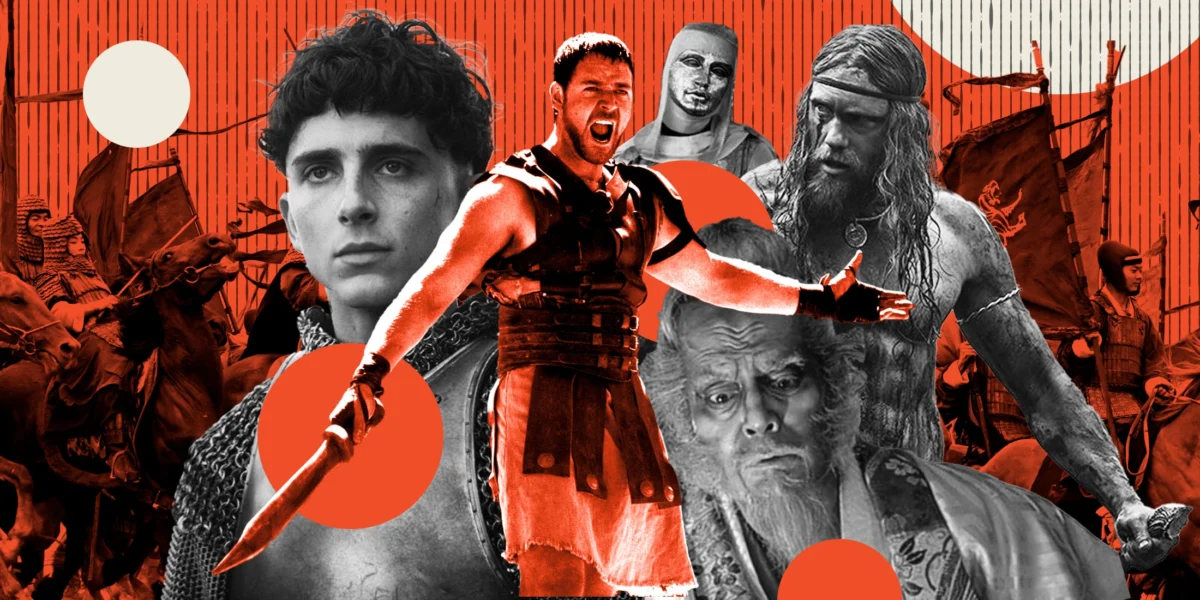
“As Christopher Nolan revives the grand-scale mythological epic with The Odyssey, he joins a lineage of filmmakers who use ancient history to explore the timeless weight of sacrifice and the arduous journey toward home.”

The announcement of a $250 million adaptation of Homer’s The Odyssey marks a pivotal moment in contemporary cinema, signaling the return of the prestige "epic" to the center of the Hollywood ecosystem. Directed by Christopher Nolan, whose career has been defined by structural ambition and technical precision, this project represents the first true blockbuster treatment of the Ithacan king’s ten-year journey through the Mediterranean. In an era dominated by superhero franchises and digital spectacles, Nolan’s pivot to antiquity suggests a renewed interest in the "swords-and-sandals" tradition, reimagined through the lens of modern psychological depth and practical filmmaking.
Christopher Nolan’s decision to adapt The Odyssey follows his significant success with Oppenheimer, a film that proved audiences still crave intellectual, high-stakes narratives framed by massive cinematic scale. While Homer’s epic poem has influenced everything from the Coen Brothers’ O Brother, Where Art Thou? to the narrative structure of Star Trek: Voyager, the specific genre of "Greek mythology" has remained curiously underserved in modern film. Nolan’s work—often centered on the theme of the difficult homecoming and the internal conflict of the hero—is uniquely suited to the story of Odysseus.

To understand the cinematic landscape into which Nolan’s The Odyssey will sail, one must look at the historical and mythological epics that have defined the genre since the mid-1960s. These films moved away from the sanitized studio epics of the early 20th century, opting instead for grit, surrealism, and philosophical inquiry.
The Foundation of Modern Myth
The 1980s provided a bridge between the classic Hollywood epic and the modern era, most notably through John Boorman’s Excalibur (1981). This adaptation of Arthurian legend remains a benchmark for mythological storytelling. Eschewing the dry historical approach, Boorman embraced the surreal and the supernatural, depicting knights in gleaming armor against a backdrop of decay and sorcery. Excalibur captures the "vitality and decay" that Nolan often explores—the idea that legends are forged through blood and sacrifice.

Parallel to the Western myth-making of Boorman was the late-career mastery of Akira Kurosawa. His 1985 masterpiece Ran reimagined Shakespeare’s King Lear within the Sengoku period of Japan. Nolan himself has cited Ran as a primary influence for The Odyssey, particularly Kurosawa’s use of elemental forces—wind, fire, and landscape—to mirror the internal madness of his characters. Ran is not merely a war film; it is a visual symphony where the costumes and colors are as communicative as the dialogue. For a director like Nolan, who prioritizes the visual language of the "prestige format," Ran offers a blueprint for how to use 70mm scale to tell an intimate story of a man’s downfall.
The 21st Century Revival
The turn of the millennium saw a resurgence of the historical epic, sparked by the massive success of Ridley Scott’s Gladiator (2000). Winning the Academy Award for Best Picture, Gladiator reminded studios that the Roman Empire could still draw a global audience. Russell Crowe’s Maximus Decimus Meridius became the archetype for the modern virtuous hero: a man of "strength and honor" guided by faith and a singular desire to return to his family. This thematic core—the yearning for a home that may no longer exist—is the engine that drives The Odyssey.

Following the success of Gladiator, the industry attempted to capitalize on the "Homer boom" with Wolfgang Petersen’s Troy (2004). While the film took significant liberties with The Iliad, including the removal of the Greek gods and the condensation of the ten-year war into a single month, it demonstrated the logistical power of modern studio filmmaking. With an A-list cast including Brad Pitt and Eric Bana, Troy showcased the visceral potential of ancient warfare. Notably, the film featured Sean Bean as Odysseus, providing a brief glimpse of the character that Nolan will now expand upon with a significantly larger budget and a more faithful adherence to the poem’s mythological roots.
Complexity and Directorial Vision
Ridley Scott returned to the genre in 2005 with Kingdom of Heaven, a film whose reputation was salvaged by its Director’s Cut. While the theatrical version was criticized for being disjointed, the three-hour edit is now regarded as one of the most robust epics of the 2000s. Set during the Crusades, the film explores the folly of religious war and the necessity of diplomatic tolerance. It moved the epic genre toward historical skepticism, questioning the motives of the "heroic" crusader. This "thorny" approach to history is a hallmark of Nolan’s filmography, where protagonists are rarely pure and their missions are often fraught with moral ambiguity.

Innovation in the genre has not always been limited to live-action. Robert Zemeckis’s Beowulf (2007) utilized motion-capture technology to adapt the Old English poem. Though the "uncanny valley" of its CG animation was divisive, the film was a serious attempt to translate the scale of ancient monsters and dragons to the screen. It offered a revisionist take on the hero, suggesting that Beowulf’s glory was built on a foundation of lies and compromise. This deconstruction of the "hero myth" is likely to play a role in Nolan’s The Odyssey, as Odysseus is a character defined as much by his cunning and deceit as by his bravery.
Global Scale and Visual Artistry
The epic genre has also thrived outside of the Hollywood system. John Woo’s Red Cliff (2008-2009) is a four-and-a-half-hour exploration of the Battle of Red Cliff in ancient China. Woo, known for his kinetic action style, applied his virtuosic "gun-fu" sensibilities to ancient naval and land battles. The film emphasizes strategic brilliance and the bond between leaders, proving that an epic can be as much about the intellectual chess match of war as the physical combat.

Stylization reached its peak with Tarsem Singh’s Immortals (2011). Singh treated the story of Theseus (Henry Cavill) as a Renaissance painting brought to life. By combining high-fashion costume design with heavy digital effects, Immortals portrayed the Greek gods as chiseled, golden superheroes. This film represents the "high-fantasy" end of the mythological spectrum, a stark contrast to the grounded, gritty realism that has dominated the genre in recent years.
The Gritty Contemporary Era
The most recent entries in the epic genre have leaned into the "grime and mud" aesthetic. David Michôd’s The King (2019) reimagined Shakespeare’s Henry V with Timothée Chalamet as a morose, reluctant monarch. The film’s centerpiece—the Battle of Agincourt—is a masterclass in claustrophobic, disorienting combat. It stripped away the glamour of royalty, focusing instead on the crushing weight of leadership.

Finally, Robert Eggers’s The Northman (2022) brought a hallucinogenic, bleak spirituality to the Viking saga. Adapting the legend that inspired Hamlet, Eggers utilized historical research to create a world that felt alien and terrifying. The film’s commitment to "weird history" and bone-crunching violence showed that there is still a hunger for uncompromising, director-driven epics.
As Christopher Nolan prepares to launch The Odyssey, he stands at the crossroads of these various traditions. He has the technical capability of Zemeckis, the historical skepticism of Scott, and the visual mastery of Kurosawa. A $250 million budget suggests a film that will not shy away from the monsters of the Mediterranean—the Scylla, the Charybdis, and the Cyclops—but Nolan’s track record suggests these spectacles will be grounded in the very real, very human struggle of a man trying to find his way back to himself. In the landscape of modern cinema, where the "epic" has often been relegated to the background, The Odyssey promises to be a foundational return to form.
