
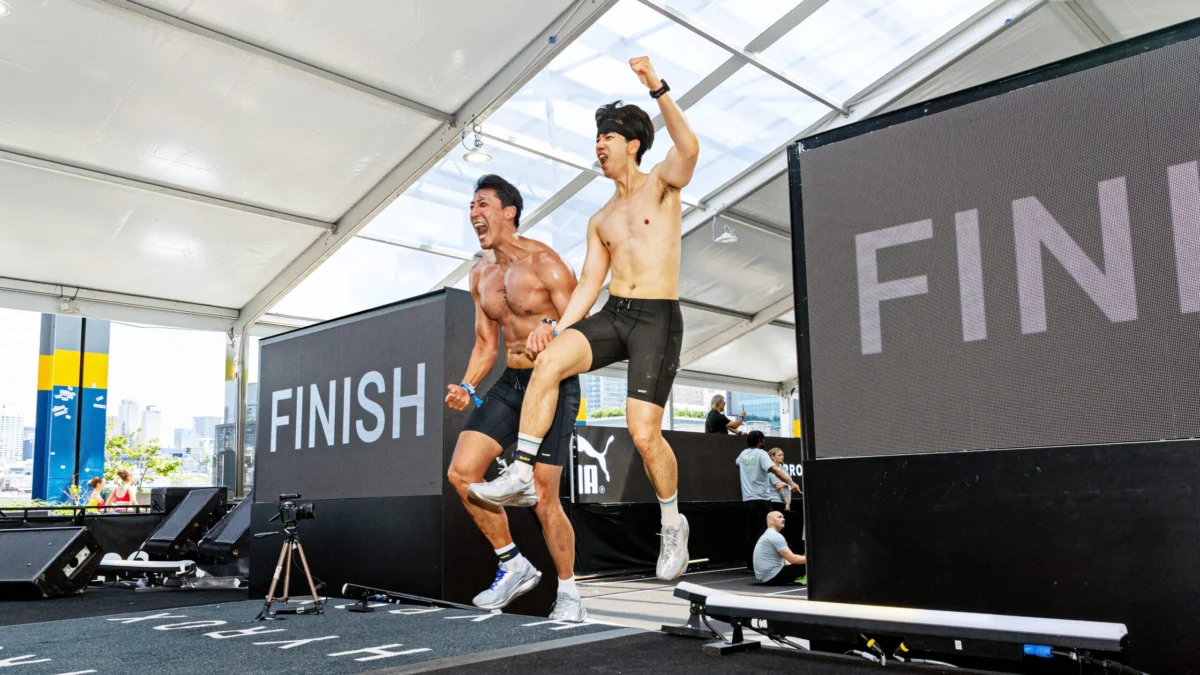
"The evolution of competitive fitness has transitioned from a niche subculture into a global participation phenomenon, proving that for the modern athlete, the ultimate motivator is no longer just aesthetic health, but the standardized measure of human performance against a global community."
This shift marks a significant departure from traditional gym culture, where progress was often measured in isolation or through subjective visual changes. Today, a new era of "functional competition" has emerged, led by brands like Hyrox and Xenom, which provide everyday gym-goers with the same structured, high-stakes environment once reserved for professional athletes. By combining accessible functional movements with rigorous aerobic demands and standardized scoring, these events have successfully gamified fitness, creating a scalable model that prioritizes community engagement, psychological resilience, and measurable achievement.

The New Proving Ground
At a high-performance training facility, Hunter McIntyre, a three-time Hyrox world champion, leans into a 198-pound sled. The incline is steep, and the magnetic resistance is dialed to its maximum setting. To make the task even more grueling, his trainer, Sam Calavitta, has added two 110-pound dumbbells to the load. McIntyre’s face is a mask of pure exertion, a physical manifestation of the grit required to stay atop a sport that is rapidly expanding beneath him.
McIntyre is the face of a movement that is no longer confined to the elite. While he battles for podiums, millions of others are signing up for the same grueling tests. According to Keith Barlow, director of Fittest PR, the participation numbers are staggering. Hyrox is projected to reach 2.5 million participants globally by next year, a massive leap from the 1.8 million recorded this year and the 550,000 seen in 2025. This exponential growth suggests that the "fitness race" is not just a passing trend but a fundamental shift in how the public consumes exercise.
For athletes like Adam and Liz Walter, both 42, these competitions provided a much-needed exit ramp from the monotony of the standard gym split. After a decade of repeating the same routines, the Walters found that Hyrox offered a "next level" focus. It wasn’t just about burning calories; it was about the feeling of accomplishment that comes from finishing a race that tests every facet of physical capability. This sentiment is the engine driving the industry: the desire to reclaim the "inner athlete" that often goes dormant in adult life.

From Functional Training to Global Competition
To understand the current boom, one must look back at the origins of functional fitness. In the 1990s, the industry began to pivot away from bodybuilding—which focused on isolated muscle hypertrophy—toward functional training. This philosophy prioritized movements that mimicked everyday actions: pushing, pulling, lunging, and carrying. The goal was healthy movement and longevity rather than just size.
By the early 2010s, this philosophy took on a competitive edge with the rise of Obstacle Course Racing (OCR). Brands like Spartan Race and Tough Mudder turned mud, fire, and barbed wire into a multi-million-dollar industry. Simultaneously, CrossFit introduced the "Open," a worldwide event where local gym members could log their scores in an international database. By 2018, the CrossFit Open had become the largest participatory sporting event in history, with nearly half a million competitors.
However, the first wave of competitive fitness hit significant turbulence. Tough Mudder faced bankruptcy in 2020, Spartan Race struggled to find a consistent television audience, and CrossFit became embroiled in internal and external controversies. Yet, the appetite for competition remained. People had become "primed" to believe that an effective workout should leave them drenched and exhausted—a phenomenon Conor Heffernan, PhD, a historian of physical culture, notes is a powerful, if sometimes misunderstood, psychological driver.

The Psychology of the Pack
Why has competition become the dominant motivator for modern exercise? Research from the University of Pennsylvania suggests that competition is a far more potent driver for consistent physical activity than social support or online accolades. Luis Torres, a certified mental performance consultant, explains that competition amplifies the dopamine hit already provided by exercise. The combination of community energy, physical exertion, and the tangible sense of completion creates a powerful neurological reward system.
Furthermore, endurance sports like marathon running or cycling often carry an air of solitude. In contrast, the new wave of competitive fitness is built on the "pull of the pack." It allows "normies"—average gym-goers—to perform the exact same workouts as the professionals, creating a shared language of struggle and achievement. This inclusivity is a cornerstone of the Hyrox model.
The Hyrox Formula: Standardization and Accessibility
Hyrox succeeded where others faltered by focusing on three pillars: standardization, accessibility, and "shareability." Unlike CrossFit, which often requires high-skill gymnastics or complex Olympic weightlifting, Hyrox utilizes movements that almost anyone can perform: sled pushes, rowers, SkiErgs, burpee broad jumps, and wall balls. It is billed as a "bucket list" item—challenging enough to require training, but accessible enough that a first-timer can finish.

The standardization is perhaps its most brilliant innovation. Every Hyrox race is identical: eight 1-kilometer runs interspersed with eight specific functional stations. This allows for a global leaderboard where a participant in Chicago can accurately compare their time to a participant in London or Sydney. "Every great sport has a scoring system that people immediately understand," says Barlow. Just as the sub-three-hour marathon is a benchmark for runners, the sub-60-minute Hyrox has become the gold standard for the functional athlete.
The events are also designed for the social media age. With cameras stationed throughout the course and a dedicated podium photo area at the finish line, Hyrox provides participants with a "shareable status symbol." These "gram-worthy" moments serve as free marketing, fueling the cycle of participation.
The Future Landscape: Xenom and Beyond
As Hyrox matures, a new generation of rivals is emerging to challenge its dominance. Keith Barlow has recently partnered with CrossFit to launch Xenom, an event designed to bring a "Super Bowl moment" to the CrossFit community. Debuting in Dallas, Xenom is a two-day, 10-station affair that attempts to bridge the gap between the high-skill technicality of CrossFit and the standardized racing format of Hyrox. It offers various tiers, allowing someone with only six months of gym experience to compete alongside veterans.

Xenom is far from the only newcomer. The landscape is becoming increasingly crowded with specialized events:
- Adidas ATHX: A time-capped event that focuses on work capacity rather than a traditional race format.
- APEX: Positioned as a "functional combine," similar to the NFL’s talent evaluation tests.
- METRIX: A high-energy pairs event featuring five stations accompanied by live DJs.
- DEKA: Spartan’s indoor answer to the fitness racing trend, offering various divisions that remove the mud and obstacles in favor of pure functional testing.
Conclusion: A Permanent Shift in Physical Culture
The proliferation of these competitions is a net positive for public health. As Conor Heffernan points out, the rise of fitness racing means more people are engaging in resistance training and cardiovascular conditioning with a level of consistency that solo gym-going rarely inspires. The motivational power of the leaderboard ensures that participants aren’t just exercising for a few weeks; they are training for an event.
For professionals like Hunter McIntyre, the influx of new competitions and participants only raises the stakes. "The global interest of seeing who’s the best at something is very fun," he says. But for the millions of others who will never stand on a professional podium, these events offer something perhaps more valuable: a tangible way to measure their own progress, a community of like-minded strivers, and a reason to push the sled just a little bit harder. Whether the goal is a world title or simply a personal record, the era of the everyday competitive athlete is here to stay.
