
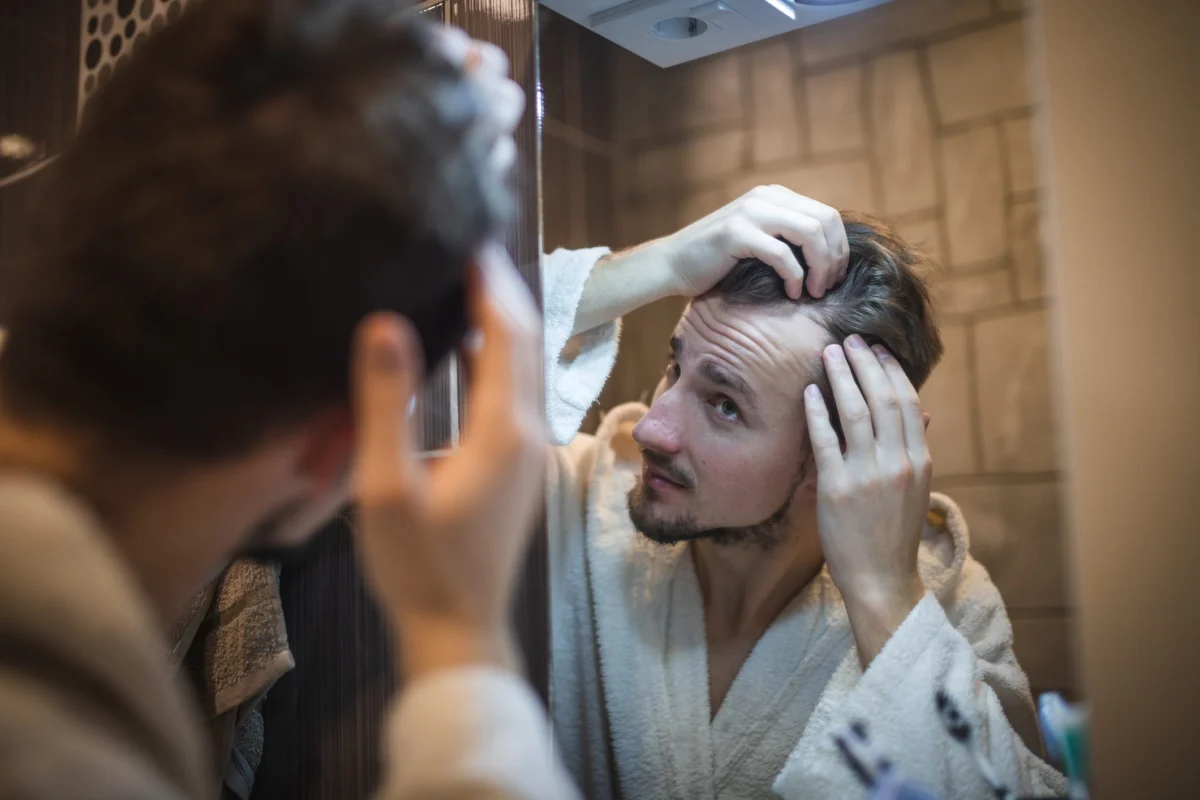
"Effective hair restoration begins with an accurate diagnosis: while thinning originates at the follicle level as a biological decline, breakage is a structural failure of the hair shaft caused by external stress, and mistaking one for the other often leads to ineffective treatment."

Distinguishing between hair thinning and hair breakage is the fundamental first step in any successful grooming or dermatological intervention. While both conditions result in a perceived loss of volume and coverage, they are governed by entirely different biological and mechanical processes—one occurring beneath the surface of the scalp within the living follicle, and the other affecting the non-living protein strand that has already emerged.
For many men, the realization of hair loss occurs during the third decade of life, often transitioning from a casual concern to a source of significant anxiety. This shift frequently manifests in social settings where peers begin to notice receding hairlines or thinning crowns. However, as medical experts point out, not all hair loss is created equal. To address the issue effectively, one must understand whether the body is failing to produce hair or if the hair being produced is simply failing to survive the rigors of daily life.

The Biological Divide: Follicle vs. Shaft
According to dermatologist Dr. Ariel Ostad, MD, the primary distinction between thinning and breakage lies in the point of origin. The hair follicle is the living structure embedded within the skin that is responsible for producing hair. The hair shaft, conversely, is the visible, non-living strand composed primarily of keratin.
Hair thinning occurs at the follicle level. This is a physiological process where the follicle undergoes "miniaturization," producing progressively finer, shorter, and less pigmented hairs until, eventually, the follicle may stop producing hair altogether. This is typically a slow, progressive decline.

Breakage is a shaft-level problem. In this scenario, the follicle remains healthy and continues to produce hair at a normal rate and thickness. However, the hair strand itself becomes compromised and snaps somewhere along its length before it reaches its full growth potential. While the result—less hair on the head—looks similar to thinning, the biological health of the scalp is often fundamentally different.
Identifying the Symptoms at Home
Dr. Deepak Khanna, DO, founder of DandRX, notes that most men first identify changes in their hair when looking in a mirror and noticing a more visible scalp or a receding hairline. However, there are specific mechanical "tests" one can perform at home to determine the nature of the loss.

The most definitive way to tell the difference is by examining the shed hair. Dr. Ostad explains that if you find a long strand of hair with a small, white bulb at the end, that hair has shed naturally from the root. This is a sign of thinning or shedding (telogen effluvium). If you find short, uneven pieces of hair without a bulb, you are looking at breakage.
Furthermore, the "feel" of the hair provides a clue. Thinning results in a loss of overall density and volume; the hair may feel soft but sparse. Breakage, on the other hand, often leaves the hair feeling rough, frizzy, and brittle. Because breakage happens at different points along the shaft, it creates uneven lengths and "flyaways" that make the hair appear unkempt despite regular grooming.

The Drivers of Thinning: Genetics and Physiology
The most common cause of thinning is androgenetic alopecia, frequently referred to as male pattern baldness. This is a genetic sensitivity to dihydrotestosterone (DHT), a byproduct of testosterone that causes hair follicles to shrink over time.
However, thinning is not always permanent or genetic. Dr. Ostad highlights telogen effluvium as a significant cause of temporary thinning. This condition occurs when a significant physiological stressor—such as a high fever, surgery, extreme weight loss, or chronic psychological stress—shocks the body into pushing a large percentage of hair follicles into the "resting" phase simultaneously. This results in diffuse shedding several months after the initial stressor.

Scalp health also plays a critical role in thinning. Inflammation, poor circulation, and clogged follicles due to sebum buildup or skin conditions like seborrheic dermatitis can disrupt the growth cycle. If the "soil" (the scalp) is not healthy, the "plant" (the hair) cannot thrive.
The Drivers of Breakage: Environmental and Chemical Stress
Breakage is rarely a result of internal biology and is almost always a result of how the hair is treated after it leaves the scalp. Modern grooming habits are often the primary culprits. Dr. Marisa Garshick, MD, notes that chemical damage from bleaching or coloring is a leading cause of weakened hair shafts.

Physical stress is equally damaging. Excessive heat styling with blow dryers or straighteners strips the hair of its natural moisture, making the keratin scales of the cuticle lift and snap. Even hairstyles can be at fault; the "man bun" or tight ponytails create "traction" that can lead to both breakage and a specific type of hair loss called traction alopecia. Even harsh brushing, especially when the hair is wet and at its most vulnerable, can cause the shaft to snap.
Navigating the Treatment Landscape
The market for hair loss is saturated with misinformation, often fueled by viral trends on social media. Dr. Garshick warns that while many thickening shampoos are excellent for providing a temporary cosmetic boost by coating the hair to make it look fuller, they do not actually treat the underlying cause of hair loss. Similarly, many popular oils and serums may add shine and manageability, but they cannot restart a dormant follicle.

One of the most persistent myths involves biotin. Dr. Ostad notes that while biotin is essential for hair health, supplementation is rarely effective for the average person. Most individuals receive sufficient biotin through a standard diet, and taking extra will only benefit the small percentage of people who are clinically deficient.
Treating Thinning: Stimulating the Root
For those facing thinning, the goal is to prolong the growth phase (anagen) and block the effects of DHT. The gold standard for over-the-counter treatment remains Minoxidil. Dr. Garshick recommends Rogaine 5% Minoxidil Foam, which works by increasing blood flow to the follicles and encouraging them to stay in the growth phase longer.

Internal support is also vital. Supplements like Nutrafol Men are designed to address the "multi-factorial" nature of thinning, targeting stress hormones (cortisol), inflammation, and micronutrient gaps that might be hindering growth. Ingredients to look for in topical thinning treatments include caffeine, niacinamide, and peptides, all of which support scalp vitality and follicle function.
Treating Breakage: Reinforcing the Structure
Treating breakage requires a "bond-repair" approach. Since the hair shaft is non-living, it cannot "heal" itself, but its structure can be chemically reinforced. Products like Olaplex No. 3 and the K18 Leave-In Molecular Repair Hair Mask utilize patented chemistry to rebuild the disulfide bonds and polypeptide chains that give hair its strength and elasticity.

In addition to bond builders, those suffering from breakage should prioritize moisture and protein balance. Shampoos and conditioners containing ceramides, fatty acids, and amino acids help to seal the hair cuticle, preventing further moisture loss and protecting the shaft from environmental friction.
The Rise of Technology: Red Light and Lasers
A significant advancement in the last decade is the emergence of FDA-cleared light therapy devices. These tools use Low-Level Laser Therapy (LLLT) and LED technology to stimulate cellular activity within the follicle.

Devices such as the HigherDOSE Red Light Hat or the iRestore Essential Laser Hair Growth System have become popular for their ease of use. These devices work on the principle of photobiomodulation, where specific wavelengths of light are absorbed by the mitochondria in hair cells, potentially increasing ATP production and extending the hair’s growth cycle. While these are not overnight cures, consistent use over six to twelve months has shown a measurable increase in hair density for many users, particularly when used in conjunction with topical treatments like Minoxidil.
The Path Forward
While there is currently no permanent "cure" for genetic hair loss that doesn’t involve surgical intervention, such as a hair transplant, the window for effective prevention and maintenance has never been wider. The key to maintaining a full head of hair into one’s 40s and beyond is early intervention and consistency. By accurately identifying whether the issue is thinning or breakage, men can stop wasting resources on the wrong products and implement a targeted strategy that protects the follicle and preserves the shaft.
