
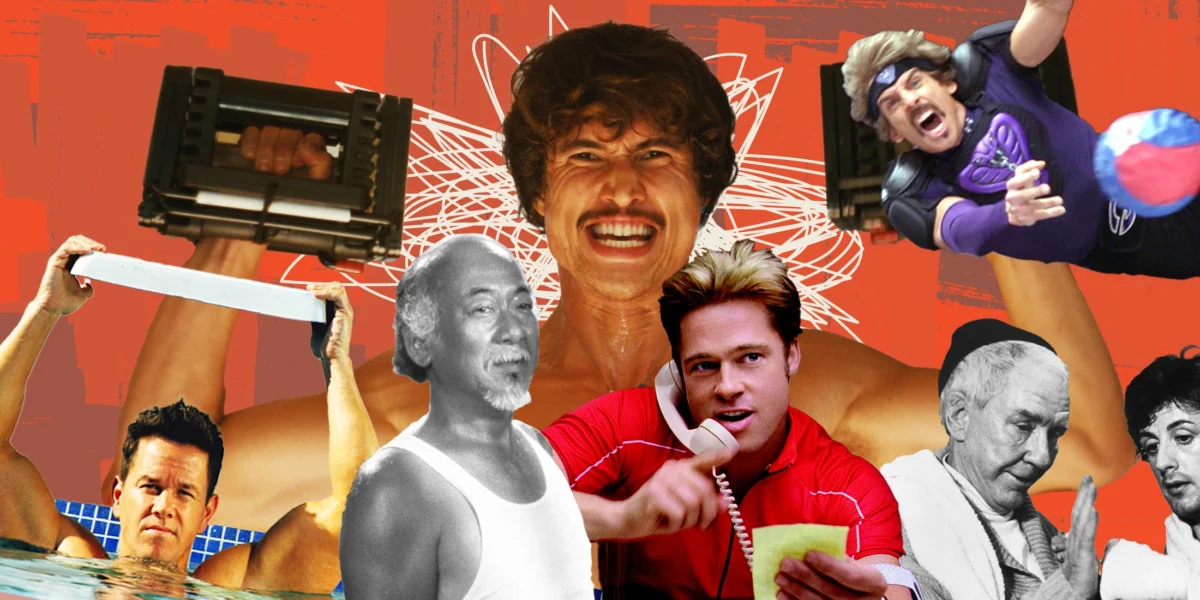
“The fictional personal trainer has evolved from a simple plot device into a sophisticated cultural mirror, reflecting our shifting societal values regarding physical perfection, mental discipline, and the often-absurd intersection of the wellness industry and the American Dream.”

This evolution of the on-screen fitness professional tracks a journey from the "crusty mentor" archetypes of the 20th century to the modern, multifaceted characters that headline today’s prestige television. By analyzing the most iconic trainers in film and television—from the philosophical guidance of Mr. Miyagi to the comedic vanity of White Goodman—we gain insight into how media shapes our perception of health, masculinity, and the transformative power of the human physique.
The Foundation of the Archetype: Mentorship and Grit
The concept of the screen trainer began not in the neon-lit gyms of the modern era, but in the gritty, sweat-soaked basements of mid-century boxing and martial arts. The quintessential example is Burgess Meredith’s Mickey Goldmill in the 1976 classic Rocky. Nominated for an Academy Award for Best Supporting Actor, Meredith’s portrayal defined the "old-school" trainer: a man who values heart over equipment and discipline over comfort. Mickey wasn’t just teaching Rocky Balboa how to punch; he was forging a man out of a "bum." This version of the trainer was a moral compass, a surrogate father who used harsh truths to build resilience.

Parallel to the grit of Mickey Goldmill was the spiritual stoicism of Pat Morita’s Mr. Miyagi in 1984’s The Karate Kid. Morita, who also earned an Oscar nomination, redefined the trainer as a philosopher. By eschewing traditional exercises for "wax on, wax off" chores, Miyagi demonstrated that physical mastery is an extension of mental and spiritual balance. The enduring legacy of this character is evident in the modern success of Cobra Kai, where the philosophical conflict between different training styles continues to drive the narrative for a new generation.
The Rise of the Fitness "Himbo" and Comedic Vanity
As the 1980s gave way to the fitness-obsessed 90s and 2000s, the cinematic trainer began to reflect the vanity and superficiality often associated with the burgeoning gym culture. This shift gave rise to the "sweet dummy" or "himbo" archetype, perhaps best exemplified by Brad Pitt’s Chad Feldheimer in the Coen Brothers’ 2008 dark comedy Burn After Reading. Pitt’s performance is a masterclass in comedic timing, portraying a trainer whose world is defined by his iPod playlist and his desire to be perceived as a "cool guy." Chad represents the trainer as a harmless but dim-witted enthusiast, a man whose physical fitness is a substitute for intellectual depth.

Contrasting Chad’s sweetness is the aggressive, narcissistic villainy of Ben Stiller’s White Goodman in Dodgeball: A True Underdog Story (2005). As the owner of GloboGym, Goodman is the corporate nightmare of the fitness world—a man who uses negging and intimidation to sell a version of perfection he barely understands. Stiller’s cartoonish performance serves as a sharp satire of the commercialization of wellness, where the "trainer" is no longer a mentor but a predatory brand manager.
Similarly, Christopher Meloni’s turn as Ray Whelans in HBO’s Veep (2014) highlights the absurdity of the "fitness guru" in the political sphere. As the trainer to Selina Meyer, Ray is a man of immense confidence and zero substance. Meloni, typically known for his "tough guy" roles in the Law & Order franchise, uses his physicality to emphasize the character’s intellectual vacancy, proving that in the world of high-stakes politics, a good trainer is often just a high-priced distraction.

Bodybuilding and the Dark Side of the American Dream
The 2013 film Pain & Gain, directed by Michael Bay, took the trainer archetype into much darker, more satirical territory. Based on a series of real 1999 Miami New Times articles, the film stars Mark Wahlberg as Daniel Lugo, a Miami trainer and ex-con who believes his physical discipline entitles him to wealth and status.
Lugo, along with characters played by Dwayne "The Rock" Johnson and Anthony Mackie, represents the "bodybuilding as religion" mindset. In this narrative, the gym is a temple, and the trainer is a misguided prophet leading his followers into a deadly criminal enterprise. Wahlberg’s Lugo is magnetic but delusional, illustrating a dangerous intersection where the pursuit of the "perfect body" bleeds into a sociopathic pursuit of the "perfect life." It remains one of the most stark examinations of how the fitness industry can fuel a toxic brand of exceptionalism.

The Modern, Layered Professional
In recent years, the portrayal of trainers has shifted toward more grounded, complex character studies. The 2015 indie film Results offers a "deep cut" into this reality. Starring Guy Pearce and Cobie Smulders as Trevor and Kat, the film explores the mundane, often stressful life of professional trainers at a local gym. These aren’t caricatures; they are people with romantic histories, financial anxieties, and a wealthy, difficult client who disrupts their equilibrium. Results treats training as a career rather than a trope, highlighting the emotional labor involved in helping others change their lives.
This trend continues with the second season of Netflix’s Beef, featuring Charles Melton as Austin Davis. Melton, the Men’s Health Spring 2026 cover star, portrays a former college football standout turned country club trainer. Austin Davis is a significant evolution for the archetype; he is physically elite—possessing the requisite washboard abs and endurance—but he is also depicted as "well-meaning, funny, and honest."

In Beef, Melton’s character interacts with a high-profile cast including Oscar Isaac, Carey Mulligan, and Cailee Spaeny. Austin is not a "dumb jock" or a "philosophical sage," but a layered individual whose professional identity as a trainer is just one facet of a complex personality. This portrayal signals a move toward realism, where the trainer is a person with their own narrative arc rather than just a catalyst for the protagonist’s growth.
The Sitcom Staple: Intensity as Humor
Television sitcoms have long used the personal trainer as a source of high-energy comedy. Joe Lo Truglio’s brief but unforgettable role as Lonnie (also known as Elmo) in I Love You, Man (2009) captured the hyper-intensity of the local gym rat. His squeaky-voiced encouragement—"Everything you got!"—became an instant cultural shorthand for the over-eager fitness professional.

In the long-running series New Girl, Damon Wayans Jr. played "Coach," a character whose entire identity was built around his background as a fitness guru. The character’s history is a unique one in television; Wayans appeared in the pilot, left for other commitments, and returned in later seasons to fully flesh out the role. Coach’s intensity was his primary comedic engine, using the "drill sergeant" persona to mask his own social insecurities. Over 44 episodes, Wayans showed that the "trainer" persona can be both a defensive shield and a source of genuine connection.
Similarly, Jason Segel’s character "Jason" in the Judd Apatow cinematic universe (Knocked Up and This Is 40) shows a more casual evolution. In This Is 40, we see the character transition from a directionless youth into a trusted, albeit arrogant, personal trainer. Segel plays the role with a specific "likable-but-obnoxious" energy that perfectly captures the friend-turned-professional dynamic common in boutique fitness circles.

Conclusion: The Trainer as a Cultural Icon
From the archival footage of the late Richard Simmons in Space Jam—shouting "You’re becoming mighty!" to a group of Looney Tunes—to the sophisticated dramatic turns of Charles Melton, the trainer remains a vital fixture in our storytelling. Whether they are serving as a source of inspiration, a target of satire, or a complex protagonist, these characters help us navigate our own relationships with our bodies and our ambitions.
As cinema and television continue to evolve, the personal trainer archetype will likely continue to shift, reflecting new trends in wellness, technology, and social dynamics. Yet, the core of the role remains unchanged: the trainer is the person who stands at the threshold of change, challenging the protagonist—and the audience—to give "everything they’ve got."
