

"We get placed in a facility like this to be taken care of, not to be murdered." – Gino Cecchetto, son of a fatal victim, highlighting the preventable tragedy within elder care facilities.
This profound statement underscores a growing crisis in long-term care facilities across the nation: the alarming frequency and severity of violence between residents. While often attributed to the cognitive impairments of dementia, these incidents reveal systemic failures in facility management, staff training, and the fundamental prioritization of resident safety over profit. The tragic death of Attilio Cecchetto, a 92-year-old retired tile installer, at the hands of his roommate, Sam Ato Timaloa, a paroled sex offender with a history of attempted murder and dementia-induced noise intolerance, serves as a stark illustration of this complex and often overlooked issue.

The case of Attilio Cecchetto, who died two days after a brutal assault by his roommate at Sunrise Post Acute in Banning, California, is a grim testament to the dangers lurking within some elder care facilities. Timaloa, 77, whose own dementia reportedly exacerbated his sensitivity to noise, was repeatedly moved between rooms over a four-month period in 2025, ultimately being placed with Cecchetto, whose dementia caused him to frequently moan, mumble, and yell. The night of the attack, a nurse aide discovered Cecchetto with his face "twisted and smashed," and Timaloa admitted to punching him twice, citing Cecchetto’s noise as the sole provocation. This incident, deemed preventable by Cecchetto’s son, Gino, highlights critical lapses in room assignment protocols and the failure to adequately manage residents with challenging behaviors. Timaloa faces murder charges, with his competency to stand trial pending a mental health evaluation. Sunrise’s owner, PACS Group, has denied negligence, expressing condolences to the family while emphasizing their commitment to quality care.
However, the Cecchetto tragedy is far from an isolated incident. A KFF Health News examination of federal inspection reports reveals a pervasive problem of resident-on-resident aggression, ranging from shoves and bites to more severe assaults. These incidents occur across the spectrum of long-term care, from facilities serving impoverished individuals to luxurious assisted living communities costing over $10,000 per month. Residents have employed a variety of makeshift weapons, including canes, walkers, pens, and even wheelchair footrests, underscoring the potential for serious harm.
The precise national prevalence of these altercations remains unknown, but studies offer a chilling glimpse into the scope of the problem. Research by Cornell University in New York state estimated that approximately one in seven residents in assisted living facilities experience aggression within a month, a figure rising to one in five in nursing homes. These studies, which include verbal, physical, and sexual aggression, also found a disproportionate likelihood for assailants to have dementia.
Dementia, characterized by its progressive impairment of cognitive functions, directly impacts brain circuits responsible for impulse control and threat perception, significantly increasing the risk of aggressive behavior. Residents with Alzheimer’s disease and other forms of dementia constitute a substantial portion of the over 900,000 individuals residing in long-term care settings, many of whom are housed in specialized memory care units designed to cater to their unique needs.
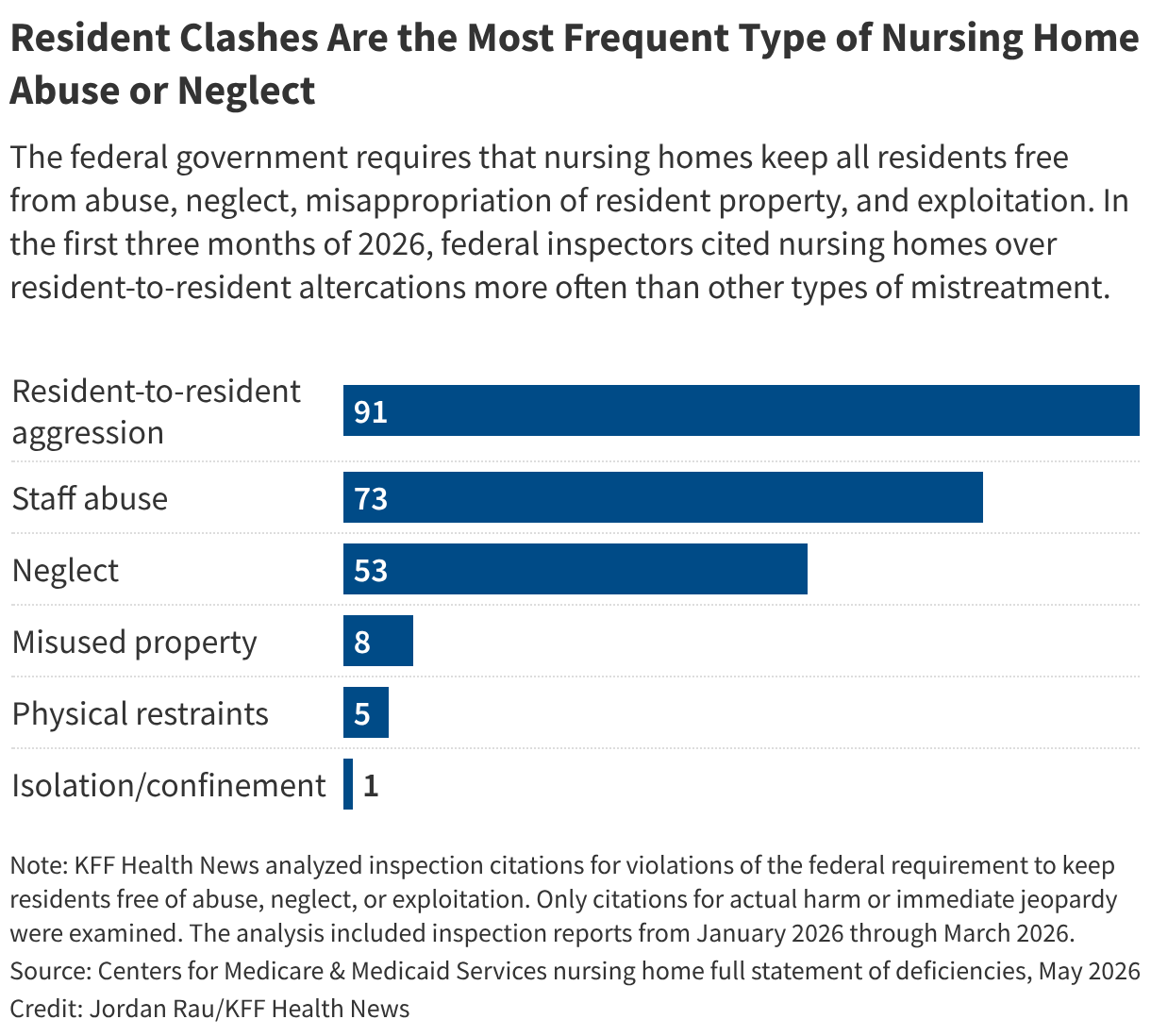
Crucially, these violent encounters often stem from missed or inadequately addressed danger signals. A KFF Health News review of court records, police reports, and state and federal inspection reports indicates that when warning signs are overlooked, the likelihood of escalating conflict intensifies. Since the beginning of 2024, the federal Centers for Medicare & Medicaid Services (CMS) has cited nursing homes at least 700 times for failing to protect residents from physical, sexual, or verbal abuse perpetrated by other residents. Notably, in the first quarter of 2026, resident-to-resident abuse citations surpassed all other types of abuse, neglect, or exploitation, including those involving staff misconduct.
The long-term care industry acknowledges the complexity of managing residents with advanced dementia, noting that behaviors can be unpredictable. Presbyterian Homes & Services, a nonprofit senior living chain, stated that "Caring for individuals living with advanced dementia is complex, and behaviors can change in ways that are difficult to fully predict or prevent, even with clinical interventions in place." However, dementia consultants like Eilon Caspi argue that most altercations are preceded by discernible unmet needs and warning signs that manifest in the days, weeks, and even minutes leading up to an incident.
The underlying pathology of diseases like Alzheimer’s plays a significant role. Psychological theories suggest that as brain networks deteriorate, the balance between the prefrontal cortex (responsible for judgment and self-control) and limbic regions (involved in fear and threat processing) shifts. This cognitive decline can lead to a diminished ability to understand surroundings and articulate distress. Pain, infections, medication side effects, and emotional distress can be expressed through aggression. The long-term care environment itself, with its close quarters, changing staff, and rigid routines, can be inherently triggering, especially for individuals experiencing the disorientation and fear associated with cognitive impairment. Geriatrician Al Power notes, "You don’t feel safe, because you don’t know these strangers who are coming in and taking off your clothes. These things will be distressing to anybody."
While verbal altercations are the most common form of aggressive interaction, studies indicate that a significant minority of residents experience physical assaults. Research in Connecticut found that police were called to nursing homes for resident-to-resident clashes more frequently than for allegations of staff abuse, theft, and resident elopement combined. National data suggests nearly 8% of residents in assisted living facilities engage in physical aggression. These aggressive behaviors are frequently perpetrated by residents with diagnoses of dementia, schizophrenia, or other cognitive disorders. In many instances, both residents involved may have been aggressors, while other conflicts are one-sided, sometimes occurring between roommates. Laura Mosqueda, a geriatrician and elder abuse expert, expresses concern that residents with cognitive impairment or severe mental health issues are blamed for altercations when they are supposed to be in a safe environment.
The case of Gladys Lynch, a 96-year-old woman who died after being fatally assaulted by another resident at Harbor Crossing, a memory care unit in White Bear Lake, Minnesota, exemplifies the potential consequences of inadequate supervision and intervention. Despite her daughter’s repeated concerns and reports of the aggressive resident entering Lynch’s room, the facility’s response was insufficient. A Minnesota Department of Health report found that Harbor Crossing failed to protect Lynch, despite knowing the other resident exhibited violent and aggressive behaviors. The aggressive resident, diagnosed with Alzheimer’s and severe dementia with agitation, depression, and anxiety, had a history of entering other residents’ rooms and hitting aides. Staff had repeatedly flagged her "ongoing aggression" and difficulty being redirected, with one nurse warning that it was "only a matter of time" before she "hurts another resident."

Video evidence captured the final days, showing the aggressive resident repeatedly entering Lynch’s room, using her bathroom, and verbally threatening her. Lynch repeatedly pressed her emergency pendant, but staff did not arrive for 13 minutes after the initial alert. The assault resulted in a brain hemorrhage and fractures, leading to Lynch’s death five days later. While prosecutors declined to press charges, the state investigation concluded Harbor Crossing was responsible for neglect. A wrongful death lawsuit has been filed against Presbyterian Homes, the owner of Harbor Crossing.
Experts advocate for proactive strategies to mitigate resident-on-resident violence. These include enhanced supervision of high-risk residents, proximity to nursing stations, separation of residents with persistent conflicts, and careful roommate assignments. Comprehensive care plans, staff training on recognizing resident triggers, and prompt intervention are crucial. While psychotropic medications are sometimes prescribed, their potential side effects, including increased risk of falls and strokes, necessitate careful consideration. Furthermore, the chronic understaffing in many facilities limits the availability of dedicated one-on-one supervision, leading some assisted living facilities to require families to hire private aides at significant additional cost. In extreme cases, facilities may resort to hospital evaluations, psychiatric admissions, or resident discharge. Camille Russell, a former long-term care ombudsman, observed that staff are often "woefully undertrained" in dementia care, suggesting a critical imbalance favoring profit over compassionate decision-making.
Even when altercations do not result in fatalities, they can inflict lasting damage on frail residents. Linda Twiddy, a woman with vascular dementia, suffered a severe leg injury after being kicked by another resident with dementia at The Vero at Chesapeake in Virginia. The assault, which occurred seven weeks after she moved into the facility, resulted in a 10-inch by 6-inch wound requiring multiple surgeries, including a skin graft, and ultimately rendered her unable to walk again. The assailant had a documented history of aggression at a previous facility, yet The Vero allegedly failed to adequately protect its residents. While the facility denied negligence and blamed Twiddy’s own actions, Virginia regulators cited The Vero for failing to assume responsibility for resident well-being. The lawsuit brought by Twiddy’s family was settled confidentially.

The background of Sam Ato Timaloa, the assailant in the Cecchetto case, reveals a history of serious offenses, including rape of a minor and attempted murder, raising further questions about the screening and placement of individuals with violent pasts in vulnerable elder care settings. PACS Group, the owner of Sunrise Post Acute, a large publicly traded company, faces accusations in a lawsuit of diverting resources from its facilities for expansion and personal enrichment, while also engaging in corporate sponsorships in states where it has no facilities. California regulators fined Sunrise $120,000 for failing to protect Cecchetto and neglecting Timaloa’s documented aversion to noise. Medicare also issued a $62,810 fine. PACS has denied negligence and is challenging the state fine, asserting that Sunrise acted reasonably. The Cecchettos’ lawsuit seeks to mandate robust procedures for admissions, staff training, room changes, and incident reporting across all PACS homes, including the appointment of a court-supervised monitor.
The Cecchetto sons, Dino, Gino, and Marco, wish to ensure their father’s tragic end serves as a catalyst for change, stating, "We don’t want this to happen to somebody again. With the life he led, he deserved a quiet, dignified death. Instead, he ended his life in pain and fear." Their plea echoes a broader call for a fundamental shift in how long-term care facilities prioritize the safety and dignity of their residents, moving beyond a focus on profit and embracing a model of truly compassionate and vigilant care.
