
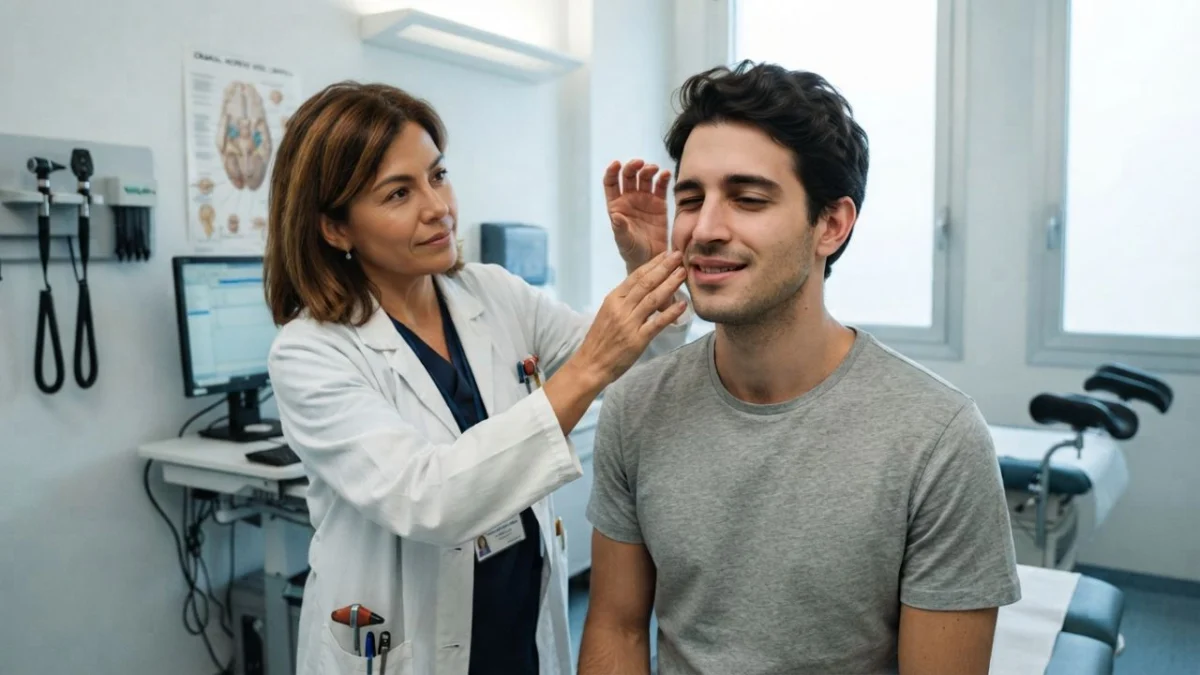
"A seemingly innocuous yawn can, in rare instances, trigger a cascade of events leading to sudden facial paralysis, highlighting the intricate connection between pressure changes and nerve function. This case underscores the importance of comprehensive medical evaluation, even when symptoms appear to stem from everyday actions."
A 27-year-old man, in peak physical condition, experienced a sudden and alarming onset of right-sided facial paralysis shortly after a prolonged yawn while seated in a car. The incident left him with a feeling of fullness in his right ear, numbness in his cheek and tongue, and an inability to close his right eye. This dramatic presentation, mirroring classic stroke symptoms, prompted an immediate medical investigation. However, after extensive brain and ear imaging revealed no underlying structural abnormalities, Italian clinicians at the Universities of Verona and Padua arrived at a less common diagnosis: alternobaric facial palsy. This condition, typically associated with activities involving significant pressure fluctuations like scuba diving, flying, or changes in altitude, involves an injury to the facial nerve caused by pressure shifts within the middle ear. Remarkably, the young man made a full recovery within three weeks, a testament to the body’s remarkable resilience and timely medical intervention.
The case, formally published in the September 2025 online edition of CRANIO and slated for the journal’s 2026 print volume, serves as a compelling illustration of how an ordinary physiological act can precipitate an unusual neurological complication. It also emphasizes the critical principle in medicine: never to jump to benign conclusions when confronted with sudden facial drooping, a symptom that demands rigorous differential diagnosis to rule out life-threatening conditions such as stroke.
The Crucial Process of Elimination: Ruling Out the Dangerous First
Upon initial examination, the man presented with a grade IV peripheral facial palsy on the right side, according to the standardized House-Brackmann scale, which quantifies facial nerve function from grade I (normal) to grade VI (complete paralysis). A key indicator of peripheral involvement was his positive Bell’s sign, characterized by the upward rolling of his eye when he attempted to close it – a phenomenon not typically observed in central nervous system lesions like stroke. Beyond this, his comprehensive neurological examination yielded no other abnormalities, a crucial detail in the diagnostic puzzle.
To definitively rule out more sinister causes, the medical team meticulously conducted CT and MRI scans of both his brain and temporal bones, the intricate bony structures housing the delicate auditory and facial nerve pathways. These advanced imaging techniques revealed no lesions, tumors, or any other structural impediments that could account for his symptoms. This thorough exclusion of common and severe pathologies was pivotal in guiding the clinicians toward a rarer diagnosis.
Alternobaric facial palsy, therefore, emerged as a diagnosis of exclusion. This means it was reached not by a specific positive test for the condition itself, but by systematically eliminating all other plausible explanations for the patient’s abrupt onset of facial paralysis following a demonstrable pressure-altering event. The absence of any underlying structural defect, coupled with the clear temporal link to the yawn and the elimination of stroke, solidified this diagnosis.
The treatment regimen prescribed was conservative yet effective. The patient was administered prednisone, a corticosteroid, starting at a dosage of 50 milligrams and gradually tapering off over three weeks. Concurrently, he received supportive care, including eye protection to prevent corneal damage due to his inability to fully close his eyelid, and close clinical monitoring. His recovery was swift and complete, with full facial function restored within three weeks. Crucially, he experienced no recurrence of symptoms at subsequent follow-up intervals of three, six, and twelve months, indicating a complete resolution of the episode.
The Forehead as a Diagnostic Clue: Distinguishing Central vs. Peripheral Nerve Issues
A fundamental principle in neurology involves differentiating between a problem originating in the facial nerve itself (peripheral palsy) and a problem originating in the brain (central lesion, such as stroke). One of the most clinically useful distinctions lies in the ability to move the forehead muscles.
According to StatPearls, a reputable medical reference, alternobaric facial paresis, a milder form of the palsy, can manifest as an inability to wrinkle the forehead, close the eye, or produce an even smile. Crucially, the same reference notes that "sparing of the forehead suggests a central cause, like stroke." This means that if a person can still wrinkle their forehead, even with drooping on one side of their face, it points more strongly towards a brain-related issue. Conversely, if the forehead muscles are also affected, it leans towards a peripheral nerve problem.
While this rule of thumb is a valuable tool for clinicians, it is imperative for the public not to rely on it for self-diagnosis. The American Stroke Association unequivocally lists facial drooping as one of the primary warning signs of stroke and urges immediate emergency medical attention by calling 911, regardless of whether symptoms appear to resolve. In the case of the 27-year-old man, it was the comprehensive diagnostic approach, including imaging and a thorough neurological examination, that allowed his doctors to confidently rule out stroke.
The Mechanics of Ear Pressure and Facial Nerve Function
The facial nerve (cranial nerve VII) is a complex nerve responsible for a multitude of functions, including controlling the muscles of facial expression, taste sensation from the anterior two-thirds of the tongue, and tear and saliva production. It traverses a narrow bony canal within the temporal bone, a pathway that runs in close proximity to the middle ear.
Alternobaric facial paresis, as explained by StatPearls, occurs when abnormal pressure fluctuations within the middle ear compress this delicate nerve as it passes through its bony canal. This compression can temporarily disrupt the nerve’s ability to transmit signals, leading to the characteristic symptoms of facial weakness.
This condition is particularly recognized within communities that experience significant atmospheric pressure changes. Divers, for instance, are susceptible due to the rapid pressure increases and decreases encountered during dives. Similarly, air travelers can be affected, especially if they experience nasal congestion or upper respiratory infections that impair the function of the Eustachian tube, the delicate canal that normally equalizes pressure between the middle ear and the nasopharynx.
Indeed, medical literature provides corroborating examples. A report in the Journal of Medical Case Reports detailed a 25-year-old man who developed temporary right-sided facial weakness during an airplane flight, a situation exacerbated by pre-existing nasal congestion and a sore throat. A comprehensive systematic review published in the Annals of Otology, Rhinology and Laryngology in 2023 identified 49 previously documented cases of alternobaric facial palsy. The review highlighted a mean patient age of 34 years and noted that approximately 80% of affected individuals were male, suggesting potential gender-related predispositions or reporting biases.
Further insights from a Chilean otolaryngology journal indicate that the condition typically arises in the context of Eustachian tube dysfunction, coupled with anatomical variations such as gaps in the bony facial nerve canal and external pressure changes. The authors of this review also observed that the majority of episodes are transient, lasting from mere minutes to a few hours, before complete resolution. The condition is likely underreported due to its self-limiting nature and the possibility of individuals not seeking medical attention for what they perceive as a brief, resolveable issue.
The Paradox of the Yawn: An Unusual Trigger for a Pressure-Related Condition
The case of the 27-year-old man is particularly noteworthy because yawning is typically considered a natural mechanism to alleviate pressure changes in the middle ear. StatPearls lists yawning and swallowing as actions that help equalize pressure within the middle ear, often resolving the discomfort associated with altitude or diving. This makes a yawn an atypical trigger for a condition that results from pressure imbalances.
The Italian researchers described the yawn in their patient as an "atypical trigger," advocating for a broader consideration of alternobaric mechanisms in cases of sudden facial palsy, even when occurring in seemingly ordinary, everyday circumstances. Furthermore, their patient’s experience deviated from the typical short-lived nature of the condition, with his weakness persisting for weeks rather than minutes or hours.
It is crucial to contextualize this single case report. While it demonstrates that alternobaric mechanisms can be at play in unexpected scenarios, it does not suggest that yawning poses a significant risk for the general population. The diagnosis of alternobaric facial palsy in this instance was contingent on the meticulous process of excluding other conditions. Moreover, the report does not imply that the pressure change itself was directly captured or measured during the yawn; rather, the diagnosis was inferred from the clinical presentation and the absence of alternative explanations.
The implications of misdiagnosis can be significant. The StatPearls reference points out that divers experiencing alternobaric facial palsy have, in some instances, been mistakenly diagnosed with more severe conditions like decompression sickness or air embolism. Such misdiagnoses can lead to unnecessary and potentially harmful recompression treatments.
Immediate Action and Future Considerations
The overarching message from this case and the medical literature is clear: sudden facial weakness, regardless of perceived cause, warrants immediate professional medical evaluation. Anyone experiencing such symptoms, or other neurological red flags such as sudden numbness, slurred speech, arm weakness, vision changes, or difficulty walking, should call 911 without delay. Prompt medical assessment is essential to differentiate between transient, benign conditions and life-threatening emergencies like stroke.
For individuals who have previously experienced facial weakness during flights or dives, it is advisable to discuss these episodes with a healthcare professional, ideally an otolaryngologist (ear, nose, and throat specialist), before undertaking future travel or diving activities. This proactive approach can help identify potential underlying predispositions and inform preventative strategies.
Key Questions Answered
What happened to the man?
A 27-year-old man experienced right-sided facial weakness, ear fullness, numbness in his cheek and tongue, and an inability to close his right eye shortly after performing a prolonged yawn in a car.
What is alternobaric facial palsy?
It is a rare condition characterized by temporary facial nerve dysfunction caused by pressure fluctuations within the middle ear. It is most commonly associated with activities like scuba diving, flying, or significant changes in altitude.
How did doctors rule out stroke?
Doctors ruled out stroke through a combination of a normal neurological examination (apart from the facial palsy) and the absence of any lesions on CT and MRI scans of the brain and temporal bones.
Why does the forehead matter in diagnosis?
The ability to move the forehead muscles can help distinguish between a central cause of facial weakness (like stroke), which often spares the forehead, and a peripheral nerve issue, which typically affects the forehead as well. However, this assessment should only be made by a qualified clinician.
Did he recover?
Yes, the man recovered fully within three weeks with a course of corticosteroid medication (prednisone) and appropriate eye care. He experienced no recurrence of symptoms in the subsequent year.
What should someone do if their face suddenly droops?
Anyone experiencing sudden facial drooping should call 911 immediately, as this is a critical stroke warning sign until proven otherwise by medical professionals.
