
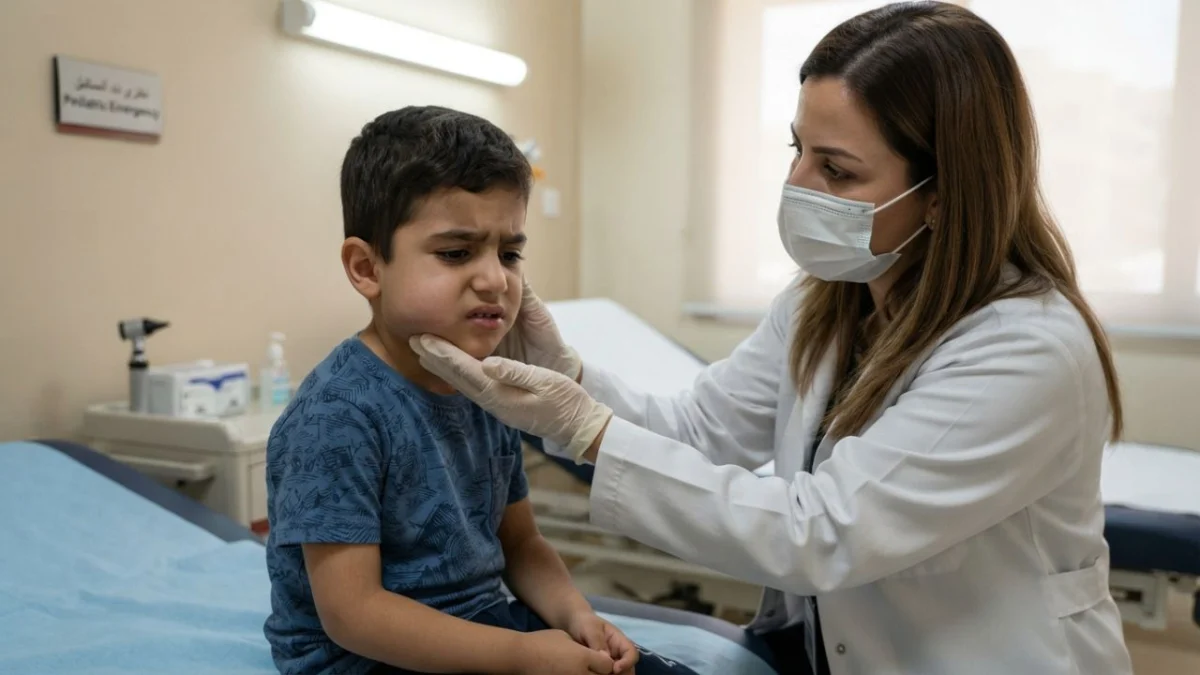
A seemingly innocuous slap on a child’s cheek can, in rare instances, lead to significant facial swelling by inflaming the parotid gland, underscoring the need for medical evaluation of any facial swelling, even in the absence of apparent injury.
A 4-year-old boy’s sudden onset of severe facial swelling, rendering him unable to eat, serves as a compelling case study illustrating how a minor childhood incident can trigger a localized inflammatory response in a crucial salivary gland. The experience, initially concerning and prompting emergency medical intervention, ultimately revealed that a child’s delicate anatomy can be surprisingly susceptible to seemingly minimal trauma, leading to conditions that mimic more common illnesses like mumps or infections. This case, detailed in the journal Open Access Emergency Medicine, highlights the importance of considering less common etiologies for facial swelling and reassures parents that not all such presentations are indicative of serious disease.
The incident began with a seemingly minor altercation during unsupervised play. The young boy, who had no prior medical history and was up-to-date on his vaccinations, experienced a slap to the left side of his face from his 5-year-old cousin. While described by medical professionals as having been delivered with "minimal force," the impact resulted in significant swelling of the boy’s left cheek, accompanied by pain that intensified with jaw movement and mouth opening, preventing him from eating his breakfast. The rapid onset of these symptoms prompted his father to seek immediate medical attention at a tertiary hospital.
Upon examination, emergency physicians noted a tender swelling localized over the parotid gland, situated just in front of the boy’s left earlobe. Crucially, there were no external signs of trauma such as redness, bruising, or skin lacerations. The boy’s vital signs were stable, including a normal temperature, and he experienced no difficulty swallowing. His facial nerve function, which traverses the parotid gland, remained intact, indicating that the swelling was not compromising this critical nerve. As a standard protocol for any case involving a child, a child protection social worker reviewed the situation. A thorough assessment of the child’s skin revealed no suspicious marks, and the caregiver’s account of the incident was consistent with the child’s, raising no concerns of abuse.
Diagnostic efforts focused on identifying the cause of the swelling, which presented a diagnostic challenge due to the absence of overt injury. Initial laboratory investigations provided a critical clue: the boy’s amylase levels were exceptionally high, measuring 1,437 units per liter, approximately 14 times the upper limit of the normal range. Amylase is an enzyme produced by both salivary glands and the pancreas, and its elevated levels are often indicative of salivary gland involvement. In contrast, his lipase levels, which are primarily produced by the pancreas, were within the normal range. This disparity strongly suggested that the salivary glands, rather than the pancreas, were the source of the elevated amylase.
Further laboratory tests effectively ruled out common infectious causes of facial swelling. The boy’s white blood cell count, a key indicator of infection, and his C-reactive protein levels, a marker of inflammation, were both normal. Serological tests for mumps, Epstein-Barr virus (mononucleosis), and human herpesvirus 6 all returned negative results, effectively dispelling concerns of viral infections.
To further investigate the anatomical source of the swelling and to rule out more serious injuries like a jaw fracture, a CT scan of the boy’s facial bones was ordered. The CT imaging revealed an enlarged left parotid gland with surrounding inflammation in the adjacent fatty tissue. Importantly, there was no evidence of a fracture. While the authors of the case report noted that ultrasound, a non-ionizing imaging modality, is often the preferred first-line investigation in pediatric patients, its absence in this instance was identified as a limitation. After meticulously ruling out other potential causes, including bacterial infection, abscess formation, swollen lymph nodes, salivary duct stones, hematoma (blood collection), and juvenile recurrent parotitis, the medical team arrived at a diagnosis of isolated traumatic parotitis.
The parotid glands, the largest of the salivary glands, are situated on each side of the face, anterior to the ear and overlying the jawbone. This anatomical position, nestled against the firm structures of the mandible and skull base, renders them susceptible to compression. The medical team proposed that the force of the slap, even if seemingly minimal, likely caused direct injury to the glandular tissue (parenchyma) or its ductal system. This could have occurred through compressive or shearing forces acting against the underlying bone. Such an injury could lead to the leakage of saliva into the surrounding tissues, triggering a chemical, non-infectious inflammatory response and subsequent swelling. While this remains a proposed mechanism, it offers a plausible explanation for the observed symptoms.
Trauma-induced parotitis is considered an uncommon condition, with blunt trauma being reported less frequently than penetrating injuries. This case serves to emphasize that even seemingly low-velocity impacts, such as an everyday slap, can indeed result in localized parotid gland swelling. This finding is supported by a similar case reported in early 2026 by physicians at The Hospital for Sick Children in Toronto. In that instance, a 9-year-old boy experienced parotid gland swelling following a minor fall while jumping on a couch. He subsequently made a full recovery within a two-week period.
For parents, swelling in the cheek area, particularly around the ear, can often trigger immediate concern about mumps. The Centers for Disease Control and Prevention (CDC) identifies "puffy cheeks and a tender, swollen jaw" as a hallmark symptom of mumps. However, widespread vaccination has dramatically reduced mumps incidence in the United States, with a decline of over 99% since the introduction of the vaccine program in 1967. The CDC recommends two doses of the MMR (measles, mumps, and rubella) vaccine, with the first dose typically administered between 12 and 15 months of age and the second between 4 and 6 years of age. While one dose offers approximately 72% efficacy against mumps, two doses provide about 86% protection.
Another condition that can present with recurrent parotid swelling in children is juvenile recurrent parotitis. This condition, most commonly beginning between the ages of 3 and 6, is characterized by repeated episodes of gland swelling that typically resolve between the ages of 10 and 15. However, in this specific case, the symptoms were acute and directly linked to a discernible event, differentiating it from the recurrent nature of juvenile parotitis.
The treatment for this young boy was straightforward and conservative. He was managed with pain relief medication, a soft diet to minimize discomfort during chewing, and warm compresses applied to the affected area. His symptoms showed a consistent improvement over the course of seven days, and by his two-week follow-up appointment, the swelling had completely resolved.
The case underscores a crucial message for parents and caregivers: any instance of facial swelling in a child warrants professional medical evaluation. While mumps and infections are common culprits, less frequent causes, such as trauma-induced parotitis, must also be considered. Parents should seek prompt medical attention, especially if the swelling is accompanied by fever, redness, escalating pain, difficulty opening the mouth, or impaired eating. Early and accurate diagnosis ensures appropriate management and alleviates parental anxiety.
