
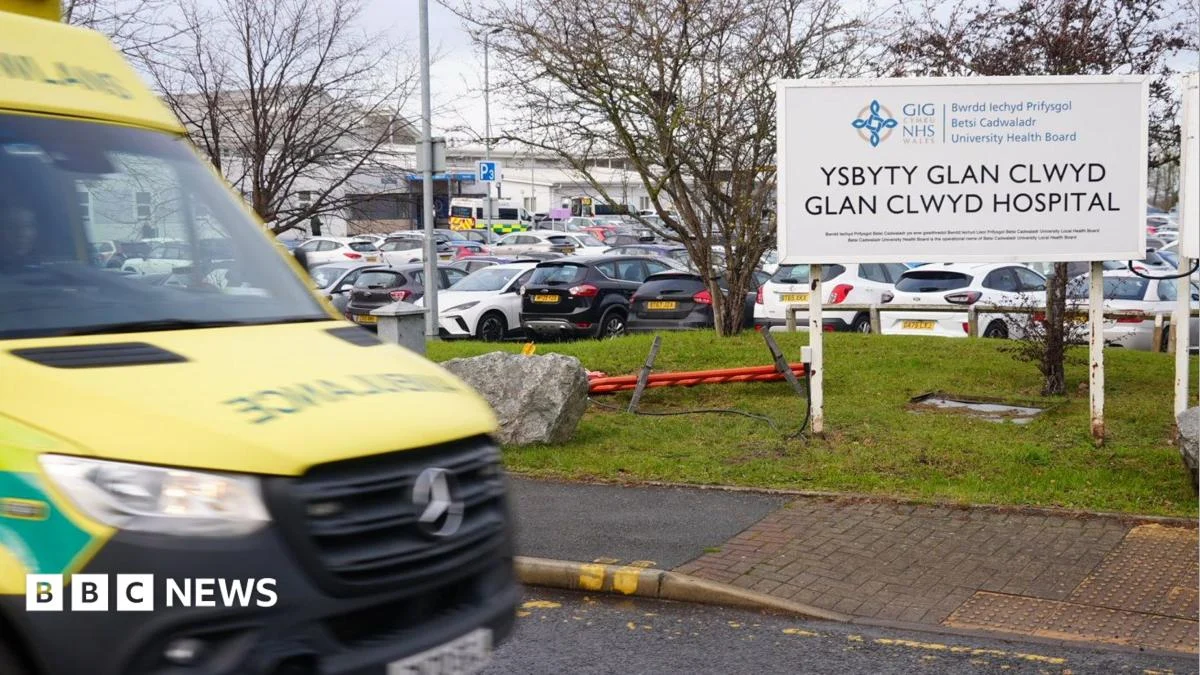
"The profound distress and physical hardship faced by patients enduring extreme waiting times in North Wales A&E departments highlight a system under immense strain, where dedicated frontline staff are battling against what many perceive as a critical leadership void and organizational disarray."
Across North Wales, emergency departments are grappling with unprecedented pressures, leading to harrowing experiences for patients seeking urgent care. The personal accounts of individuals like Hughes from Abergele, Conwy, and John Cooke, a retired assistant chief constable from North Wales Police, paint a stark picture of a healthcare system where delays, discomfort, and a perceived lack of strategic oversight have become disturbingly commonplace. Their stories resonate with a growing public concern over the operational integrity and leadership effectiveness within the region’s health services, particularly at facilities like Ysbyty Glan Clwyd, which falls under the Betsi Cadwaladr University Health Board.
Hughes’s ordeal began last month when, on her doctor’s advice, she presented at A&E. What followed was a bewildering and deeply distressing experience. "I didn’t know what was happening to me. I didn’t know what I’d got," she recounted, describing the agonizing hours and days as a "nightmare that I’d like to forget." Her physical discomfort was compounded by the desperate search for even a rudimentary place to rest, as she found herself "looking round to see if there was something spare that you could lie on." This immediate and acute sense of vulnerability, coupled with a lack of basic comfort, underscores the profound human cost of an overburdened system.
Her frustration, however, was not directed at the clinical teams. Hughes was quick to commend the frontline staff, acknowledging their tireless efforts under challenging circumstances. Instead, her criticism was aimed squarely at the upper echelons of the health service: "I think it’s the higher-ups. It’s not the people on the ground, it’s the chief executives, it’s the bosses in my opinion. They’re not doing their jobs." This sentiment, that "the top people have lost interest," points to a deep-seated perception of disconnect between leadership and the reality of patient care. The traumatic nature of her experience was so profound that Hughes declared she would refuse to return to A&E, stating, "I’m not going back to that after what I’ve been through," indicating a severe erosion of trust in the emergency care provision.
Beyond her personal anguish, Hughes voiced grave concerns for the most vulnerable members of society. She articulated a chilling fear for older patients who might face similar conditions, stating, "They wouldn’t stand a chance. How could you have an 80 or 90-year-old sitting in a chair for 48 hours? It’s ridiculous. No blankets, nothing like that. You’re just plonked." This highlights not only the physical indignity but also the potential for significant health deterioration in elderly individuals subjected to such prolonged periods of discomfort and neglect, amplifying ethical considerations around patient welfare and basic human dignity.
John Cooke, 78, a retired assistant chief constable with North Wales Police, offers a unique perspective, having navigated the healthcare system for decades. Diagnosed with Crohn’s disease in 1995 and first hospitalised in 1996, his regular flare-ups have led to two to three admissions every year to Ysbyty Glan Clwyd over the past three decades. His long-term engagement with the hospital provides a valuable historical lens through which to observe the marked decline in conditions. While echoing Hughes’s praise for the dedication of frontline staff, Cooke noted a palpable deterioration in overall service quality.
The most glaring change, according to Cooke, is the escalating time it takes for patients to be seen and subsequently allocated a ward bed. "When I first started on this road I could certainly be in a ward, in a bed within an hour," he recalled. This starkly contrasts with his more recent experiences, where "it can be very lengthy waits, despite the pain." He recently endured a staggering 47-hour wait in A&E before even being seen by a doctor, a wait that would have been unimaginable in earlier years. Cooke also cited instances of others waiting "almost a week to be allocated a bed," emphasizing that "very seriously ill people are not exempt from these waits at all," underscoring the critical risks posed by such delays.
Beyond emergency care, Cooke also reported a significant erosion in outpatient services. What were once guaranteed quarterly appointments for his chronic condition have now become "almost non-existent." This breakdown in continuity of care for long-term conditions not only impacts patient health but also places additional strain on emergency departments as patients may have no other recourse during flare-ups.
Cooke’s analysis of the systemic issues mirrors Hughes’s, but with the added weight of his experience in public service leadership. He firmly believes that improvement is impossible without a "complete restructuring of the organisation." His blame is directed squarely at "the management, the senior management, the executives," whom he describes as responsible for a system that is "completely leaderless." He carefully distinguishes this from the health board itself, acknowledging that boards might not have "direct access to the workforce," but holding operational leadership accountable for the palpable failures in service delivery. He too lauded the frontline staff, observing that they "work so hard and continue to labour under these conditions," highlighting the resilience and commitment of those at the sharp end of patient care.
The experiences recounted by Hughes and Cooke are not isolated incidents but reflect a broader, systemic crisis within NHS Wales, particularly pronounced in the Betsi Cadwaladr University Health Board (BCUHB) area, which oversees Ysbyty Glan Clwyd. BCUHB has a history of performance challenges, having been in and out of various levels of Welsh Government oversight, including special measures, due to persistent issues with leadership, governance, and patient safety. The chronic A&E delays are a symptom of a complex interplay of factors that have been exacerbated over time.
One of the primary drivers of emergency department overcrowding is the increasing demand for services. An ageing population with more complex, chronic conditions, coupled with challenges in accessing primary care, often leads patients to present at A&E for conditions that might otherwise be managed elsewhere. However, demand alone does not fully explain the extreme waits. Critical factors include persistent staff shortages across all disciplines – doctors, nurses, and allied health professionals – which limit bed capacity and the ability to process patients efficiently. Recruitment and retention issues, exacerbated by burnout and low morale among existing staff, contribute to a vicious cycle.
Furthermore, a significant contributor to A&E backlogs is the phenomenon of "delayed transfers of care" (DToC), often referred to as "bed blocking." This occurs when patients are medically fit for discharge but cannot leave the hospital due to a lack of available social care packages, community rehabilitation beds, or suitable residential placements. These patients occupy vital hospital beds, preventing new admissions from A&E and creating a bottleneck that ripples throughout the entire hospital system. The underinvestment in social care and community services directly impacts the flow through acute hospitals.
The implications of prolonged A&E waits extend far beyond mere discomfort. Medically, studies have shown a direct correlation between extended A&E stays and increased patient mortality and morbidity. Vulnerable patients, especially the elderly, are at a higher risk of hospital-acquired infections, falls, and a general decline in their physical and mental well-being when subjected to such environments for extended periods. Psychologically, the uncertainty, pain, and lack of dignity associated with long waits in busy, often underequipped, emergency departments can be deeply traumatising, eroding public trust in the very institutions designed to provide safety and care.
For the dedicated frontline staff, these conditions are equally devastating. Working in overcrowded A&Es, witnessing patient suffering that they are often powerless to alleviate due to systemic constraints, leads to immense moral injury, stress, and burnout. This, in turn, fuels the cycle of staff shortages and makes it harder to recruit new talent, further exacerbating the crisis.
The calls for "complete restructuring" and accountability for "senior management" reflect a broader dissatisfaction with governance and operational leadership within the health board. Effective leadership in a complex healthcare system requires not only clinical acumen but also strategic foresight, robust resource management, and the ability to foster a culture of accountability and continuous improvement. When patients and long-serving observers perceive a "leaderless" situation or a lack of interest from the "top people," it signals a fundamental breakdown in these critical functions.
Addressing this multifaceted crisis requires a comprehensive and sustained effort. This includes strategic investment in workforce planning and retention, significant bolstering of social care and community health services to alleviate bed blocking, and a fundamental review of patient pathways to ensure appropriate care is delivered in the right setting. Moreover, a renewed focus on transparent governance, strong leadership, and accountability at all levels of the health board is paramount to restoring public confidence and ensuring that the "nightmare" experiences of patients like Hughes and Cooke become a relic of the past, rather than a recurring reality. The human cost of these systemic failures demands urgent and decisive action.
Additional reporting by Owain Clarke
