
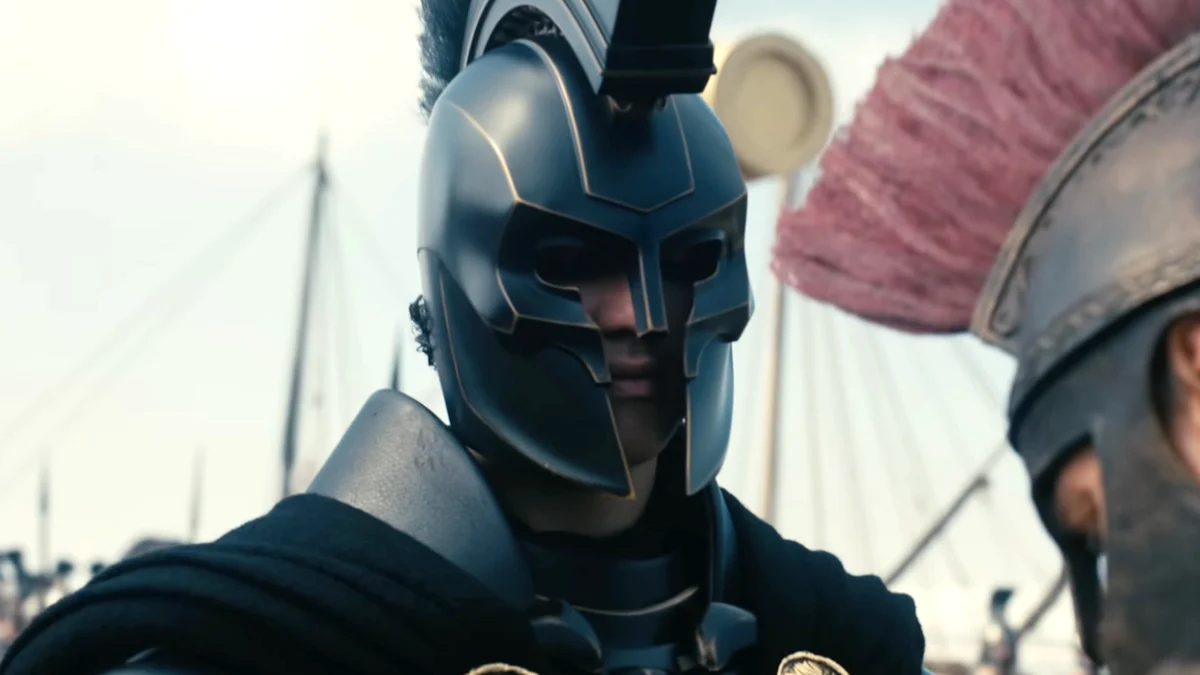
"Benny Safdie’s portrayal of Agamemnon in The Odyssey demonstrates how precise physicality and a deliberate ‘cinematic aura’ can transform a limited supporting role into the foundational anchor of an ancient epic."
In Christopher Nolan’s ambitious adaptation of Homer’s The Odyssey, the narrative weight is distributed across a sprawling ensemble of Hollywood’s most elite performers. While the film focuses on the arduous journey of Odysseus, the presence of the Greek King Agamemnon—played with a towering, metallic intensity by Benny Safdie—serves as the brutal ideological precursor to the hero’s journey. Safdie’s performance, characterized by a rigid, intimidating physicality and a suit of armor that evokes the most iconic villains in cinema history, provides a masterclass in how a character can dominate the screen through presence alone, establishing the high-stakes reality of the Trojan War and its lingering psychological toll.
The Architect of the Achaean Might
Christopher Nolan has long been a director fascinated by the intersection of myth and the individual, and in The Odyssey, he finds a canvas large enough to explore the themes of legacy, power, and the cost of victory. To ground this ancient story, Nolan assembled a cast that includes Matt Damon, Anne Hathaway, Tom Holland, Robert Pattinson, and Himesh Patel. However, in the world of the Trojan War, power is often measured by the shadow one casts. No shadow looms larger than that of Agamemnon, the King of Mycenae and commander of the Achaeans.
Agamemnon is historically depicted as a man of relentless ambition—a leader who would sacrifice his own kin for a favorable wind and who sought to consolidate power at any cost. In Nolan’s vision, he is the "misguided north star" for Odysseus. He represents the peak of human authority and the depths of human cruelty, serving as a template for the kind of leader Odysseus must both emulate and eventually surpass in wisdom.
The Physicality of Power: Safdie as the Iron King
Benny Safdie’s casting as Agamemnon marks a significant evolution in his career as a character actor. Known for his frantic, high-strung energy in films like Good Time and his intellectual depth as Edward Teller in Oppenheimer, Safdie pivots here toward a performance defined by stillness and weight. Safdie’s Agamemnon is less a man and more a monolith, encased in dark, imposing armor that has drawn immediate comparisons to cinematic titans like Darth Vader and Magneto.

In interviews, Safdie has emphasized that the role required a fundamental shift in how he approached movement. The armor was not merely a costume but a psychological constraint. "I had not done anything like this, where the physicality was so important," Safdie noted. He described a character who could not afford to be "floppy" or casual. Every movement had to be deliberate. When Agamemnon turns to address a subordinate, he does not simply move his head; he turns his entire torso, a movement that Safdie describes as "pretty aggressive." This rigidity conveys a level of absolute confidence and unyielding authority. It tells the audience—and the other characters—that Agamemnon is a man who expects the world to move around him, rather than the other way around.
The "Aura" of the Epic: Nolan and Van Hoytema’s Visual Language
The impact of Safdie’s performance is amplified by the collaboration between Nolan and his long-time cinematographer, Hoyte van Hoytema. The film utilizes the concept of "aura farming"—a modern internet colloquialism for the deliberate cultivation of a cool, impressive, and stylish presence. Through low-angle shots, high-contrast lighting, and a focus on the clanking, heavy textures of his Mycenaean gear, the filmmaking team ensures that Agamemnon’s brief screen time leaves an indelible mark on the viewer’s memory.
This visual strategy is essential for a film that deals with the transition from the "Age of Heroes" to the "Age of Men." Agamemnon must feel like a relic of a more brutal, more certain era. By shooting Safdie as a looming, stationary force of nature, Nolan creates a sense of dread that persists even when the character is off-screen. The "dark energy" Safdie brings to the role provides the necessary contrast to the more fluid, desperate, and human struggles faced by Odysseus on his long voyage home.
A Masterclass in the "Small" Role
While The Odyssey is a long film, Safdie’s appearance is concentrated in pivotal flashbacks and a haunting sequence set in Hades, which explores his post-war fate. He is part of a tradition of actors in this film who "own the screen" in limited windows. This includes Lupita Nyong’o, who pulls double duty as Helen of Troy and Clytemnestra, and Jon Bernthal, who brings a different, more grounded intensity to Menelaus, the King of Sparta. Even Elliot Page, in the role of Sinon, provides a crucial emotional core to the Trojan Horse sequence.
Safdie’s ability to stand out in such a crowded field is a testament to his growing shorthand with Nolan. Having previously worked together on Oppenheimer, Safdie has spoken about the "spontaneity" of Nolan’s process. Despite the massive scale of a production like The Odyssey, Nolan maintains a directness and an excitement on set that allows actors to find the "truth" of a character within the spectacle. For Safdie, this meant finding the human ego inside the iron suit of a king.
The Dual Career of Benny Safdie
To understand Safdie’s success in The Odyssey, one must look at his dual identity as both a director and an actor. Alongside his brother Josh, Safdie helmed some of the most visceral films of the last decade, including Uncut Gems. This directorial eye likely informs his acting; he understands how a performance fits into the larger architecture of a scene. Whether he is playing a villain in Happy Gilmore 2 or voicing Bowser Junior in The Super Mario Galaxy Movie, Safdie brings a level of commitment that makes his characters feel fully realized, regardless of genre.

His recent work in the television series The Curse, alongside Emma Stone, showcased his ability to play nuanced, often uncomfortable characters. In The Odyssey, he strips away the neuroses of his previous roles to find something primal. It is a performance of pure status, proving that he can hold his own against the most seasoned leading men in the industry.
Looking Ahead: Lizard Music and Beyond
The momentum from The Odyssey is set to carry Safdie into his next major project, Lizard Music. Based on the children’s book by Daniel Pinkwater, the film marks a reunion with Dwayne "The Rock" Johnson, whom Safdie directed in the MMA drama The Smashing Machine.
Lizard Music represents a wild departure from the grim halls of Mycenae. Safdie describes it as a "beautiful adventure of discovery" involving a kid who finds an island of sentient, human-sized lizards. Johnson is set to play a 70-year-old man, a casting choice that speaks to Safdie’s desire to push actors into unexpected territory—much as Nolan did for him.
Conclusion: The Legacy of Agamemnon
In the final analysis, Benny Safdie’s Agamemnon is more than just a supporting character in a summer blockbuster; he is the embodiment of the "Nolan Epic" style. By focusing on the weight of armor, the aggression of a simple turn, and the "aura" of a king, Safdie and Nolan have created a version of Agamemnon that honors the ancient text while speaking to modern cinematic sensibilities.
As The Odyssey continues to draw audiences to theaters, Safdie’s performance will likely be remembered as the film’s most intimidating human element. He serves as a reminder that in the hands of a capable actor and a visionary director, even the oldest stories can be made to feel new, heavy, and undeniably powerful. Through Agamemnon, Safdie has not only "farmed aura"—he has harvested a permanent place in the pantheon of great cinematic leaders.
