
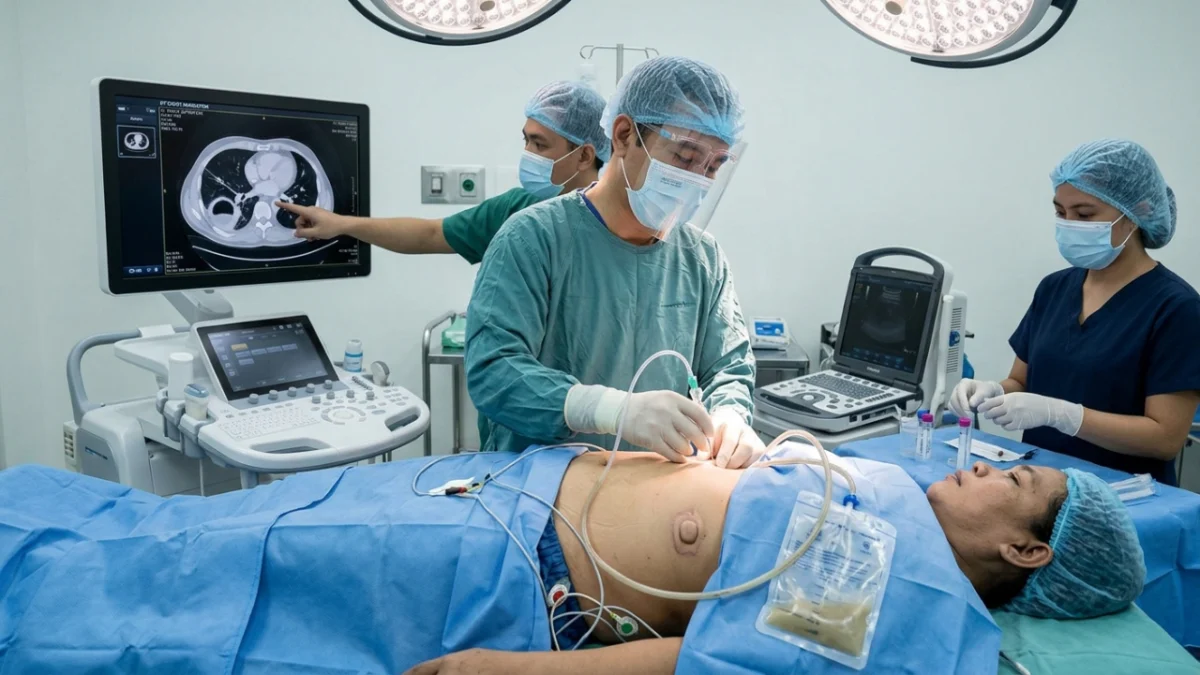
"A slipped gastric band, once a solution for obesity, can become a decade-long threat, leading to life-threatening lung infections through aspiration, underscoring the critical need for long-term patient surveillance."
This striking case report highlights a rare but severe complication stemming from a bariatric surgery device placed over a decade prior. A 43-year-old man’s life was put at risk by a lung abscess so extensive it had consumed a significant portion of his left lung. The root cause, surgeons discovered, was not a new ailment but a long-standing issue with an adjustable gastric band that had slipped, leading to a cascade of events culminating in a life-threatening infection. This instance serves as a stark reminder that the long-term implications of certain medical devices require diligent monitoring and prompt intervention, even years after their initial placement.
The medical journey of a 43-year-old man took a perilous turn when he presented at Ascension Saint Joseph Hospital in Chicago with acute respiratory distress. His symptoms – a persistent fever, a rapid heart rate, and a four-day-old cough producing foul-smelling sputum – painted a grim picture of a severe pulmonary infection. A diagnostic CT scan revealed the alarming extent of the problem: a lung abscess so colossal it had effectively obliterated the upper segment of his lower lobe in his left lung. This devastating pulmonary devastation, however, was not a spontaneous event. Investigations by the surgical team traced the origin of this critical condition back to his stomach, and more specifically, to a weight-loss device that had been surgically implanted around his stomach 15 years earlier.
This extraordinary case, detailed in a recent publication in the Journal of Surgical Case Reports, sheds light on a potential, albeit uncommon, long-term risk associated with adjustable gastric bands. The patient had undergone laparoscopic gastric banding in 2007 to address severe obesity, obstructive sleep apnea, and chronic acid reflux. Unfortunately, he was lost to follow-up shortly after the procedure. This lapse in consistent medical oversight proved to be a critical factor in the unfolding of his subsequent health issues.
The first documented complication arose in 2012, when the patient developed empyema, a serious infection characterized by the accumulation of pus within the chest cavity surrounding his left lung. At the time, physicians suspected recurrent aspiration – the inhalation of foreign material into the lungs – as the cause. Surgeons intervened by opening his chest to surgically remove the infected lining of the lung, a procedure that would have inevitably led to the formation of dense scar tissue in the thoracic region.
Fast forward to 2022, the patient’s health deteriorated once more. He returned to the hospital presenting with a constellation of severe symptoms: fever, tachycardia (a racing heart), a critical need for supplemental oxygen, and an elevated white blood cell count of approximately 19,500, a clear indicator of a significant infection. Given the extensive scarring from his previous chest surgery, the surgical team utilized the CT scan as a precise guide to locate the new abscess, which was found nestled beneath his shoulder blade. A second thoracotomy was performed, during which surgeons removed a portion of his sixth rib, meticulously cleaned out the abscess, and placed drains to facilitate healing and prevent further infection.
Despite the aggressive treatment for the lung abscess, the patient continued to struggle with eating. A crucial diagnostic step, an upper gastrointestinal X-ray series conducted eight days post-surgery, revealed the underlying culprit: the gastric band had slipped from its original position, creating a severe, high-grade narrowing in the upper portion of his stomach. This obstruction was preventing food from passing through normally, leading to his persistent feeding difficulties.
To address the immediate nutritional needs, doctors inserted a feeding tube through his nose. Eleven days later, the bariatric surgical team successfully removed the slipped gastric band using robotic assistance. Following the removal of the device, the patient experienced significant improvement in his nausea and ability to eat. He was discharged on day 22, able to tolerate a regular diet. A follow-up CT scan in May 2023, approximately five months after his chest surgery, confirmed excellent healing of the lung tissue, a testament to the successful resolution of the acute infection.
The authors of the case report emphasize the profound implications of this patient’s experience. They posit that long-term pulmonary complications arising from recurrent aspiration in individuals with gastric bands carry a substantial risk of severe morbidity and mortality, particularly for those who miss crucial follow-up appointments. Factors such as chronic acid reflux and poor adherence to dietary recommendations are identified as contributing elements that can exacerbate these risks. The report advocates for a proactive approach when patients with gastric bands present with pulmonary issues, recommending contrast imaging of the digestive tract and lung imaging, followed by prompt loosening or removal of the band and ongoing long-term surveillance.
Adjustable gastric bands, a surgical intervention designed to aid weight loss by constricting the upper stomach into a smaller pouch, have become less prevalent in bariatric surgery. This decline in popularity is largely attributed to a spectrum of complications, including band slippage, band erosion into the stomach wall, and port malfunction, all of which can necessitate further surgical intervention. While pulmonary complications are less common than these gastrointestinal issues, they are nonetheless a documented concern.
Previous reports have documented pulmonary complications occurring anywhere from one month to three years after gastric band placement, making this case, with its decade-long latency period, particularly noteworthy. A retrospective study involving 2,100 gastric band patients identified 30 individuals who developed respiratory complications. Among these, aspiration pneumonia was the most frequent diagnosis (19 patients), followed by lung abscess (four patients). In the majority of these cases, band removal was the primary treatment. Notably, patients who opted against band removal continued to experience persistent lung problems, underscoring the device’s role in the pathology.
Further research cited in the report indicates a higher incidence of morning cough in patients with gastric bands compared to those who underwent a sleeve gastrectomy. Specifically, 59.6% of gastric band patients reported morning cough, in stark contrast to 12.3% of sleeve gastrectomy patients. This suggests a potential for subtle, ongoing airway irritation or reflux-related issues even in the absence of overt aspiration events.
The esophagus can also be significantly impacted by gastric bands. At Columbia University Medical Center, a study utilizing barium swallows in gastric band patients revealed that 14% had esophageal dilation (a widening of the esophagus with a diameter of at least 35 millimeters) one year after surgery. These patients were more prone to experiencing reflux symptoms and vomiting. A long-term study following 167 gastric band patients who underwent annual barium swallows found that 25.5% developed esophageal dilation, with an average onset occurring about six years post-surgery. In exceedingly rare instances, a severely dilated esophagus can pose a direct threat to the airway. A case from Adelaide, Australia, described a 77-year-old woman whose gastric band, placed 12 years prior, led to severe shortness of breath and difficulty swallowing shortly after consuming soup. Within minutes, she developed a hoarse voice, noisy breathing, and tense swelling of her neck. A CT scan confirmed her esophagus had widened to an alarming 75 millimeters (approximately 3 inches). Fortunately, deflating the band through its port rapidly resolved the neck swelling, highlighting the direct mechanical pressure exerted by the dilated esophagus on surrounding structures.
While these severe events are uncommon, and a single case report cannot definitively establish the frequency of long-term lung complications associated with gastric bands, it serves as a critical alert. Furthermore, it is important to acknowledge that not every lung infection in a patient with a gastric band is directly attributable to the device. Nevertheless, these reports collectively highlight crucial warning signs that both patients and clinicians should heed.
The Australian medical team emphasized the importance of deflating the gastric band whenever device-related issues, such as severe vomiting, intractable reflux, unexplained neck swelling, or breathing difficulties, are suspected. They also urged clinicians to consider a gastric band complication in any patient presenting with unexplained neck swelling or airway obstruction.
The Chicago-based surgeons reinforced the notion that the risk of complications is significantly elevated in patients who fail to adhere to regular follow-up schedules, as was the case with their patient. This underscores the vital role of ongoing medical surveillance in managing patients with implanted bariatric devices.
Individuals who have undergone gastric banding surgery and experience persistent symptoms such as a chronic cough, recurrent pneumonia, worsening acid reflux, frequent regurgitation, or difficulty swallowing should promptly consult their bariatric surgeon or another qualified healthcare professional. In cases of sudden onset of breathing difficulty or neck swelling, immediate emergency medical attention is imperative. These symptoms may indicate an acute complication requiring urgent intervention to prevent potentially life-threatening outcomes. The long-term management of patients with adjustable gastric bands requires vigilance and a comprehensive understanding of the potential complications that can arise, even years after the initial procedure.
