
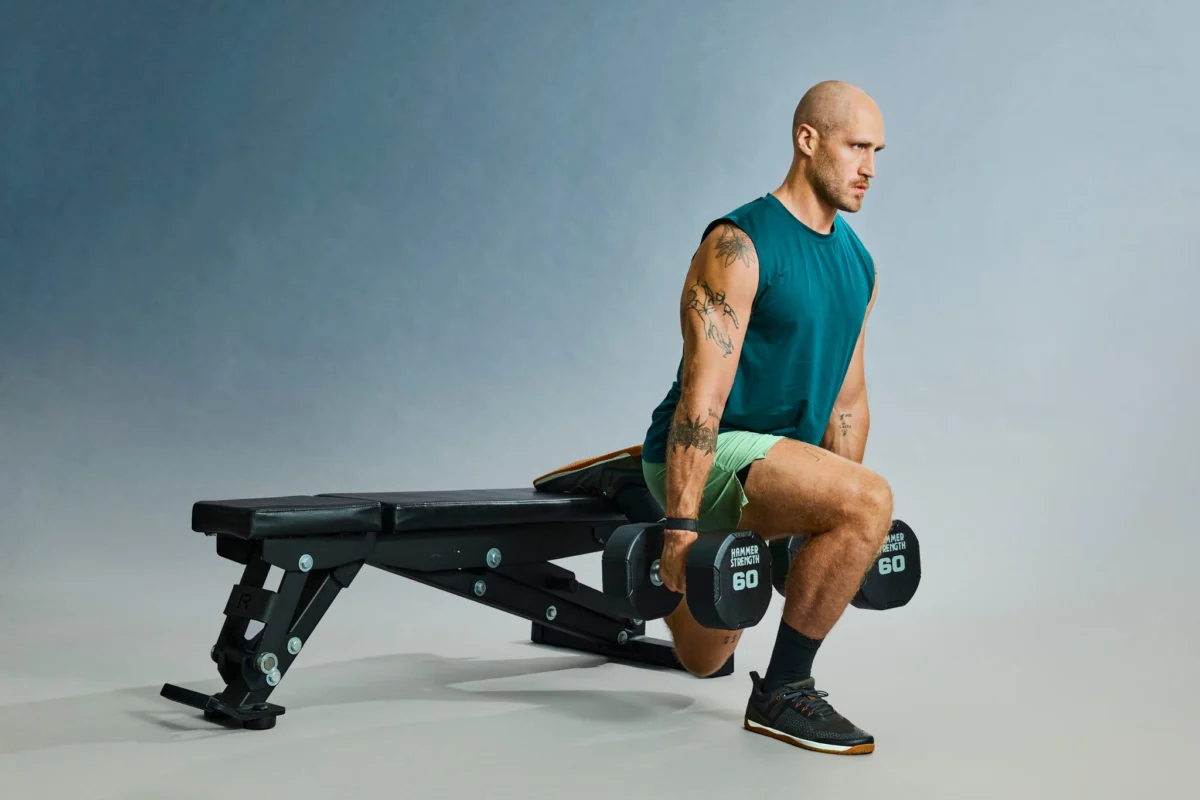
"Unilateral training is the essential bridge between gym-based hypertrophy and real-world athleticism, making the Bulgarian split squat a non-negotiable tool for correcting muscle imbalances and maximizing functional lower-body power."

While traditional bilateral squats serve as the foundation of many strength programs, they often allow the dominant side of the body to compensate for the weaker one, masking underlying imbalances that can lead to injury. The Bulgarian split squat, or rear-foot elevated split squat, forces each leg to operate independently, demanding high levels of stability, core engagement, and eccentric control. By isolating the lower-body musculature, trainees can achieve significant muscle growth and improved joint health while simultaneously developing the balance required for sports and daily movement.
The Science of Moving on One Leg
Human movement is inherently unilateral. Whether walking, running, climbing stairs, or leaping for a rebound on a basketball court, the body spends the majority of its locomotive time supported by a single limb. Despite this, many fitness enthusiasts prioritize bilateral movements—like the standard back squat or leg press—as their primary drivers of leg strength. While these exercises are excellent for moving maximum weight, they fail to address the specific stability requirements of one-legged movement.

The Bulgarian split squat bridges this gap. By elevating the rear foot, the exercise places roughly 80 to 90 percent of the load on the front leg. This creates a unique stimulus that targets the quadriceps, glutes, and hamstrings with surgical precision. Furthermore, the staggered stance challenges the adductors and the core to maintain pelvic alignment, providing a level of "functional" carryover that traditional squats cannot replicate.
Perfecting the Setup: Starting from the Ground Up
According to Ebenezer Samuel, C.S.C.S., fitness director at Men’s Health, the most common mistake made during the Bulgarian split squat occurs before the first rep even begins. Setup is the most critical phase of the movement. If the front foot is too close to the bench, the front knee is subjected to excessive shear force, often leading to patellar discomfort. Conversely, if the foot is placed too far forward, the trainee may overextend their hip flexor, leading to an arched lower back and a loss of core tension.

To find the "Goldilocks" position, Samuel recommends starting from the bottom. Rather than trying to balance while hopping into position, sit on the bench, extend one leg out straight, and place that heel on the floor. Stand up from that position while keeping the front foot planted; this usually marks the ideal distance. Once the front foot is set, place the top of the rear foot on the bench behind you. This ensures a vertical shin or a slight forward knee travel that remains within a safe, productive range of motion.
The "No-Touch" Rule and Eccentric Control
The Bulgarian split squat is not an exercise in explosive speed; it is an exercise in controlled tension. A frequent error is allowing the back knee to crash into the floor or using the floor as a "bounce" point to gain momentum for the upward phase.

Samuel emphasizes that the back knee should never actually touch the ground. When the knee makes contact with the floor, the tension is momentarily removed from the working muscles, turning the exercise into what Samuel describes as a "loaded couch stretch." To maximize hypertrophy and strength, the trainee should lower their hips until the back knee is roughly one inch above the floor. Holding this bottom position for a split second—a "pause at the pit"—forces the muscles to work through the most difficult part of the range of motion without the help of the stretch reflex. This eccentric control is what builds the "brakes" of the lower body, protecting the knees during high-impact activities.
Glute Activation and Knee Tracking
The role of the glutes in the Bulgarian split squat goes beyond mere aesthetics. In a unilateral stance, the hip is under constant pressure to rotate or collapse inward (a movement known as knee valgus). Keeping the glutes active and "on" throughout the set acts as a stabilizing force that keeps the front knee tracking directly over the second and third toes.

When the glutes are disengaged, the pelvis often tilts, and the front knee may drift toward the midline of the body, a position that puts the ACL and medial meniscus at risk. By consciously squeezing the glute of the working leg, the trainee ensures that the drive comes from the hip and thigh, leading to a safer and more powerful ascent out of the "hole."
Equipment and Loading Strategies
One of the primary benefits of the Bulgarian split squat is its versatility regarding equipment. For beginners, bodyweight alone provides a significant challenge to balance and coordination. As the trainee progresses, several loading options can be utilized:

- Dumbbells and Kettlebells: Held in a "suitcase" fashion at the sides, these are the most common tools for this movement. They lower the center of gravity, making balance slightly easier to maintain.
- Goblet Hold: Holding a single weight at chest height increases the demand on the upper back and core, helping to keep the torso upright.
- Barbell: For advanced trainees, a barbell on the back allows for maximum loading, though it significantly increases the balance requirement.
- Raised Platforms: While a standard weight bench is the go-to, home trainees can use an ottoman, a couch, or even a specialized "split squat stand" with a rolling pad to reduce friction on the rear ankle.
Advanced Variations for Specific Goals
Once the basic form is mastered, several variations can be employed to target different aspects of physical performance:
Pulse Pause Bulgarian Split Squat
This variation introduces a "one-and-a-half" rep style. The trainee lowers to the bottom, rises halfway up, returns to the bottom, and then stands all the way up. This increases the "time under tension" for the quadriceps and glutes, making it an exceptional tool for muscle growth.

Pass-Through Clean Bulgarian Split Squat
Combining a split squat with a weight-shifting element, this variation involves passing a kettlebell or dumbbell under the front leg or cleaning it to the shoulder while in the staggered stance. This challenges the core’s ability to resist rotation (anti-rotation) and improves total-body coordination.
Dead Stop Bulgarian Split Squat
In this version, the trainee begins each rep from the bottom, or brings the weights to a complete rest on the floor (if using heavy dumbbells) before driving upward. This eliminates all momentum, forcing the nervous system to recruit the maximum number of muscle fibers to initiate the movement.

Mixed-Load Bulgarian Split Squat
By holding a weight in only one hand (unilateral loading) or using different weights in each hand, the trainee creates an asymmetrical load. This forces the obliques and deep core stabilizers to work overtime to keep the torso from leaning to one side, effectively turning a leg exercise into a full-body stability drill.
Programming for Success
The Bulgarian split squat can be integrated into a workout in two primary ways. As a "main lift," it should be performed early in the session when the nervous system is fresh. In this context, lower rep ranges (3 sets of 8 to 10 reps per leg) with heavier loads are ideal.

Alternatively, it can be used as a "finisher" to exhaust the legs at the end of a workout. When used as a finisher, bodyweight or light loads are preferred, with higher volume (3 sets of 15 to 20 reps per leg). Regardless of the placement, it is vital to perform the same number of reps on both legs, starting with the weaker leg to ensure that the stronger side does not continue to outpace it.
The Path to Longevity
Ultimately, the Bulgarian split squat is more than just a leg exercise; it is a diagnostic tool and a performance enhancer. By identifying and correcting the "leaks" in a trainee’s stability and strength, it builds a foundation that supports heavy bilateral lifting while reducing the risk of chronic injury. For those seeking to maintain a high level of physical capability well into their later years, mastering the art of moving on one leg is an essential pursuit.
