
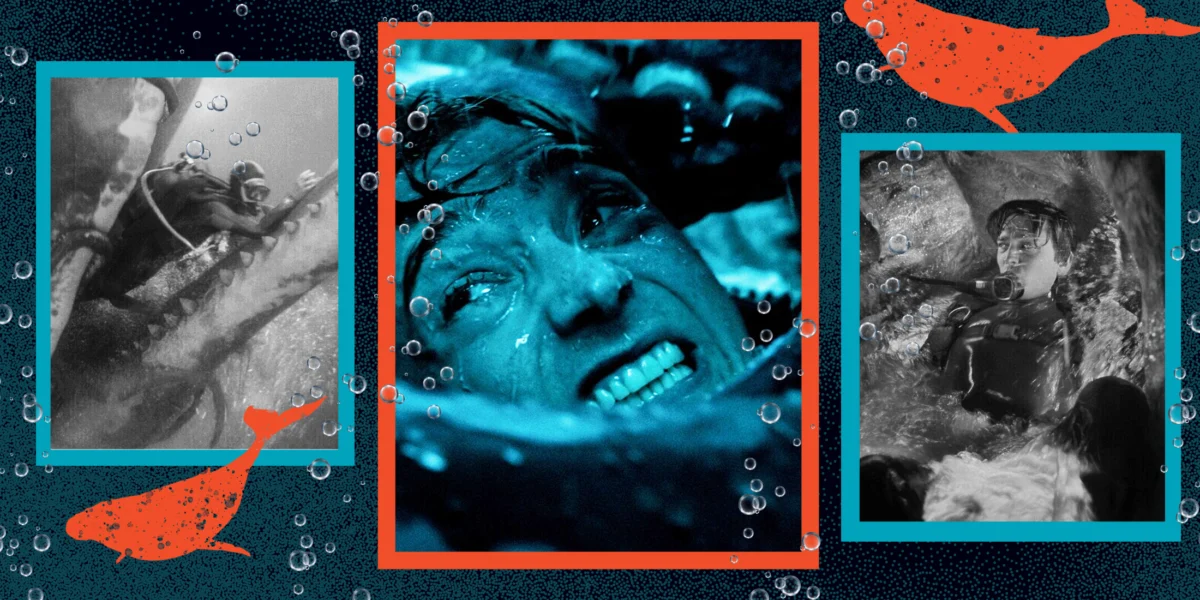
"By grounding its survival narrative in the brutal realities of cetacean biology, Whalefall transforms a legendary maritime myth into a claustrophobic exploration of physiological limits and the sheer scale of the deep ocean."
The upcoming cinematic adaptation of Daniel Kraus’s acclaimed novel Whalefall seeks to bridge the gap between ancient maritime folklore and modern marine biology. By moving away from the whimsical, cavernous depictions of whale interiors seen in classic literature and animation, the film’s production team has committed to a visceral, scientifically informed portrayal of what it would actually mean for a human being to be consumed by a sperm whale.
The Myth and the Modern Reality
For centuries, the story of a human surviving inside a whale was relegated to the realm of the miraculous, most notably in the biblical account of Jonah. However, recent history has provided chilling evidence that encounters between humans and the mouths of these leviathans are not entirely relegated to fiction. In 2021, lobster fisherman Michael Packard made international headlines when he was scooped into the mouth of a humpback whale off the coast of Provincetown, Massachusetts. Packard survived the ordeal, describing a terrifying darkness before being spat back into the Atlantic. Similarly, reports of a kayaker being momentarily engulfed near Chile in 2025 have reinforced the idea that as humans venture further into marine habitats, these "accidental swallowings" are a rare but tangible hazard.

While most real-world incidents involve the whale quickly realizing its mistake—humans are not a natural food source for baleen whales—Whalefall pushes the premise to its physiological extreme. The story follows Jay Gardiner (played by Austin Abrams), a young scuba diver who is not merely held in the mouth, but sucked into the digestive tract of a sperm whale while searching for the remains of his deceased father (Josh Brolin). To make this nightmare believable, the film’s production team had to abandon Hollywood tropes and look toward the grisly reality of cetacean dissection.
The Mechanics of the Sperm Whale
Production designer Ramsey Avery and his team began the project with a daunting realization: very few people have ever seen the interior of a living sperm whale’s digestive system. To build a "camera-ready" whale, Avery collaborated with leading cetacean experts, including Dr. Joy Reidenberg, a renowned comparative anatomist. Their research revealed that the sperm whale (Physeter macrocephalus) is an evolutionary marvel designed specifically to hunt and consume giant squid in the crushing depths of the mesopelagic zone.
Unlike blue whales or humpbacks, which use baleen to filter tiny krill, sperm whales are odontocetes (toothed whales). However, their teeth are largely used for social dominance and display rather than mastication. Instead, they utilize a powerful suction-feeding mechanism. By using their massive tongues to create a pressure vacuum within their mouths, they draw prey inward. This biological detail became a cornerstone of the film’s realism.
Furthermore, the sperm whale’s anatomy is uniquely asymmetrical. To accommodate the passage of massive, struggling giant squid, the whale’s larynx is shifted to the side. This explains why a sperm whale’s blowhole is located on the left side of its head rather than centered. For the film, these anatomical nuances were not just trivia; they dictated the physical path Jay Gardiner would take through the creature’s body, providing a roadmap for a journey that is as much a biological tour as it is a survival thriller.

Engineering a Leviathan: The 80-Foot Calculation
One of the primary challenges for the production was "reverse math." The team needed to determine exactly how large a whale would have to be to plausibly contain a six-foot-tall human and a film crew. Through historical whaling records and biological data, Avery determined that to have a stomach cavity measuring roughly eight feet long—the minimum space required for an actor and a camera—the whale itself would need to be approximately 80 feet in length.
While 80 feet represents the absolute upper limit for the species, it is a size that has been documented in the wild. This commitment to scale ensures that the environment feels oppressive and cramped without feeling impossible. To bring this to life, the production avoided relying solely on digital effects. Instead, they constructed 360-degree sets that were fully enclosed and capable of holding water. These "stomach sets" were built using upholstery foam mockups to test movement and camera angles before being finalized as functional, submerged environments.
The Four-Stomach Gauntlet
The interior of the whale in Whalefall is not a singular room, but a series of distinct biological chambers. A sperm whale possesses four stomachs, each with a specific function. The first stomach, where much of the film’s action occurs, is a muscular, non-glandular chamber designed to crush prey. It is an environment of pure mechanical force, devoid of digestive acids but filled with the remnants of previous meals.
Avery’s team had to tackle the delicate task of designing the "sphincters"—the muscular valves that connect the various chambers. In a departure from typical cinematic framing, the team chose to place these entrances and exits at the top of the stomach sets, adhering to actual sperm whale anatomy rather than the "tunnel" structure often seen in fiction. This added a layer of verticality to Jay’s struggle, forcing him to climb through the creature’s internal architecture while battling the buildup of methane and other unbreathable gases.

The environmental hazards inside the whale serve as a "ticking clock" for the narrative. Research into whale carcasses has shown that the digestive tract is a pressurized environment filled with volatile gases. In some instances, researchers cutting into deceased whales have triggered literal explosions due to gas buildup. For Jay Gardiner, this means his survival is tethered to the remaining oxygen in his scuba tanks, as the atmosphere inside the whale is toxic.
Practical Effects and the Wētā Influence
To populate the whale’s stomach with the detritus of the deep, the production enlisted the legendary Wētā Workshop. The team created hyper-realistic "flotsam and jetsam" of the abyss, including giant squid beaks in various stages of digestion. These beaks, made of hard chitin, are often the only parts of a squid that a whale cannot digest, eventually forming the basis of ambergris—a waxy substance produced in the whale’s intestines.
The film also features a harrowing sequence involving a giant squid, which was handled through a combination of practical props and digital augmentation. By having Austin Abrams interact with physical tentacles and beaks in a pressurized water tank, the production captured a level of tactile desperation that CGI alone often fails to convey.
The Psychological Depth of the Deep
Beyond the technical achievements in production design, Whalefall remains a deeply human story. The narrative utilizes the whale’s stomach as a metaphorical "liminal space" where Jay Gardiner must confront the memory of his father. The film frequently cuts between the suffocating darkness of the cetacean’s interior and flashbacks to Jay’s life on land, creating a dual narrative of physical and emotional survival.

The casting of Josh Brolin as the father provides a rugged, looming presence that mirrors the scale of the whale itself. As Jay navigates the literal guts of a monster, he is simultaneously navigating the complex, often painful "guts" of his family history. This thematic layering elevates the film from a mere creature feature to a sophisticated exploration of grief and endurance.
Conclusion: The Uncharted Ocean
As Ramsey Avery noted during the production, there is still an immense amount of mystery surrounding the ocean’s apex predators. Despite modern technology, we have only recently captured the first high-quality footage of giant squid in their natural habitat, and much of what we know about sperm whales comes from "post-mortem" study.
Whalefall serves as a reminder of the sheer scale of the natural world and the fragility of humans within it. By prioritizing anatomical accuracy and practical craftsmanship, the film offers a terrifyingly plausible look at one of humanity’s oldest fears. It challenges the audience to consider not just how one would get out of a whale, but what the experience would reveal about the limits of human will. In the end, the film suggests that the most dangerous part of being swallowed by a whale isn’t the darkness or the acid—it’s the realization of how small we truly are in the face of the deep.
