
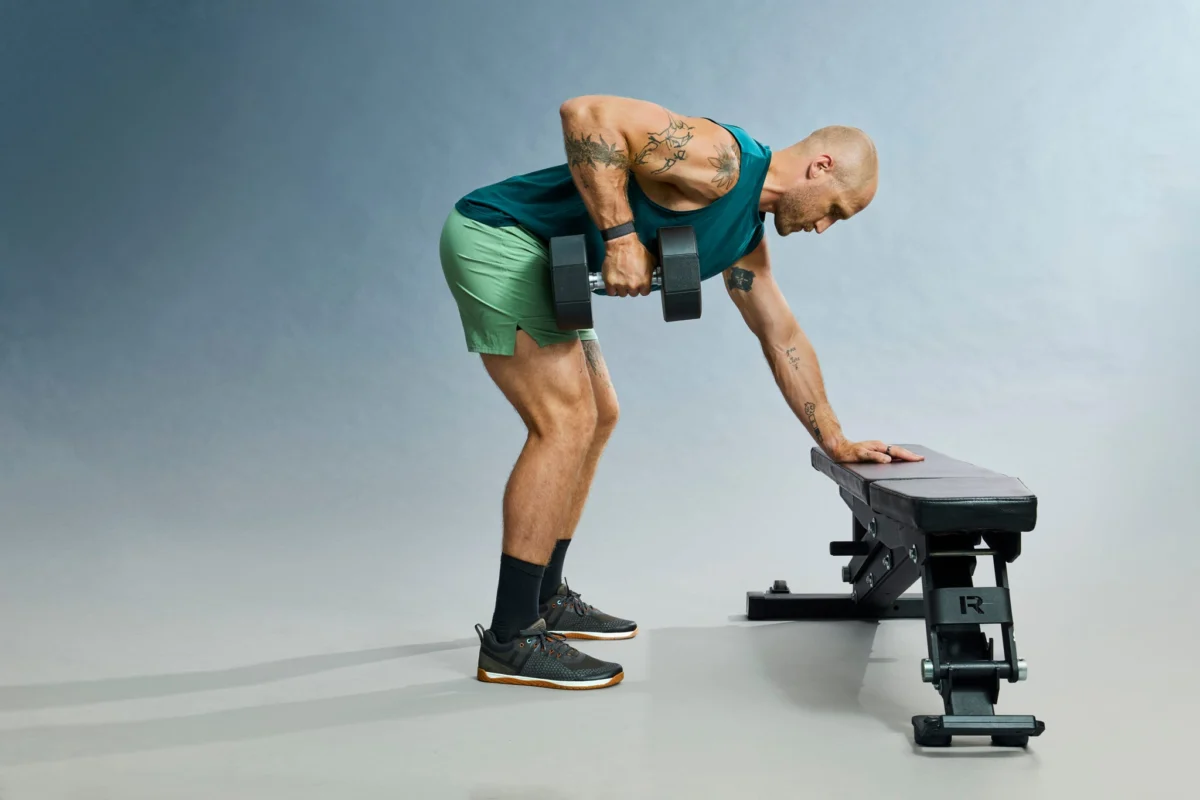
"The key to a powerful back isn’t just the weight you pull, but the stability of your spine; moving your knee off the bench transforms the dumbbell row from a sloppy habit into a precision strength builder."
The dumbbell row is a foundational movement in resistance training, yet it is frequently executed with technical flaws that limit muscle recruitment and increase the risk of injury. By shifting from the traditional "knee-on-bench" stance to a more stable, ground-based hinge position, lifters can better isolate the musculature of the posterior chain while maintaining a neutral, protected spine.

The Science and Significance of the Dumbbell Row
In the modern world, the human body is under constant "anterior" stress. From typing at a keyboard and driving a car to scrolling on a smartphone, most daily activities involve reaching forward, which leads to rounded shoulders and a weakened posterior chain. This "push-dominant" lifestyle can result in postural imbalances, chronic back pain, and shoulder impingement. The dumbbell row serves as the primary antidote to these issues, targeting the latissimus dorsi, rhomboids, and rear deltoids to pull the body back into alignment.
Unlike barbell rows, which fix the hands in a specific path, the dumbbell row is a unilateral exercise. This means it allows for a greater range of motion and helps identify and correct strength imbalances between the left and right sides of the body. However, the effectiveness of the move depends entirely on the integrity of the setup. As Ebenezer Samuel, C.S.C.S., and Brett Williams, NASM-CPT, point out, the most common way guys perform this move—propped up with one knee on a weight bench—is often the very thing holding them back.
The "Knee-on-Bench" Fallacy
Walk into any commercial gym, and you will likely see the "lawnmower" row: a trainee with one knee and one hand on a bench, yanking a heavy dumbbell with a rounded back and twisting torso. While this position is ubiquitous, it is far from optimal. Placing a knee on the bench often creates a tilt in the pelvis, making it difficult to keep the hips square to the floor. When the hips shift, the spine follows, often resulting in a "corkscrew" effect that puts unnecessary shearing force on the lumbar vertebrae.

Furthermore, this unstable tripod position encourages "cheating." When the weight gets heavy, the lifter tends to use momentum, rotating their chest toward the ceiling to finish the rep. This shifts the focus away from the back muscles and places it on the lower back and shoulder joints, defeating the purpose of the exercise.
The Superior Stance: The Hinge Setup
To maximize the benefits of the row, Samuel suggests a modification that prioritizes stability. Instead of placing your knee on the bench, keep both feet firmly on the ground in a wide, athletic stance. Bend at the hips (a "hinge") and place only your non-working hand on the bench for support.
This setup provides several advantages:

- Hip Squareness: With both feet on the floor, you have a much wider base of support, making it easier to keep your hips level and parallel to the ground.
- Core Engagement: Without the bench supporting your lower body, your core must work overtime to prevent your torso from rotating. This turns the row into a high-level "anti-rotation" core exercise.
- Spinal Protection: By keeping the shoulders slightly higher than the hips and engaging the back extensors, you create a natural "bridge" that protects the lower back from the downward pull of the weight.
The Scapular Secret: More Than Just an Arm Movement
The most common mistake in the execution of the row is treating it as an arm exercise rather than a back exercise. If you simply pull the weight with your hand, your biceps and forearms will do the bulk of the work. To truly target the back, the movement must begin at the shoulder blade (scapula).
Before the weight even moves upward, you should intentionally squeeze your shoulder blade toward your spine. This "scapular retraction" sets the shoulder in a safe position. If you skip this step, the head of your humerus (upper arm bone) can glide forward toward your collarbone, potentially irritating the rotator cuff tendons or the labrum. By initiating with the back muscles, you ensure that the lats and rhomboids are the primary movers, leading to better muscle hypertrophy and long-term joint health.
The Mind-Muscle Connection: Pulling with the Elbow
Once the scapula is set, the path of the dumbbell matters. Many lifters pull the weight straight up toward their chest. This often results in a "bicep curl" motion. Instead, imagine your hand is merely a hook. Your goal is not to lift the weight with your hand, but to drive your elbow toward the ceiling and back toward your hip.

By pulling the elbow "back and up," you maximize the contraction of the lower lats. This arc-like motion keeps the tension on the back and minimizes the involvement of the biceps. At the top of the movement, your forearm should remain relatively vertical, and the dumbbell should finish near your lower ribcage or hip, rather than your armpit.
Common Pitfalls to Avoid
Even with a perfect stance, small errors can creep in as fatigue sets in.
- Hips Above Shoulders: If your hips rise too high, you lose the protective engagement of your back extensors. Always keep your chest slightly elevated relative to your glutes.
- The "Head Crane": Many lifters look up into the mirror while rowing. This puts the cervical spine in extension and can lead to neck strain. Keep your gaze neutral, looking at a spot on the floor a few feet in front of the bench.
- The Weight Swing: Avoid the temptation to "drop" the weight quickly at the bottom. Controlled eccentric (lowering) phases are where a significant amount of muscle growth occurs. Lower the weight slowly, feeling the stretch in your lat, but stop before your shoulder "collapses" toward the floor.
Programming for Results
The dumbbell row is versatile enough to be the centerpiece of a back workout or a supporting player in a full-body routine. For those focused on general muscle growth (hypertrophy), a range of 3 sets of 8 to 12 reps per arm is ideal. This allows for enough "time under tension" to stimulate muscle fibers without reaching systemic exhaustion too early.

For those looking to build raw strength, the dumbbell row can be performed with heavier loads for 6 to 8 reps. Because it is a unilateral move, it is often best performed at the beginning or middle of a workout when the core and grip are still fresh.
Choosing the Right Equipment
The quality of your tools can impact your form. While any weight will work, certain designs lend themselves better to the row:
- Hex Dumbbells: These are ideal because they won’t roll away between sets, and the flat edges provide a stable base if you are performing "renegade rows" or other variations.
- Adjustable Dumbbells: For home gym enthusiasts, sets like the Bowflex SelectTech offer the ability to quickly change weights, allowing you to move from heavy, low-rep strength sets to lighter, high-rep finishers without needing a full rack of weights.
- Vertical Racks: Keeping your space organized is more than just aesthetics; it ensures you can safely pick up and put down heavy weights without awkward reaching that could tweak your back.
Conclusion
The dumbbell row is a masterclass in functional strength. It builds a back that is as strong as it looks, protects the shoulders from the rigors of heavy pressing, and reinforces the postural integrity needed for a pain-free life. By moving the knee off the bench and focusing on the subtle cues of scapular retraction and elbow drive, you can turn this gym staple into your most effective tool for total-body stability and upper-body power. Consistency in form is the fastest route to progress; respect the mechanics, and the gains will follow.
