
"In a departure from comic book tradition, HBO’s Lanterns explores the profound psychological weight of destiny, framing John Stewart not just as a chosen hero, but as a man meticulously engineered for fearlessness by a mother’s complex ambition."
This reimagining of the Green Lantern mythos shifts the focus from cosmic chance to domestic discipline, positioning the superhero mantle as a burden of expectation rather than a sudden gift. By centering the narrative on the domestic origins of John Stewart’s stoicism, the series transforms a galactic police procedural into a grounded character study about the generational costs of greatness.
The early episodes of HBO’s Lanterns have begun to dismantle the traditional "hero’s journey" by posing a sophisticated question about the nature of destiny. For decades, the Green Lantern lore has been defined by the "chosen one" trope—the idea that a power ring seeks out an individual who possesses the ability to overcome great fear. However, the series highlights a stark contrast between its two leads. On one side stands Hal Jordan, played by Kyle Chandler with a weary, veteran gravitas. Jordan represents the traditional archetype: a test pilot who was plucked from his ordinary life and thrust into a lifelong commitment to the Green Lantern Corps. On the other side is John Stewart, portrayed by Aaron Pierre, whose path to the ring was not a surprise, but a lifelong curriculum.

The tension of the series is rooted in the diametric opposition of these two men. While Jordan operates on instinct and the scars of his experience, Stewart operates on the blueprints of a life designed for this specific purpose. The third episode, titled "OutKast," serves as a pivotal deep dive into Stewart’s psyche, moving beyond the glimpses of his bizarre childhood provided in the series premiere. It reveals a narrative that is largely a departure from the DC Comics source material, where Stewart is traditionally depicted as an architect or a U.S. Marine. In the world of Lanterns, John Stewart is a product of intentional cultivation—a man raised from birth to inherit a mantle that his father was unable to hold.
This narrative pivot introduces a tragic layer to the Green Lantern legacy. We learn that John’s father, John Stewart Sr. (J. Alphonse Pierre), was the original candidate for the role. However, after failing a test administered by the Guardians of the Universe—the ancient, immortal beings who oversee the Corps and created the mechanical Manhunters—he was left psychologically shattered and gaslit. The Guardians, in their cold, alien pragmatism, moved on to Hal Jordan, leaving the Stewart family to deal with the fallout of a "failed" destiny.
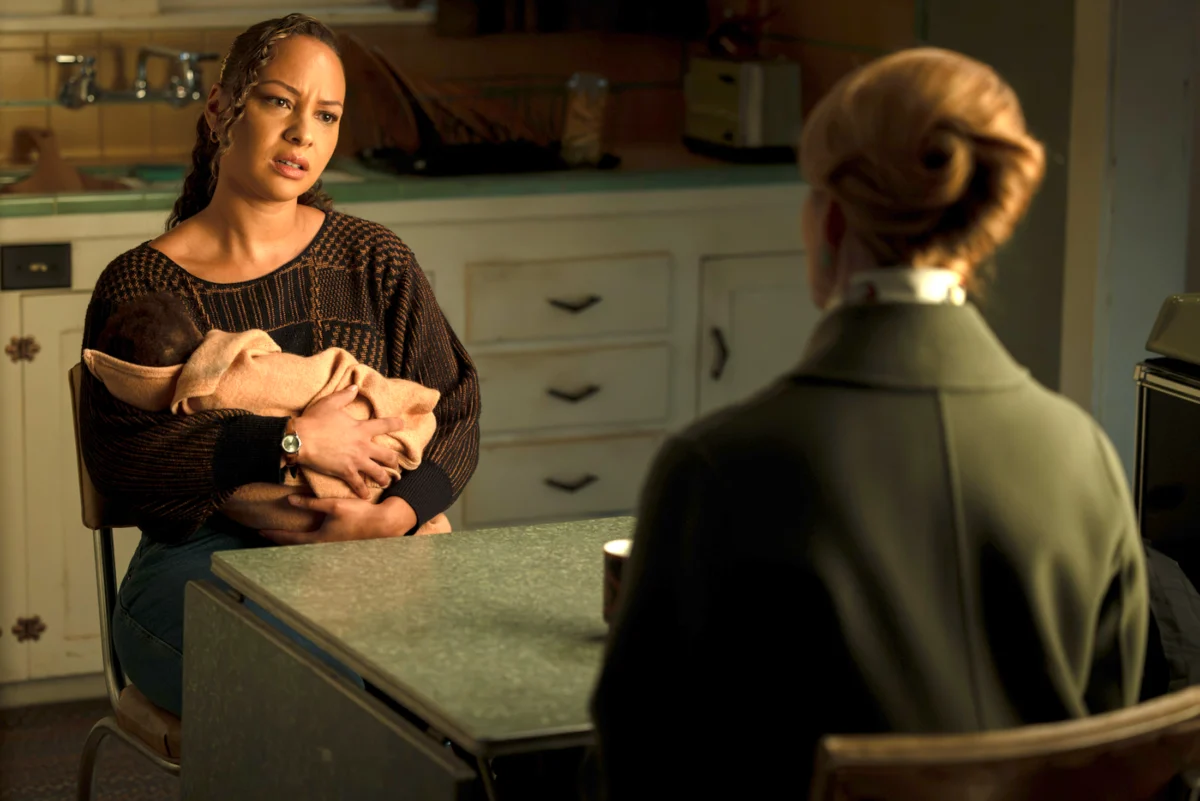
However, the most compelling ripple in this new backstory is not the failure of the father, but the resolve of the mother. Bernadette Stewart, played with a magnetic intensity by Jasmine Cephas Jones, emerges as the true architect of John’s future. In a universe where meeting an extraterrestrial being usually results in terror or awe, Bernadette meets the Guardian Lianna (portrayed by Laura Linney) with a startling, pragmatic composure. While her husband was rattled by the cosmic scale of the Guardians, Bernadette saw an opportunity to secure a "special life" for her son, one that transcended the limitations of their earthly circumstances.
The series portrays Bernadette as a classically complex figure, one whose maternal love is indistinguishable from her ambition. She leads John’s training with a methodology that borders on the fanatical, aiming to strip him of the capacity for fear. This is illustrated most viscerally in scenes where she facilitates exercises of extreme danger, such as shooting an apple off her son’s head or allowing him to do the same to her. While these tropes are common in superhero origins, Lanterns treats them with the grounded weight of a prestige drama. We are forced to view Bernadette not as a comic book caricature, but as a mother who is willing to sacrifice her son’s childhood—and potentially his safety—to ensure he is never "ordinary."

Jasmine Cephas Jones delivers a standout performance that captures this duality. She brings a warmth to Bernadette that makes her actions all the more unsettling; she isn’t a villain, but a woman who believes that the only way to protect her son in a dangerous universe is to make him the most dangerous thing in it. Cephas Jones is no stranger to complex roles, having broken through a decade ago in the original Broadway cast of Hamilton, where she played the dual roles of Peggy Schuyler and Maria Reynolds. Her career has since been defined by a series of nuanced performances in Noah Baumbach films like Mistress America and Marriage Story, as well as her acclaimed work in the Blindspotting film and television series.
The casting of Cephas Jones also carries a poignant meta-textual weight. She is the daughter of the late Ron Cephas Jones, a revered character actor who won two Emmy Awards for his role as William Hill in This Is Us. The elder Jones was known for his ability to imbue characters with a sense of weary wisdom and hidden depth, traits that Jasmine clearly carries into her portrayal of Bernadette. In a show that is fundamentally about the legacy parents leave for their children, her presence feels especially resonant.
The climax of the "OutKast" episode provides a final piece of the puzzle regarding John’s upbringing. Bernadette reveals that she orchestrated John’s entry into art school, which served as the ultimate staging ground for his meeting with Lianna. It is here that the Stewart family finally converges with Hal Jordan, bridging the gap between the "accidental" hero and the "manufactured" one. This meeting underscores the show’s central thesis: that being "fearless" is not always a natural virtue; sometimes, it is a scar.
By enriching John Stewart’s backstory with this domestic complexity, Lanterns elevates itself above the standard superhero fare. It explores the idea that the Guardians of the Universe, in their quest to protect the cosmos, are willing to disrupt human families and manipulate individual lives across generations. The Manhunters, the Guardians’ first failed attempt at galactic order, serve as a dark mirror to John Stewart. Both were created to be tools of the Guardians, but where the Manhunters lacked a soul, John has been raised to suppress his human instincts in favor of a cosmic mandate.

The implications of this training are visible in Aaron Pierre’s performance. His John Stewart is a man of immense control, but there is a lingering sense of what he had to give up to achieve that composure. He is a Green Lantern not because he found a ring in a crashed spaceship, but because his mother spent twenty years ensuring he was the only person on Earth capable of wearing it. This creates a fascinating friction with Hal Jordan, who represents the chaos of human choice and the unpredictability of "the right stuff."
As Lanterns progresses, the chemistry between Chandler and Pierre will likely be tested by these differing origins. Jordan’s "Trust Fall" philosophy (the title of the second episode) relies on a leap of faith, whereas Stewart’s "OutKast" upbringing relies on a lack of alternative. The show suggests that while the Green Lantern ring provides the power, the true conflict lies in the burden of the person wearing it. Bernadette Stewart may have succeeded in making her son a hero, but the series leaves us to wonder at what cost that heroism was purchased.
In the broader context of the DC Universe, this version of John Stewart provides a more modern, psychologically driven take on the character. It moves away from the "black-and-white" morality of early comic books and enters the "grey" area of modern prestige television. By focusing on the family unit as the crucible of the hero, Lanterns ensures that the stakes are personal even when the threats are interstellar. The series successfully argues that the most terrifying thing in the universe isn’t an alien monster or a cosmic entity—it is the weight of a destiny you never asked for, but were raised to believe was your only choice.
